

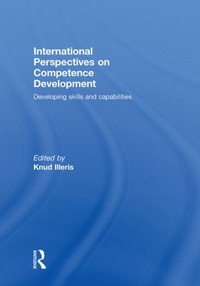
International Perspectives on Competence Development
Developing Skills and Capabilities
1st Edition
Published on 18. May 2009
Book
Hardback
240 pages
978-0-415-49210-2 (ISBN)
Description
In today's complex and ever-changing world it has become obvious that even highly developed knowledge and skills are no longer sufficient to meet new challenges, situations and problems facing individuals, organisations and nations. This raises an enormous and potentially confusing issue for educators and trainers: how is it possible to generate and assess abilities to deal with challenges and problems unknown - or not even in existence - at the time when the learning takes place?
The book builds on the experiences and insights of its expert contributors, all of whom have worked with, studied and analysed competences and how they are developed. Their collected work presents
Comprehensive explanation and analysis of the concept and nature of competence.
Specific contexts of competence development, e.g. in the public sector or small business.
Competence development as a national strategy for building an up-to-date education and training system.
With chapters from around the world, including the UK, USA, Canada, Australia, Scandinavia, this book illustrates in an engaging and convincing manner the importance and innovative nature of the concept of competences, resulting in a varied, differentiated and empathetic guide to the topic. It will appeal to educators, both in academic and management circles, as well as students and administrators of education.
The book builds on the experiences and insights of its expert contributors, all of whom have worked with, studied and analysed competences and how they are developed. Their collected work presents
Comprehensive explanation and analysis of the concept and nature of competence.
Specific contexts of competence development, e.g. in the public sector or small business.
Competence development as a national strategy for building an up-to-date education and training system.
With chapters from around the world, including the UK, USA, Canada, Australia, Scandinavia, this book illustrates in an engaging and convincing manner the importance and innovative nature of the concept of competences, resulting in a varied, differentiated and empathetic guide to the topic. It will appeal to educators, both in academic and management circles, as well as students and administrators of education.
More details
Language
English
Place of publication
London
United Kingdom
Publishing group
Taylor & Francis Ltd
Target group
College/higher education
Professional and scholarly
Product notice
Paper over boards
Illustrations
4 s/w Tabellen
4 Tables, black and white
Dimensions
Height: 234 mm
Width: 156 mm
Weight
600 gr
ISBN-13
978-0-415-49210-2 (9780415492102)
Copyright in bibliographic data and cover images is held by Nielsen Book Services Limited or by the publishers or by their respective licensors: all rights reserved.
Schweitzer Classification
Other editions
Additional editions
E-Book
07/2012
1st Edition
Routledge
€76.49
Available for download
E-Book
07/2012
1st Edition
Routledge
€76.49
Available for download
Book
05/2009
1st Edition
Routledge
€82.50
Shipment within 15-20 days
Person
Knud Illeris is Professor of Lifelong Learning at the Danish University of Education. He is internationally acknowledged as an innovative contributor to learning theory and adult education. In 2005 he became Honorary Adjunct Professor of Teachers College, Columbia University, New York, and in 2006 he was inducted to The International Hall of Fame of Adult and Continuing Education. He is the author of numerous books, including How We Learn, which provides a comprehensive understanding of human learning and non-learning, and Contemporary Theories of Learning, which draws together the world's leading theorists of human learning.
Content
In today's complex and ever-changing world it has become obvious that even highly developed knowledge and skills are no longer sufficient to meet new challenges, situations and problems facing individuals, organisations and nations. This raises an enormous and potentially confusing issue for educators and trainers: how is it possible to generate and assess abilities to deal with challenges and problems unknown - or not even in existence - at the time when the learning takes place?