

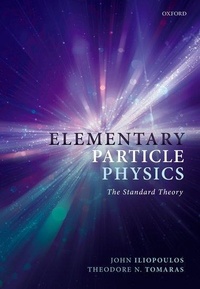
Elementary Particle Physics
The Standard Theory
Published on 25. October 2021
Book
Paperback/Softback
528 pages
978-0-19-284421-7 (ISBN)
Description
Since the development of natural philosophy in Ancient Greece, scientists have been concerned with determining the nature of matter's smallest constituents and the interactions among them. This textbook examines the question of the microscopic composition of matter through an accessible introduction to what is now called 'The Physics of Elementary Particles'.
In the last few decades, elementary particle physics has undergone a period of transition, culminating in the formulation of a new theoretical scheme, known as 'The Standard Model', which has profoundly changed our understanding of nature's fundamental forces. Rooted in the experimental tradition, this new vision is based on geometry and sees the composition of matter in terms of its accordance with certain geometrical principles.
This textbook presents and explains this modern viewpoint to a readership of well-motivated undergraduate students, by guiding the reader from the basics to the more advanced concepts of Gauge Symmetry, Quantum Field Theory and the phenomenon of spontaneous symmetry breaking through concrete physical examples.
This engaging introduction to the theoretical advances and experimental discoveries of the last decades makes this fascinating subject accessible to undergraduate students and aims at motivating them to study it further.
In the last few decades, elementary particle physics has undergone a period of transition, culminating in the formulation of a new theoretical scheme, known as 'The Standard Model', which has profoundly changed our understanding of nature's fundamental forces. Rooted in the experimental tradition, this new vision is based on geometry and sees the composition of matter in terms of its accordance with certain geometrical principles.
This textbook presents and explains this modern viewpoint to a readership of well-motivated undergraduate students, by guiding the reader from the basics to the more advanced concepts of Gauge Symmetry, Quantum Field Theory and the phenomenon of spontaneous symmetry breaking through concrete physical examples.
This engaging introduction to the theoretical advances and experimental discoveries of the last decades makes this fascinating subject accessible to undergraduate students and aims at motivating them to study it further.
Reviews / Votes
This volume offers a comprehensive introduction to the Standard Model of particle physics, which is the best description of strong, weak, and electromagnetic forces available * M. C. Ogilvie, CHOICE * I find this book extremely relevant and interesting. It addresses deep and important issues from a modern perspective * Nathan Seiberg, Institute for Advanced Study, Princeton * The authors have done a fabulous job in orchestrating their discussion of physics: a herculean task, evidently carried out well. Moreover, the way the authors go about this follows the historical development of modern physics, from quantum mechanics, to quantum electrodynamics, to quantum field theory, and of course particle physics and the standard model. Very impressive. * Michael C. Berg, Loyola Marymount University * This is an excellent introduction, at an advanced undergraduate level, to the physics of elementary particles and their mutual interactions. Unlike many books in this subject, it starts from a historical and experimental perspective to illustrate how the present theoretical framework, the Standard Model, came about through a long and fascinating bottom-up process. The book will play an important role in inspiring undergraduate students to undertake graduate studies, or perhaps a career, in theoretical (or experimental) high energy physics. * Gabriele Veneziano, Department of Theoretical Physics, CERN, Professor Emeritus, College de France *More details
Edition
1
Language
English
Place of publication
Oxford
United Kingdom
Target group
College/higher education
Product notice
Paperback (trade)
Unsewn / adhesive bound
Illustrations
112 line drawing and colour halftones
Dimensions
Height: 247 mm
Width: 174 mm
Thickness: 30 mm
Weight
1014 gr
ISBN-13
978-0-19-284421-7 (9780192844217)
Copyright in bibliographic data and cover images is held by Nielsen Book Services Limited or by the publishers or by their respective licensors: all rights reserved.
Schweitzer Classification
Other editions
Additional editions
E-Book
10/2021
1st Edition
OUP eBook
€40.99
Available for download
Book
10/2021
Oxford University Press
€116.50
Shipment within 15-20 days
Persons
John Iliopoulos is a Director of Research Emeritus at the Ecole Normale Superieure in Paris. He has taught on many introductory courses in Theoretical Physics, including Quantum Field Theory and the Theory of Elementary Particles, at the Ecole Normale Superieure and the Ecole Polytechnique as well as in various Schools and Universities. In 1970, in collaboration with Sheldon Glashow and Luciano Maiani, he predicted the existence of the charm quark and proposed the GIM mechanism, an important step in the construction of the Standard Model. He also contributed to the development of supersymmetry, with Bruno Zumino and Pierre Fayet. He has received many awards, including the Ricard Prize of the French Physical Society, the Sakurai Prize of the American Physical Society, the High Energy Physics Prize of the European Physical Society and the Dirac Medal.
Following his PhD at Harvard University, Theodore Tomaras worked as research associate at CalTech and junior faculty at Rockefeller University, before joining the University of Crete, Greece, where he is now Professor of Physics Emeritus. He has taught many undergraduate and postgraduate courses, on elementary particle physics, quantum field theory, and gravitation and cosmology. He has contributed to the study of magnetic monopoles in GUT models, to the physics beyond the Standard Model, to the study of solitons in High Energy and Condensed Matter Physics, and to astroparticle physics. He has served as Head of the Department of Physics and of the Institute of Theoretical and Computational Physics of the University of Crete for several years, and was recently honoured with the 'S. Pihorides Award for Exceptional University Teaching'.
Following his PhD at Harvard University, Theodore Tomaras worked as research associate at CalTech and junior faculty at Rockefeller University, before joining the University of Crete, Greece, where he is now Professor of Physics Emeritus. He has taught many undergraduate and postgraduate courses, on elementary particle physics, quantum field theory, and gravitation and cosmology. He has contributed to the study of magnetic monopoles in GUT models, to the physics beyond the Standard Model, to the study of solitons in High Energy and Condensed Matter Physics, and to astroparticle physics. He has served as Head of the Department of Physics and of the Institute of Theoretical and Computational Physics of the University of Crete for several years, and was recently honoured with the 'S. Pihorides Award for Exceptional University Teaching'.
Content
1: Introduction
2: Quantisation of the Electromagnetic Field and Spontaneous Photon Emission
3: Elements of Classical Field Theory
4: Scattering in Classical and Quantum Physics
5: Elements of Group Theory
6: Particle Physics Phenomenology
7: Relativistic Wave Equations
8: Towards a Relativistic Quantum Mechanics
9: From Classical to Quantum Mechanics
10: From Classical to Quantum Fields: Free Fields
11: Interacting Fields
12: Scattering in Quantum Field Theory
13: Gauge Interactions
14: Spontaneously Broken Symmetries
15: The Principles of Renormalisation
16: The Electromagnetic Interactions
17: Infrared Effects
18: The Weak Interactions
19: A Gauge Theory for the Weak and Electromagnetic Interactions
20: Neutrino Physics
21: The Strong Interactions
22: The Standard Model and Experiment
23: Beyond the Standard Model
Free
2: Quantisation of the Electromagnetic Field and Spontaneous Photon Emission
3: Elements of Classical Field Theory
4: Scattering in Classical and Quantum Physics
5: Elements of Group Theory
6: Particle Physics Phenomenology
7: Relativistic Wave Equations
8: Towards a Relativistic Quantum Mechanics
9: From Classical to Quantum Mechanics
10: From Classical to Quantum Fields: Free Fields
11: Interacting Fields
12: Scattering in Quantum Field Theory
13: Gauge Interactions
14: Spontaneously Broken Symmetries
15: The Principles of Renormalisation
16: The Electromagnetic Interactions
17: Infrared Effects
18: The Weak Interactions
19: A Gauge Theory for the Weak and Electromagnetic Interactions
20: Neutrino Physics
21: The Strong Interactions
22: The Standard Model and Experiment
23: Beyond the Standard Model
Free