

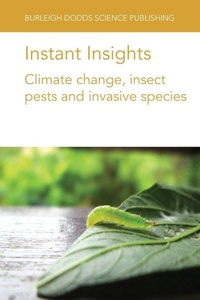
Instant Insights: Climate Change, Insect Pests and Invasive Species
Climate change, insect pests and invasive species
Published on 8. December 2020
Book
Paperback/Softback
90 pages
978-1-78676-927-5 (ISBN)
Description
This specially curated collection features three reviews of current and key research on climate change, insect pests and invasive species.
The first chapter reviews the impact of climate change on insect pests and how it has affected insect pest development and population dynamics, activity and abundance, diversity and geographical distribution. It also assesses insect-host plant interactions and the effectiveness of crop pest management techniques.
The second chapter discusses the literature on the potential impact of climate change on the principal insect pests of wheat, including cereal aphids, Hessian fly, orange wheat blossom midge, cereal leaf beetle and cotton bollworm. It assesses the different methods used to assess likely impacts as well climate change effects on biological control in wheat systems.
The final chapter surveys what we know about the ecology of invasive species and potential management strategies. In particular, it assesses how integrated pest management (IPM) needs to evolve to deal with invasive species, particularly in focussing more on monitoring, prevention and rapid response.
The first chapter reviews the impact of climate change on insect pests and how it has affected insect pest development and population dynamics, activity and abundance, diversity and geographical distribution. It also assesses insect-host plant interactions and the effectiveness of crop pest management techniques.
The second chapter discusses the literature on the potential impact of climate change on the principal insect pests of wheat, including cereal aphids, Hessian fly, orange wheat blossom midge, cereal leaf beetle and cotton bollworm. It assesses the different methods used to assess likely impacts as well climate change effects on biological control in wheat systems.
The final chapter surveys what we know about the ecology of invasive species and potential management strategies. In particular, it assesses how integrated pest management (IPM) needs to evolve to deal with invasive species, particularly in focussing more on monitoring, prevention and rapid response.
More details
Series
Language
English
Place of publication
Cambridge
United Kingdom
Target group
College/higher education
Professional and scholarly
Researchers, students and industry professionals wanting immediate access to the latest research that empowers them to contribute to achieving more sustainable agricultural production.
Product notice
Paperback (trade)
Illustrations
Color tables, photos and figures
Dimensions
Height: 229 mm
Width: 152 mm
Thickness: 5 mm
Weight
148 gr
ISBN-13
978-1-78676-927-5 (9781786769275)
DOI
10.19103.9781786769282
Copyright in bibliographic data and cover images is held by Nielsen Book Services Limited or by the publishers or by their respective licensors: all rights reserved.
Schweitzer Classification
Other editions
Additional editions
Kayode David Ileke | Luke Chinaru Nwosu | Maduamaka Cyriacus Abajue
Instant Insights: Climate Change, Insect Pests and Invasive Species
E-Book
12/2020
Burleigh Dodds Science Publishing Limited
€49.49
Available for download
Persons
Dr Sanford D. Eigenbrode is University Distinguished Professor in the College of Agricultural and Life Sciences at the University of Idaho, USA. A Fellow of the Entomological Society of America, Professor Eigenbrode is internationally known for his research on the chemical ecology of insect-plant interactions, particularly in the context of vector-borne plant pathogens and cropping systems under climate change.
Content
Chapter 1 - Understanding and mitigating the impact of climate change on insect pests and food security: Kayode David Ileke, Federal University of Technology - Akure, Nigeria; Luke Chinaru Nwosu and Maduamaka Cyriacus Abajue, University of Port Harcourt, Nigeria; 1 Introduction 2 Climate change effects on insect pests 3 Climate change impacts on insect pest population dynamics 4 Climate change impacts on insect pest behaviour and activity 5 Climate change impacts on the geographical distribution of insect pests 6 Climate change impacts on host plant resistance to insects 7 Climate change impacts on insect pollinators 8 Climate change impacts on the effectiveness of pest management techniques 9 Conclusions 10 Where to look for further information 11 References
Chapter 2 - The impact of climate change on wheat insect pests: current knowledge and future trends: Sanford D. Eigenbrode, University of Idaho, USA; and Sarina Macfadyen, CSIRO, Australia; 1 Climate change and insect pests: the global perspective 2 Cereal aphids 3 Vector-borne plant viruses 4 Hessian fly and orange wheat blossom midge 5 Cereal leaf beetle, cotton bollworm and other pest species affecting wheat 6 Climate change effects on biological pest control in wheat systems 7 Other considerations: interaction of stress factors, extreme events and pest behaviour 8 Conclusions 9 Where to look for further information 10 Acknowledgements 11 References
Chapter taken from: Langridge, P. (ed.), Achieving sustainable cultivation of wheat - Volume 1: Breeding, quality traits, pests and diseases, Burleigh Dodds Science Publishing, Cambridge, UK, 2017, (ISBN 978 1 78676 016 6)
Chapter 3 - Advances in understanding the ecology of invasive crop insect pests and their impact on IPM: Robert Venette, USDA Forest Service, USA; and Amy Morey, University of Minnesota, USA; 1 Introduction 2 Ecology of invasive species 3 Invasive species management strategies 4 Relationship of invasive species management to IPM 5 Future trends 6 Acknowledgements 7 Where to look for further information 8 References
Chapter taken from: Kogan, M. and Heinrichs, E. A. (eds.), Integrated management of insect pests: Current and future developments, Burleigh Dodds Science Publishing, Cambridge, UK, 2019, (ISBN 978 1 78676 220 3)
Chapter 2 - The impact of climate change on wheat insect pests: current knowledge and future trends: Sanford D. Eigenbrode, University of Idaho, USA; and Sarina Macfadyen, CSIRO, Australia; 1 Climate change and insect pests: the global perspective 2 Cereal aphids 3 Vector-borne plant viruses 4 Hessian fly and orange wheat blossom midge 5 Cereal leaf beetle, cotton bollworm and other pest species affecting wheat 6 Climate change effects on biological pest control in wheat systems 7 Other considerations: interaction of stress factors, extreme events and pest behaviour 8 Conclusions 9 Where to look for further information 10 Acknowledgements 11 References
Chapter taken from: Langridge, P. (ed.), Achieving sustainable cultivation of wheat - Volume 1: Breeding, quality traits, pests and diseases, Burleigh Dodds Science Publishing, Cambridge, UK, 2017, (ISBN 978 1 78676 016 6)
Chapter 3 - Advances in understanding the ecology of invasive crop insect pests and their impact on IPM: Robert Venette, USDA Forest Service, USA; and Amy Morey, University of Minnesota, USA; 1 Introduction 2 Ecology of invasive species 3 Invasive species management strategies 4 Relationship of invasive species management to IPM 5 Future trends 6 Acknowledgements 7 Where to look for further information 8 References
Chapter taken from: Kogan, M. and Heinrichs, E. A. (eds.), Integrated management of insect pests: Current and future developments, Burleigh Dodds Science Publishing, Cambridge, UK, 2019, (ISBN 978 1 78676 220 3)