

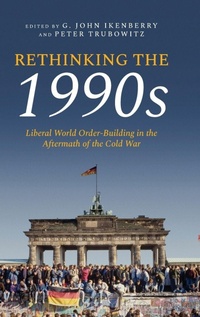
Rethinking the 1990s
Liberal World Order-Building in the Aftermath of the Cold War
Published on 12. November 2025
Book
Hardback
376 pages
978-0-19-781309-6 (ISBN)
Description
In the decade following the end of the Cold War, Western democracies stood victorious, brimming with optimism and grand designs. Today, the 1990s look less like a great triumph for liberal democracy and Western modernity than a decade in which post-Cold War excitement and anticipation obscured a slowly gathering global storm. At a time of intensifying geopolitical rivalry, economic nationalism, and ideological extremism, Rethinking the 1990s brings together a group of leading political scientists and historians who look back on that era of world-historical change to identify choices and pathways that have brought the world to this unsettled moment. Authors explore whether the United States and other countries could have made different choices in the 1990s to place the world order then envisioned by Western policymakers on a firmer foundation.
Written in a highly engaging style, these wide-ranging essays offer new insight into the strategic choices, political trade-offs, and missed opportunities of that historic decade as well as much-needed perspective on the international pressures and domestic cross-pressures fracturing the liberal order today.
Written in a highly engaging style, these wide-ranging essays offer new insight into the strategic choices, political trade-offs, and missed opportunities of that historic decade as well as much-needed perspective on the international pressures and domestic cross-pressures fracturing the liberal order today.
Reviews / Votes
As we strive to understand the profound upheaval in the international order, it makes sense to go back to the 1990s, a time when liberalism seemed triumphant and ask if its decline was inevitable. To tackle this question, Ikenberry and Trubowitz have assembled a dream team of political scientists and historians, who walk us through topics ranging from economic and financial hegemony to NATO's march eastward, to the emergence of a global human rights regime. In the end, the rich scholarship in this book provides us with no easy answer and instead urges us to unpack our long-standing assumptions about the source of the order's expansion and the origins of its current challenges. It is a critical read at this uncertain moment. * Stacie E. Goddard, Wellesley College, Betty Freyhof Johnson '44 Professor of Political Science, Associate Provost, Wellesley in the World * Coming off the success of the Cold War, the 1990s were a breakthrough moment for the American international liberal project. Yet, in retrospect, the seeds of backlash and opposition both inside the West and beyond were being sown. This masterful collaborative volume brings leading IR thinkers together to assess the legacies, positive and negative alike, of this fateful decade. * Daniel Deudney, Johns Hopkins University * Rethinking the 1990s is the best book available on how the world tried to get to grips with the sudden end of the Cold War. If the 1990s is the crucial decade for understanding our times, this book provides an excellent way of grasping what its key issues actually were. * O. A. Westad, Yale University, author of The Coming Storm: Power, Conflict, and Lessons from History * The past endlessly changes as it is rethought in the present and its relevance in the creation of the latter is rethought. And so, as this excellent volume shows, very much with the 1990s. ..a very valuable collection that deserves attention. * Jeremy Black, The Critic * ...the book is highly recommended to anyone engaged in the study of international relations or tracing the path from the fall of the Soviet Union to the present. * D. W. Bath, CHOICE *More details
Language
English
Place of publication
New York
United States
Target group
College/higher education
Dimensions
Height: 240 mm
Width: 161 mm
Thickness: 27 mm
Weight
797 gr
ISBN-13
978-0-19-781309-6 (9780197813096)
Copyright in bibliographic data and cover images is held by Nielsen Book Services Limited or by the publishers or by their respective licensors: all rights reserved.
Schweitzer Classification
Other editions
Additional editions
G. John Ikenberry | Peter Trubowitz
Rethinking the 1990s
Liberal World Order-Building in the Aftermath of the Cold War
Book
11/2025
Oxford University Press Inc
€35.00
Shipment within 15-20 days
Persons
G. John Ikenberry is the Albert G. Milbank Professor of Politics and International Affairs at Princeton University in the Department of Politics and the School of Public and International Affairs. He is also a Global Eminence Scholar at Kyung Hee University in Seoul, Korea. In 2018-2019, Ikenberry was a Visiting Fellow at All Souls College, Oxford University. In 2013-2014, he was the 72nd Eastman Visiting Professor at Balliol College, Oxford. Ikenberry is a Fellow of the American Academy of Arts and Sciences. Ikenberry is the author of eight books, most recently, A World Safe for Democracy: Liberal Internationalism in the Making of Modern World Order, and Debating Worlds: Contested Narratives of Global Modernity and World Order.
Peter Trubowitz is Professor of International Relations and Director of the Phelan United States Center at the London School of Economics and Political Science, and Associate Fellow at Chatham House, the Royal Institute of International Affairs. His research focuses on international security, domestic politics and foreign policy, and party politics. His published work includes Geopolitics and Democracy: The Western Liberal Order from Foundation to Fracture, with Brian Burgoon, Politics and Strategy: Partisan Ambition and American Statecraft, and Defining the National Interest: Conflict and Change in American Foreign Policy, which won the annual J. David Greenstone Prize for best book on politics and history.
Peter Trubowitz is Professor of International Relations and Director of the Phelan United States Center at the London School of Economics and Political Science, and Associate Fellow at Chatham House, the Royal Institute of International Affairs. His research focuses on international security, domestic politics and foreign policy, and party politics. His published work includes Geopolitics and Democracy: The Western Liberal Order from Foundation to Fracture, with Brian Burgoon, Politics and Strategy: Partisan Ambition and American Statecraft, and Defining the National Interest: Conflict and Change in American Foreign Policy, which won the annual J. David Greenstone Prize for best book on politics and history.
Content
List of Contributors Preface and Acknowledgments 1: G. John Ikenberry;Peter Trubowitz: Making Sense of the 1990s: Choices, Pathways, and Missed Opportunities Part I: BRAVE NEW WORLD: LIBERAL CONSOLIDATION OR TRANSFORMATION? 2: How Recursive Is Global Governance? Revisiting the Ordering Choices of the Nineties 3: Jonathan Kirshner: That Faustian Decade: The Financialization of the American Economy 4: Michael Mastanduno: When Hegemony Mostly Worked: U.S. Relations with Europe and Japan during the 1990s 5: Jennifer M. Welsh: Responsible Sovereignty and Individual Accountability: Liberal Internationalist Aspirations from the 1990s Part II: Taking Stock: Western Successes and Failures 6: Populism and the Durability of the Liberal Order in Eastern Europe: EU and NATO Enlargement Reconsidered 7: Michael Cox: Who Lost Russia? The 1990s Revisited 8: Miles Kahler: Reconsidering Engagement with China: Authoritarian Power and International Order 9: Harold James: The Return of/to Europe and the New Politics of Globalism Part III: False Dawn: Western Overreach or Underreach? 10: Ever Deeper and Wider? The Globalization of the Liberal International Order and the End of the Cold War 11: Charles A. Kupchan: The Liberal Order Reconsidered: Europe, the United States, and the Missteps of the 1990s 12: Ayse Zarakol: Mistakes Were Made: Revisiting the 1990s from the EU's Immediate Neighborhood 13: Amrita Narlikar: On Breakthroughs, Deadlocks, and Rose-Gardens Lost in Between: The Failed Promise of North-South Cooperation Index