

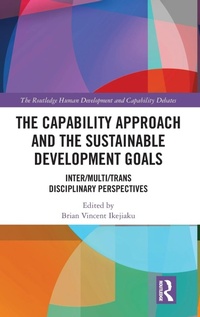
The Capability Approach and the Sustainable Development Goals
Inter/Multi/Trans Disciplinary Perspectives
1st Edition
Published on 26. July 2024
Book
Hardback
322 pages
978-1-032-59857-4 (ISBN)
Description
This book demonstrates how the capability approach to human development can contribute to the realisation of the 2015 United Nations Sustainable Development Goals (SDGs).
The capability approach dictates that success should not be measured by economic indicators but by people leading meaningful, free, fulfilled, happy, or satisfied lives. Drawing from a range of disciplinary perspectives, this book argues that it is vital that the focus for the SDGs should shift to benefiting the most vulnerable. Case studies from across Asia, Africa, Latin America (Global South), and the United States, the United Kingdom, and Australia (Global North) consider how the capability approach can contribute as a practical framework to achieving the SDGs' ambitions for social, economic, political, and legal progress.
Drawing on insights from a range of disciplines, this book will be of interest to researchers and practitioners from the fields of law, politics, international relations, criminology, international development, sociology, public policy, area studies, and others.
The capability approach dictates that success should not be measured by economic indicators but by people leading meaningful, free, fulfilled, happy, or satisfied lives. Drawing from a range of disciplinary perspectives, this book argues that it is vital that the focus for the SDGs should shift to benefiting the most vulnerable. Case studies from across Asia, Africa, Latin America (Global South), and the United States, the United Kingdom, and Australia (Global North) consider how the capability approach can contribute as a practical framework to achieving the SDGs' ambitions for social, economic, political, and legal progress.
Drawing on insights from a range of disciplines, this book will be of interest to researchers and practitioners from the fields of law, politics, international relations, criminology, international development, sociology, public policy, area studies, and others.
More details
Series
Language
English
Place of publication
London
United Kingdom
Publishing group
Taylor & Francis Ltd
Target group
College/higher education
Professional and scholarly
Academic and Postgraduate
Illustrations
23 s/w Abbildungen, 55 s/w Tabellen, 6 s/w Photographien bzw. Rasterbilder, 17 s/w Zeichnungen
55 Tables, black and white; 17 Line drawings, black and white; 6 Halftones, black and white; 23 Illustrations, black and white
Dimensions
Height: 240 mm
Width: 161 mm
Thickness: 23 mm
Weight
681 gr
ISBN-13
978-1-032-59857-4 (9781032598574)
Copyright in bibliographic data and cover images is held by Nielsen Book Services Limited or by the publishers or by their respective licensors: all rights reserved.
Schweitzer Classification
Other editions
Additional editions
Brian Vincent Ikejiaku
The Capability Approach and the Sustainable Development Goals
Inter/Multi/Trans Disciplinary Perspectives
Book
11/2025
1st Edition
Routledge
€64.50
Shipment within 10-20 days
Brian Vincent Ikejiaku
The Capability Approach and the Sustainable Development Goals
Inter/Multi/Trans Disciplinary Perspectives
E-Book
07/2024
1st Edition
Routledge
€60.49
Available for download
Brian Vincent Ikejiaku
The Capability Approach and the Sustainable Development Goals
Inter/Multi/Trans Disciplinary Perspectives
E-Book
07/2024
1st Edition
Routledge
€60.49
Available for download
Person
Brian Vincent Ikejiaku gained his PhD from Keele University, UK, where he was a Dandelion Scholar. He is Senior Fellow of the Higher Education Academy, UK; he has taught in different UK Universities including Coventry University where he was Director of PG Law programme, and University of Bradford, where he was Director of Research and PGR Coordinator. He is an interdisciplinary scholar and one of the global leading scholars/experts in the field of International and Global Law (particularly international development law, and international law, international human rights, sustainable development law, and social justice). He is Editorial Member of the International Journal of Law and Society. His research cuts across law, politics/international relations, international development, and business. His work has gained impact with the UNESCO, ADB, LDi, and others. He is a Lifetime Fellow Member of International Society for Development and Sustainability (ISDS).
Content
Introduction Section One: General Conceptual and Theoretical 1. Sustainable Development, Capabilities, Hegemonic Forces and Social Risks: Extending the Capability Approach to Promote Resilience against Social Inequalities Section Two: Asia 2. Child Malnutrition and Energy Service Access in India 3. A Capability Approach Towards Achieving the Sustainable Development Goals 16.a: Prevent Violence and Combat Terrorism: Bangladesh as a Case Study 4. Nepalese Agriculture in Transition? High Value Agriculture and Changing Gender Roles in Eastern Nepal 5. Women's (Micro)enterprise and the SDGs: Reframing Women's Economic Development in Sri Lanka 6. Inclusive Conservation in Forests and Agriculture Landscape: A Capabilities-Oriented Approach for Sustainable Development Goals Section Three: Africa 7. Application of Capability Approach to Achieving Sustainable Development Goals in Nigeria: A Gendered Perspective 8. The Rule of Law, Good Governance, Mob Justice, and Sustainable Development in Africa: A Capability Approach with Case of Ghana 9. Refugee Youth and the Provision of Educational Capabilities Section Four: Latin America 10. The Relevance of Strong Institutions: an Insight into Child Justice System Protection in Argentina Based on the Capability and Socio-Legal Approaches 11. Access To Water And Sanitation At the Municipal Level in Brazil: A Challenging Path Towards Sustainable Development Goals 12. Social Policies in Response to Child Poverty (SDG1): the Case of Argentina 13. Evaluating the Progression and the Sustainability of SDGs in Brazil Using the Capability Approach Section Five: Cross-Country / Regional / Cross-Regional (with more than one country study) 14. Education and Sustained Poverty Escapes in Sub-Saharan Africa 15. The SDGs and the 'Leave No One Behind' Agenda in Middle Income Countries Section Six: Developed Countries (USA, UK, and Australia) 16. Livable Cities: Wealth for Human Flourishing 17. Capability Approach as a Tool for Achieving Sustainable Development Goal 3- Good Health and Wellbeing: A Case of the United Kingdom and Australia Conclusion