

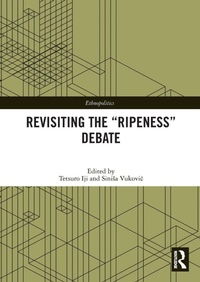
Revisiting the "Ripeness" Debate
1st Edition
Published on 27. May 2024
Book
Paperback/Softback
166 pages
978-1-032-32497-5 (ISBN)
Description
This book takes stock of the accumulated body of literature on ripeness theory, inspired by the seminal work of I. William Zartman. The book posits the continued relevance of the ripeness theory, well into the 21st century, and sheds new light on the potential for further development.
The timing of efforts for resolution, either negotiation or mediation, is always a central concern for policy makers and scholars alike in the field of international conflict resolution. The work of I. William Zartman on ripeness was a groundbreaker in the long-standing inquiry into this key question, and over more than three decades, the notion of a ripe moment and its adjuncts, such as a mutually hurting stalemate and a mutually enticing opportunity, has not only served as an essential policy guidance but also inspired wide-ranging research programs. The chapters in this edited volume feature studies intended to advance ripeness theory conceptually, test it empirically through case studies for possible implications to the theory itself, or examine relations with related concepts and theories.
This volume is divided into two parts. The Foreword and the chapters included in Part I were originally published as a special issue of the journal Ethnopolitics. Part II features, first and foremost, Zartman's own seminal article published in the inaugural issue of the same journal. It also includes other recently published articles in journals such as Security Studies, Civil Wars, and Studies in Conflict & Terrorism that are considered to have made important contributions to the debate on the subject.
The timing of efforts for resolution, either negotiation or mediation, is always a central concern for policy makers and scholars alike in the field of international conflict resolution. The work of I. William Zartman on ripeness was a groundbreaker in the long-standing inquiry into this key question, and over more than three decades, the notion of a ripe moment and its adjuncts, such as a mutually hurting stalemate and a mutually enticing opportunity, has not only served as an essential policy guidance but also inspired wide-ranging research programs. The chapters in this edited volume feature studies intended to advance ripeness theory conceptually, test it empirically through case studies for possible implications to the theory itself, or examine relations with related concepts and theories.
This volume is divided into two parts. The Foreword and the chapters included in Part I were originally published as a special issue of the journal Ethnopolitics. Part II features, first and foremost, Zartman's own seminal article published in the inaugural issue of the same journal. It also includes other recently published articles in journals such as Security Studies, Civil Wars, and Studies in Conflict & Terrorism that are considered to have made important contributions to the debate on the subject.
More details
Series
Language
English
Place of publication
London
United Kingdom
Publishing group
Taylor & Francis Ltd
Target group
College/higher education
Postgraduate and Undergraduate
Dimensions
Height: 246 mm
Width: 174 mm
Thickness: 10 mm
Weight
332 gr
ISBN-13
978-1-032-32497-5 (9781032324975)
Copyright in bibliographic data and cover images is held by Nielsen Book Services Limited or by the publishers or by their respective licensors: all rights reserved.
Schweitzer Classification
Other editions
Additional editions
Tetsuro Iji | Sinisa Vukovic
Revisiting the "Ripeness" Debate
E-Book
08/2022
1st Edition
Routledge
€55.49
Available for download
Tetsuro Iji | Sinisa Vukovic
Revisiting the "Ripeness" Debate
E-Book
08/2022
1st Edition
Routledge
€55.49
Available for download
Tetsuro Iji | Sinisa Vukovic
Revisiting the "Ripeness" Debate
Book
08/2022
1st Edition
Routledge
€205.90
Shipment within 10-20 days
Persons
Tetsuro Iji is Associate Professor at the Faculty of Global and Regional Studies at Toyo University, Japan. His research interest has focused on international conflict resolution, negotiation, and mediation. He has published in the journals International Negotiation, International Peacekeeping, and Global Governance, among others. He is the author of Multiparty Mediation in Violent Conflict: Peacemaking Diplomacy in the Tajikistan Civil War (Routledge, 2019). After completing a B.A. at Sophia University in Tokyo, Iji received an M.A. in International Relations from the Paul H. Nitze School of Advanced International Studies (SAIS), Johns Hopkins University, Baltimore, USA, and a Ph.D. in the same field from the London School of Economics and Political Science (LSE).
Sinisa Vukovic is Senior Lecturer of Conflict Management and Global Policy, and Director of the Master of Arts in Global Policy Program (MAGP) at Johns Hopkins University, School of Advanced International Studies (SAIS), Baltimore, USA. He is also Visiting Professor at Leiden University and Amsterdam University College, Netherlands. His research and teaching focuses on various forms of international conflict resolution, negotiation, and mediation. He has published in various academic journals and contributed to several edited volumes with book chapters. His book International Multiparty Mediation and Conflict Management (2017) was published by Routledge.
Sinisa Vukovic is Senior Lecturer of Conflict Management and Global Policy, and Director of the Master of Arts in Global Policy Program (MAGP) at Johns Hopkins University, School of Advanced International Studies (SAIS), Baltimore, USA. He is also Visiting Professor at Leiden University and Amsterdam University College, Netherlands. His research and teaching focuses on various forms of international conflict resolution, negotiation, and mediation. He has published in various academic journals and contributed to several edited volumes with book chapters. His book International Multiparty Mediation and Conflict Management (2017) was published by Routledge.
Content
Foreword PART 1 - Revisiting the "Ripeness" Debate 1. War-Making and Mediation in Civil Wars: Three Ideal Types of Third Parties and Ripeness Concepts 2. Elusive Settlements in Regional Conflict Complexes: Syria, Zartman, and the Limits of Ripeness Theory 3. Healing Stalemates: The Role of Ceasefires in Ripening Conflict 4. Muscular Mediation and Ripeness Theory 5. Ripeness in Negotiating with Proscribed Terrorist Groups 6. Expanding Ripeness Beyond Push and Pull: The Relevance of Mutually Enticing Opportunities (MEOs) Part 2 - Important Works on Ripeness 7. The Timing of Peace Initiatives: Hurting Stalemates and Ripe Moments 8. Battle Stalemates and Rebel Negotiation Attempts in Civil Wars 9. Sympathy for the Devil: When and How to Negotiate with Criminal Gangs-Case of El Salvador 10. When to Get Out of the Trench? Using Smart Pressure to Resolve Civil Wars