

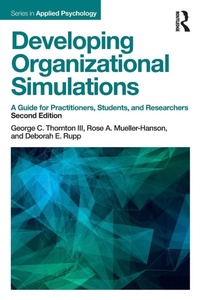
Developing Organizational Simulations
A Guide for Practitioners, Students, and Researchers
2nd Edition
Published on 6. April 2017
Book
Paperback/Softback
238 pages
978-1-138-11929-1 (ISBN)
Description
This second edition of Developing Organizational Simulations provides a concise source of information on effective and practical methods for constructing simulation exercises for the assessment of psychological characteristics relevant to effectiveness in work organizations. Incorporating new additions such as the multiple ways technology can be used in the design, delivery, scoring, and evaluating of simulation exercises, as well as the delivery of feedback based on the results, this book is user-friendly with practical how-to guidance, including many graphics, boxes, and examples. This book is ideal for practitioners, consultants, HR specialists, students, and researchers in need of guidance developing organizational simulations for personnel selection, promotion, diagnosis, training, or research. It is also suited for courses, workshops, and training programs in testing and measurement, personnel selection, training and development, and research methodology.
Reviews / Votes
"In the second edition of this book, Thornton, Mueller-Hanson, and Rupp present a perfect mix of best practices, recent theories, empirical evidence, and examples for designing high-fidelity and low-fidelity simulations. Therefore, this book represents an excellent updated 'do-it-yourself' guide for all HR professionals, consultants, and students interested in developing such simulations."-Filip Lievens, Ghent University, Belgium
"Thornton, Mueller-Hanson, and Rupp have produced an indispensable resource for HR and assessment professionals. This comprehensive book provides a practical, empirically-based, and innovative guide for designing simulations that will effectively drive critical talent decisions in the 21st century workplace."
-John C. Scott, Ph.D., Chief Operating Officer, APTMetrics, Inc.
"I find this book to be a great resource for anyone interested in learning about simulations. It is well written, adequately cited, very well organized, and, most importantly, has something for everyone (in varying proportions, of course), so go grab your copy! And, live long and prosper!"
- Bharati B. Belwalkar, Personnel Administrator, Civil Service Department, City of New Orleans, New Orleans, LA
More details
Series
Edition
2nd edition
Language
English
Place of publication
London
United Kingdom
Publishing group
Taylor & Francis Ltd
Target group
College/higher education
Professional and scholarly
Postgraduate and Professional
Illustrations
57 s/w Tabellen
57 Tables, black and white
Dimensions
Height: 229 mm
Width: 152 mm
Thickness: 14 mm
Weight
376 gr
ISBN-13
978-1-138-11929-1 (9781138119291)
Copyright in bibliographic data and cover images is held by Nielsen Book Services Limited or by the publishers or by their respective licensors: all rights reserved.
Schweitzer Classification
Other editions
Additional editions
George C. Thornton Iii | Rose A. Mueller-Hanson | Deborah E. Rupp
Developing Organizational Simulations
A Guide for Practitioners, Students, and Researchers
Book
04/2017
2nd Edition
Routledge
€205.70
Shipment within 10-20 days
George C. Thornton Iii | Rose A. Mueller-Hanson | Deborah E. Rupp
Developing Organizational Simulations
A Guide for Practitioners, Students, and Researchers
E-Book
03/2017
2nd Edition
Routledge
€63.49
Available for download
George C. Thornton Iii | Rose A. Mueller-Hanson | Deborah E. Rupp
Developing Organizational Simulations
A Guide for Practitioners, Students, and Researchers
E-Book
03/2017
2nd Edition
Routledge
€63.49
Available for download
Previous edition
George C. Thornton Iii | Deborah E. Rupp | Rose A. Mueller-Hanson
Developing Organizational Simulations
A Guide for Practitioners and Students
Book
09/2003
1st Edition
Lawrence Erlbaum Associates Inc
€64.56
Article exhausted; check for reprint
Persons
George C. Thornton III is Professor Emeritus of Psychology at Colorado State University, USA. He specializes in assessment centers and implications of employment discrimination law for personnel psychology. He is the lead author of Assessment Center Perspectives for Talent Management Strategies.
Rose A. Mueller-Hanson is Associate Director/CFO at Community Interface Services, USA. She specializes in developing and implementing talent management programs and has published numerous articles and given presentations on a variety of talent management topics.
Deborah E. Rupp is Professor and William C. Byham Chair in Industrial-Organizational Psychology at Purdue University, USA. She specializes in the psychometric, technological, cross-cultural, legal, and ethical issues inherent in workplace behavioral assessment. She also consults and conducts research in the areas of organizational justice/ethics, corporate social responsibility, and humanitarian work psychology.
Rose A. Mueller-Hanson is Associate Director/CFO at Community Interface Services, USA. She specializes in developing and implementing talent management programs and has published numerous articles and given presentations on a variety of talent management topics.
Deborah E. Rupp is Professor and William C. Byham Chair in Industrial-Organizational Psychology at Purdue University, USA. She specializes in the psychometric, technological, cross-cultural, legal, and ethical issues inherent in workplace behavioral assessment. She also consults and conducts research in the areas of organizational justice/ethics, corporate social responsibility, and humanitarian work psychology.
Content
Part I: Concepts and Principles 1. Simulations in Context 2. Developing Simulations Step by Step 3. Theories, Principles, and Conceptual Frameworks Relevant for Constructing Simulations 4. General Issues and Specific Tips for Constructing Simulations 5. Technology and Simulations Part II: Categories and Types of Simulations 6. Individual Interpersonal Simulations 7. Individual Information Simulations 8. Intra-Group Simulations 9. Inter-Group Simulations 10. Simulations Involving Physical Activities 11. Low-Fidelity Simulations 12. Integrated Simulations: A "Day-in-the-Life" Part III: Implementation and Evaluation 13. Choosing and Training Assessors, Role Players, Administrators, Feedback Providers/Coaches, and Technical Support Persons 14. Demonstrating the Value of Simulations 15. Ensuring Simulations are Compliant with Statutes, Regulations, Standards, and Guidelines 16. Summary and Conclusions Regarding Organizational Simulations