

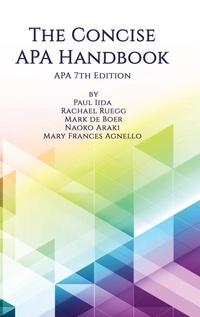
Concise APA Handbook
7th Edition
Published on 21. July 2020
Book
Hardback
76 pages
978-1-64802-184-8 (ISBN)
Description
Most students struggle with learning how to find references, use them effectively, and cite them appropriately in a required format. One of the most common formats is that of APA. The authors all have vast experience teaching writing courses to various levels of students from undergraduates to graduates in other countries. However, there was lacking a book that could explain the basics of APA in simple, easy-to-understand language for non-native speakers of English, who are often unfamiliar with using references and formatting an essay in a particular method. In order to offer English Learner student writers a source of information that is appropriate for their level, and is cost-effective, this updated APA 7th edition guidebook provides students with important information in clear, concise, user-friendly language, as well as to offer practical examples that will help them grasp the concept of secondary research writing.
Much of the published materials on the market targets native speakers of English. The problem with this is that they present the nitpicky details of APA in ways that do not make sense to native speakers of English, let alone to those for whom English is not their first language, because the information is presented in very technical terms that are not easy to understand. This handbook presents the same information in simplified terms with images and step-by-step instructions in ways that make sense to both native and non-native English speaking student writers. Additionally, student writers often struggle with understanding the concept of plagiarism, as well as how to find sources, evaluate the appropriateness of sources, and use sources in effective ways (e.g., how to integrate quotes, when to paraphrase, among others). This book provides this important information that is concise and easy to understand.
NOTE: This is a REVISED edition of our original The Concise APA Handbook, which has been updated for APA 7th edition, which was issued in the fall, 2019.
Much of the published materials on the market targets native speakers of English. The problem with this is that they present the nitpicky details of APA in ways that do not make sense to native speakers of English, let alone to those for whom English is not their first language, because the information is presented in very technical terms that are not easy to understand. This handbook presents the same information in simplified terms with images and step-by-step instructions in ways that make sense to both native and non-native English speaking student writers. Additionally, student writers often struggle with understanding the concept of plagiarism, as well as how to find sources, evaluate the appropriateness of sources, and use sources in effective ways (e.g., how to integrate quotes, when to paraphrase, among others). This book provides this important information that is concise and easy to understand.
NOTE: This is a REVISED edition of our original The Concise APA Handbook, which has been updated for APA 7th edition, which was issued in the fall, 2019.
More details
Edition
7th Revised edition
Language
English
Place of publication
United States
Publishing group
Emerald Publishing Inc
Target group
Professional and scholarly
Edition type
Revised edition
Dimensions
Height: 240 mm
Width: 161 mm
Thickness: 9 mm
Weight
288 gr
ISBN-13
978-1-64802-184-8 (9781648021848)
Copyright in bibliographic data and cover images is held by Nielsen Book Services Limited or by the publishers or by their respective licensors: all rights reserved.
Schweitzer Classification
Other editions
Additional editions
E-Book
01/2020
1st Edition
Information Age Publishing
from
€62.33
Available for download
Persons
Paul Iida, Akita International University
Rachael Ruegg, Victoria University of Wellington
Mark de Boer, Akita International University
Naoko Araki, Akita International University
Mary Frances Agnello, Agnello Enterprises
Rachael Ruegg, Victoria University of Wellington
Mark de Boer, Akita International University
Naoko Araki, Akita International University
Mary Frances Agnello, Agnello Enterprises
Content
Preface.
Chapter 1. What is Referencing and Why Do We Need It?
Chapter 2. Plagiarism.
Chapter 3. Evaluating Sources for Academic Work.
Chapter 4. In-Text Citation.
Chapter 5. Making Your List of References.
Chapter 6. Formatting.
Chapter 1. What is Referencing and Why Do We Need It?
Chapter 2. Plagiarism.
Chapter 3. Evaluating Sources for Academic Work.
Chapter 4. In-Text Citation.
Chapter 5. Making Your List of References.
Chapter 6. Formatting.