

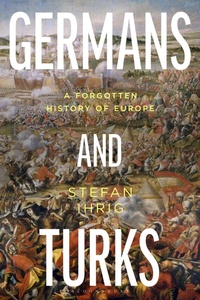
Germans and Turks
A Forgotten History of Europe
Will be published approx. on 25. June 2026
Book
Paperback/Softback
424 pages
978-0-7556-6001-8 (ISBN)
Description
German-Turkish relations form an integral backdrop to many of today's most pressing political concerns, including the absorption of refugees from the Middle East in Europe, debates about coexistence with Muslims in Western societies, and European geopolitics in Western Asia. Yet the story of this relationship, its 800-year history and often fateful consequences, has never been fully told.
In this book, Stefan Ihrig presents the first combined history of the two peoples, from the Middle Ages until today. It is a relationship that has had many twists and turns, from adversaries in the early modern conflict between the Ottoman Empire and Christian Central Europe to allies at the end of the nineteenth century and during WWI. It is also a relationship that has shaped world history, often to disastrous effect: Ihrig shows how the Armenian Genocide of the early twentieth century and Mustafa Kemal's ethno-nationalist 'Turkification' project influenced Nazi Germany's murderous policies. And, as Ihrig shows, it's a relationship that surprises and confounds simplistic narratives. Far from one sided, the encounter between German and Turkish-speaking people over the centuries reveals a mutual fascination that stands in contrast to British, French or American interactions with the Middle East and North Africa.
The coda to this story is the now up to four million people of Turkish descent living in Germany. With modern Turkey taking an increasingly prominent role on the global stage and the German state the most powerful in the European Union, understanding the history of this complicated and dynamic relationship is more important than ever.
In this book, Stefan Ihrig presents the first combined history of the two peoples, from the Middle Ages until today. It is a relationship that has had many twists and turns, from adversaries in the early modern conflict between the Ottoman Empire and Christian Central Europe to allies at the end of the nineteenth century and during WWI. It is also a relationship that has shaped world history, often to disastrous effect: Ihrig shows how the Armenian Genocide of the early twentieth century and Mustafa Kemal's ethno-nationalist 'Turkification' project influenced Nazi Germany's murderous policies. And, as Ihrig shows, it's a relationship that surprises and confounds simplistic narratives. Far from one sided, the encounter between German and Turkish-speaking people over the centuries reveals a mutual fascination that stands in contrast to British, French or American interactions with the Middle East and North Africa.
The coda to this story is the now up to four million people of Turkish descent living in Germany. With modern Turkey taking an increasingly prominent role on the global stage and the German state the most powerful in the European Union, understanding the history of this complicated and dynamic relationship is more important than ever.
Reviews / Votes
Throughout the centuries, Germans and the Turks developed an 'elective affinity,' and Stefan Ihrig does a great job telling this story * Ayhan Aktar, author of Nationalism and Non-Muslim Minorities in Turkey, 1915-1950 *More details
Language
English
Place of publication
London
United Kingdom
Target group
Professional and scholarly
Illustrations
5 bw illus
Dimensions
Height: 234 mm
Width: 156 mm
Thickness: 34 mm
Weight
480 gr
ISBN-13
978-0-7556-6001-8 (9780755660018)
Copyright in bibliographic data and cover images is held by Nielsen Book Services Limited or by the publishers or by their respective licensors: all rights reserved.
Schweitzer Classification
Other editions
Additional editions
E-Book
05/2026
I.B. Tauris & Co. Ltd.
€27.49
Available for download
E-Book
05/2026
I.B. Tauris & Co. Ltd.
€27.49
Available for download
Person
Stefan Ihrig is Professor of History at the University of Haifa, Israel. His previous books include Atatuerk in the Nazi Imagination (2014) and Justifying Genocide: Germany and the Armenians from Bismarck to Hitler (2016), winner of the 2017 Sona Aronian Book Prizes for Excellence in Armenian Studies.
Content
Introduction
Prologue: Of men and monsters
Crusaders, conquerors, and contacts
1. The Turks are Coming
2. Killing in the Name of...
3. Fortifying the East
4. The Mongol Storm
5. The Ottoman Avalanche
6. In Front of Vienna
7. The Grand Stand Off (111-)
8. The Reformation and the Turks
9. Reconquista and Re-Evaluation
10. All things Turkish
11. Captured Turks and Diplomats
Questions of empire and nation
12. Bismarck's Bones
13. Tripping the Life Fantastic I
14. Tripping the Life Fantastic II
15. Wilhelm's Dreams
16. German Ottomans
17. World War I (1): Wishful thinking
18. World War I (2): All the plans
19. World War I (3): Harsh realities
20. The Armenian Genocide debated
21. Hitler's Star in the Darkness
22. The Third Reich and Turkey
23. Colony B
From 'Guestworkers' to Turkish Germans
24. New Beginnings
25. Guests and Workers
26. Immigrants
27. Problems
28. Violence and Citizenship
29. Debates, Debates, and More Debates
Epilogue: Of neighbors and citizens
Prologue: Of men and monsters
Crusaders, conquerors, and contacts
1. The Turks are Coming
2. Killing in the Name of...
3. Fortifying the East
4. The Mongol Storm
5. The Ottoman Avalanche
6. In Front of Vienna
7. The Grand Stand Off (111-)
8. The Reformation and the Turks
9. Reconquista and Re-Evaluation
10. All things Turkish
11. Captured Turks and Diplomats
Questions of empire and nation
12. Bismarck's Bones
13. Tripping the Life Fantastic I
14. Tripping the Life Fantastic II
15. Wilhelm's Dreams
16. German Ottomans
17. World War I (1): Wishful thinking
18. World War I (2): All the plans
19. World War I (3): Harsh realities
20. The Armenian Genocide debated
21. Hitler's Star in the Darkness
22. The Third Reich and Turkey
23. Colony B
From 'Guestworkers' to Turkish Germans
24. New Beginnings
25. Guests and Workers
26. Immigrants
27. Problems
28. Violence and Citizenship
29. Debates, Debates, and More Debates
Epilogue: Of neighbors and citizens