

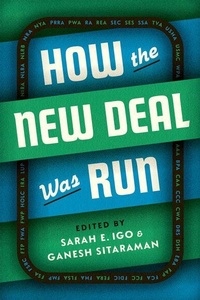
How the New Deal Was Run
Will be published approx. on 22. January 2027
Book
Paperback/Softback
384 pages
978-0-226-85491-5 (ISBN)
Description
Notable historians delve into the brass tacks of launching and sustaining federal agencies.
Critics regularly complain that the United States government can't do big things. While their explanations differ, there is now a growing sense that American institutions are not delivering solutions to the problems of our time. The New Deal offers a striking contrast. During the 1930s, the United States created a wealth of new agencies, departments, offices, and programs-and in very short order.
This illuminating collection brings together leading American historians to offer fifteen detailed accounts of how this remarkable expansion of state capacity actually happened. From the Civilian Conservation Corps to the Rural Electrification Administration to the Securities and Exchange Commission, the authors dig into the nuts and bolts of how exactly the New Dealers did so much all at once. They detail the choices before state builders who, operating under the pressure and immediacy of the era, made decisions that held even greater consequences in the longer term.
In a time when federal agencies are under stress like never before, the contributors offer critical insights about what future administrations can learn from the New Deal's extraordinary achievements and how they can build state capacity and deliver for Americans once again.
Features contributions by W. Tanner Allread, Mary Bridges, Brent Cebul, Sarah E. Igo, Meg Jacobs, Richard R. John, Neil M. Maher, Sharon Ann Musher, Sarah T. Phillips, Kathryn Olmsted and Eric Rauchway, Alex Platt, Jason Scott Smith, Ganesh Sitaraman, Abby Spinak, Chloe Thurston, and Mason B. Williams.
Critics regularly complain that the United States government can't do big things. While their explanations differ, there is now a growing sense that American institutions are not delivering solutions to the problems of our time. The New Deal offers a striking contrast. During the 1930s, the United States created a wealth of new agencies, departments, offices, and programs-and in very short order.
This illuminating collection brings together leading American historians to offer fifteen detailed accounts of how this remarkable expansion of state capacity actually happened. From the Civilian Conservation Corps to the Rural Electrification Administration to the Securities and Exchange Commission, the authors dig into the nuts and bolts of how exactly the New Dealers did so much all at once. They detail the choices before state builders who, operating under the pressure and immediacy of the era, made decisions that held even greater consequences in the longer term.
In a time when federal agencies are under stress like never before, the contributors offer critical insights about what future administrations can learn from the New Deal's extraordinary achievements and how they can build state capacity and deliver for Americans once again.
Features contributions by W. Tanner Allread, Mary Bridges, Brent Cebul, Sarah E. Igo, Meg Jacobs, Richard R. John, Neil M. Maher, Sharon Ann Musher, Sarah T. Phillips, Kathryn Olmsted and Eric Rauchway, Alex Platt, Jason Scott Smith, Ganesh Sitaraman, Abby Spinak, Chloe Thurston, and Mason B. Williams.
More details
Language
English
Place of publication
Chicago
United States
Publishing group
The University of Chicago Press
Target group
Professional and scholarly
Illustrations
21 halftones, 4 tables
Dimensions
Height: 229 mm
Width: 152 mm
Weight
454 gr
ISBN-13
978-0-226-85491-5 (9780226854915)
Copyright in bibliographic data and cover images is held by Nielsen Book Services Limited or by the publishers or by their respective licensors: all rights reserved.
Schweitzer Classification
Persons
Sarah E. Igo holds the Andrew Jackson Chair in American History at Vanderbilt University and is the faculty director of Dialogue Vanderbilt. She is the author of The Known Citizen: A History of Privacy in Modern America and The Averaged American: Surveys, Citizens, and the Making of a Mass Public. Ganesh Sitaraman holds the New York Alumni Chancellor's Chair in Law and is director of the Vanderbilt Policy Accelerator at Vanderbilt University. He is the author or coauthor of six books, including The Great Democracy: How to Fix Our Politics, Unrig the Economy, and Unite America and The Public Option: How to Expand Freedom, Increase Opportunity, and Promote Equality.
Content
Introduction: The Realities of Reform
Sarah E. Igo and Ganesh Sitaraman
Part 1: Mobilizing
1. "Administration in the Field Is Decentralized": How Horizontal Bureaucracy Helped the CCC Work
Neil M. Maher
2. Experimentation, Decentralization, and Collaboration: Strategies for Funding Art in the 1930s and Today
Sharon Ann Musher
3. How the PWA and WPA Were Run: The Politics of Public Works, Policy Implementation, and the Expansion of State Capacity
Jason Scott Smith
4. We Do Our Part: The National Recovery Administration and Enforcement at the Grassroots
Meg Jacobs
Part 2: Borrowing and Collaborating
5. Accounting for Success: How Social Security Got Its Start
Sarah E. Igo
6. Cooperative Ownership in the Rural Electrification Administration
Abby Spinak
7. Going the Next Mile: Building Governing Capacity and Market Making in the Federal Housing Administration
Chloe Thurston
8. Farms and Food: The Agricultural Adjustment Administration and the First Food Stamps
Sarah T. Phillips
Part 3: Standard-Setting
9. Sound Policy: How the Federal Communications Commission Worked in the Age of Radio
Richard R. John
10. How the SEC Was Run
Alexander I. Platt
11. Making Money Boring: How the FDIC Turned Banking from Politics to Paperwork
Mary Bridges
Part 4: Geographies
12. Patronage, Partnerships, and Power: Localism, Public Finance, and the Making of the New Deal
Brent Cebul
13. Organizing Indian Country: Tribal Constitution-Making Under the Indian Reorganization Act
W. Tanner Allread
14. The Progressive Paradox: Envisioning, Implementing, and Receiving New Deal Works Projects in New York City
Mason B. Williams
15. Tropical Laboratory: The Virgin Islands Company
Kathryn S. Olmsted and Eric Rauchway
Conclusion: Implementation and the Lessons of the New Deal
Ganesh Sitaraman
Acknowledgments
List of Contributors
Index
Sarah E. Igo and Ganesh Sitaraman
Part 1: Mobilizing
1. "Administration in the Field Is Decentralized": How Horizontal Bureaucracy Helped the CCC Work
Neil M. Maher
2. Experimentation, Decentralization, and Collaboration: Strategies for Funding Art in the 1930s and Today
Sharon Ann Musher
3. How the PWA and WPA Were Run: The Politics of Public Works, Policy Implementation, and the Expansion of State Capacity
Jason Scott Smith
4. We Do Our Part: The National Recovery Administration and Enforcement at the Grassroots
Meg Jacobs
Part 2: Borrowing and Collaborating
5. Accounting for Success: How Social Security Got Its Start
Sarah E. Igo
6. Cooperative Ownership in the Rural Electrification Administration
Abby Spinak
7. Going the Next Mile: Building Governing Capacity and Market Making in the Federal Housing Administration
Chloe Thurston
8. Farms and Food: The Agricultural Adjustment Administration and the First Food Stamps
Sarah T. Phillips
Part 3: Standard-Setting
9. Sound Policy: How the Federal Communications Commission Worked in the Age of Radio
Richard R. John
10. How the SEC Was Run
Alexander I. Platt
11. Making Money Boring: How the FDIC Turned Banking from Politics to Paperwork
Mary Bridges
Part 4: Geographies
12. Patronage, Partnerships, and Power: Localism, Public Finance, and the Making of the New Deal
Brent Cebul
13. Organizing Indian Country: Tribal Constitution-Making Under the Indian Reorganization Act
W. Tanner Allread
14. The Progressive Paradox: Envisioning, Implementing, and Receiving New Deal Works Projects in New York City
Mason B. Williams
15. Tropical Laboratory: The Virgin Islands Company
Kathryn S. Olmsted and Eric Rauchway
Conclusion: Implementation and the Lessons of the New Deal
Ganesh Sitaraman
Acknowledgments
List of Contributors
Index