

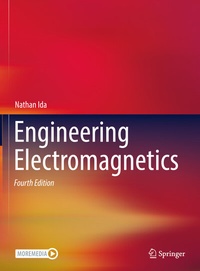
Engineering Electromagnetics
Description
- Features hundreds of examples and exercises, many new or revised for every topic in the book.
- Includes over 650 end-of-chapter problems, many of them new or revised, mostly based on applications or simplified applications.
- Includes a suite of online demonstration software including a computerized Smith Chart.
Reviews / Votes
"During the recent three decades, multiple antenna techniques have become increasingly important to wireless radio engineering, leading to their vast exploitation in 4G and 5G. This makes it a necessity to have a modern textbook which includes basic vector analysis applied to the relevant electrostatic and electrodynamic phenomena in an easy to capture way for electrical engineers. While working on modernized versions of my lectures, I discovered Dr. Ida's textbook, an excellent text!" (Dr. Peter Jung, University of Duisburg-Essen, Chair for Communication Technologies (Kommunikationstechnik))More details
Other editions
Additional editions
Previous edition
Person
Nathan Ida is the Distinguished Professor of Electrical and Computer Engineering at the University of Akron. He is the author of five previous books in the area of electromagnetics and over 250 journal and conference papers. A Fellow of the IEEE and the American Society for non-destructive testing, he is active in numerous conferences and symposia that emphasize interdisciplinary research and practical applications.
Content
Introduction.- Vector Algebra.- Vector Calculus.- Coulomb's Law and the Electric Field.- Gauss's Law and the Electric Potential.- Boundary Value Problems: Analytic Methods of Solution.- Boundary Value Problems.- The Steady Electric Current.- The Static Magnetic Field.- Magnetic Materials and Properties.- Faraday's Law and Induction.- Maxwell's Equations.- Electromagnetic Waves and Propagation.- Re?ection and Transmission of Plane Waves.- Theory of Transmission Lines.- The Smith Chart, Impedance Matching, and Transmission Line Circuits.- Transients on Transmission Lines.- Waveguides and Resonators.- Antennas and Electromagnetic Radiation.- Conclusion.