

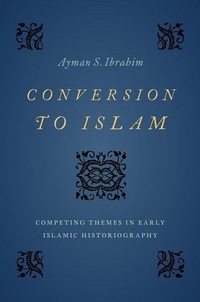
Conversion to Islam
Competing Themes in Early Islamic Historiography
Published on 15. April 2021
Book
Hardback
320 pages
978-0-19-753071-9 (ISBN)
Description
Why did non-Muslims convert to Islam during Muhammad's life and under his immediate successors? How did Muslim historians portray these conversions? Why did their portrayals differ significantly? To what extent were their portrayals influenced by their time of writing, religious inclinations, and political affiliations? These are the fundamental questions that drive this study.
Relying on numerous works, including primary sources from over a hundred classical Muslim historians, Conversion to Islam is the first scholarly study to detect, trace, and analyze conversion themes in early Muslim historiography, emphasizing how classical Muslims remembered conversion, and how they valued and evaluated aspects of it. Ayman S. Ibrahim examines numerous early Muslim sources and wrestles with critical observations regarding the sources' reliability and unearths the hidden link between historical narratives and historians' religious sympathies and political agendas. This study leads readers through a complex body of literature, provides insights regarding historical context, and creates a vivid picture of conversion to Islam as early Muslim historians sought to depict it.
Relying on numerous works, including primary sources from over a hundred classical Muslim historians, Conversion to Islam is the first scholarly study to detect, trace, and analyze conversion themes in early Muslim historiography, emphasizing how classical Muslims remembered conversion, and how they valued and evaluated aspects of it. Ayman S. Ibrahim examines numerous early Muslim sources and wrestles with critical observations regarding the sources' reliability and unearths the hidden link between historical narratives and historians' religious sympathies and political agendas. This study leads readers through a complex body of literature, provides insights regarding historical context, and creates a vivid picture of conversion to Islam as early Muslim historians sought to depict it.
Reviews / Votes
... Ibrahim has written a significant contribution to the study of Arabic historical writing, on one hand, and the phenomenon of conversion to Islam, on the other. The bulk of material that Ibrahim uses as his source is vast, and the analysis of it is of high quality. * Ilkka Lindstedt, University of Helsinki, Journal of Near Eastern Studies * Thought provoking, meticulously researched, and clearly written. * Prof. Mohammad H. Faghfoory, Journal of South Asian and Middle Eastern Studies * This remarkably thorough book overturns the facile notion that the first Muslim historians had little to say about conversion to Islam. Ayman Ibrahim tracks down the myriad stories they told about the all-important conversions of Muhammad's inner circle, showing how the political and religious commitments of each writer guided his narrative. He has given us an authoritative account of conversion themes and topoi in the debates that tore the early Muslim community apart. It is a book that has much to teach us about how conversion was represented and imagined in early Islamic history * Luke B. Yarbrough, University of California, Los Angeles * Reading Conversion to Islam is an education. Ibrahim has used his vast knowledge of early Arabic historical works and encyclopedic grasp of secondary scholarship on them to produce a compelling and important study of how medieval Muslim historians wrote about conversion. This book is a wonderful achievement * Jack B. Tannous, Princeton University * Ayman Ibrahim's newest study is his most comprehensive so far. Until now, Ibrahim has demonstrated a thorough grasp of the Arabic sources, and this volume on conversion, which could almost serve as an introduction to the early Islamic sources in Arabic, does not disappoint. He gives the reader a very thorough discussion of the issue of conversion to Islam as it is portrayed in the earliest sources, not shying away from the many problematic issues such a study entails. This survey is sure to be a fundamental work not merely on conversion but also on Arabic historiography for years to come * David B. Cook, Rice University * How was conversion to Islam remembered by medieval Muslim scholars? Working at the intersection of history and historiography, Ayman Ibrahim illuminates multilayered discourses on conversion and offers a sensible typology of evolving literary themes and narratives in the source material. In so doing, Ibrahim sheds a fresh light on the memory of one of the most significant social and cultural changes of the formative period of Islam * Antoine Borrut, Author of Entre memoire et pouvoir * Ibrahim's detailed analysis undoubtedly fills a surprisingly large research gap and provides an exciting and deep insight into the different contexts, motives and intentions of Muslim historiography regarding the topic of conversion. * Dr. Carsten Polanz, Evangelische Missiologie *More details
Language
English
Place of publication
New York
United States
Target group
Professional and scholarly
Product notice
sewn/stitched
Cloth over boards
Dimensions
Height: 241 mm
Width: 163 mm
Thickness: 32 mm
Weight
614 gr
ISBN-13
978-0-19-753071-9 (9780197530719)
Copyright in bibliographic data and cover images is held by Nielsen Book Services Limited or by the publishers or by their respective licensors: all rights reserved.
Schweitzer Classification
Other editions
Additional editions
E-Book
02/2021
1st Edition
OUP eBook
€62.99
Available for download
E-Book
02/2021
1st Edition
OUP eBook
€62.99
Available for download
Person
Ayman S. Ibrahim is the Bill and Connie Jenkins Professor of Islamic Studies at Southern Seminary and Director of the Jenkins Center for the Christian Understanding of Islam. He is the author of The Stated Motivations for the Early Islamic Expansion.
Content
Acknowledgments
Note on Transliteration
1. Introduction: Conversion Themes in Early Islamic Historiography
2. Precursors of Converstion Themes during the Umayyad Caliphate
3. Establishing Pro-Abbasid Orthodoxy: Conversion Themes in Islamic Historiography under the Early Abbasids
4. Attempts at Compromise: Conversion Themes in Islamic Historiography in the Aftermath of the Mihna
5. Conclusion
Glossary
Primary Source Authors in Chronological Order
Modern and Conemporary Arabic-Speaking Authors that Appear in the Study
Works Cited
Index
Note on Transliteration
1. Introduction: Conversion Themes in Early Islamic Historiography
2. Precursors of Converstion Themes during the Umayyad Caliphate
3. Establishing Pro-Abbasid Orthodoxy: Conversion Themes in Islamic Historiography under the Early Abbasids
4. Attempts at Compromise: Conversion Themes in Islamic Historiography in the Aftermath of the Mihna
5. Conclusion
Glossary
Primary Source Authors in Chronological Order
Modern and Conemporary Arabic-Speaking Authors that Appear in the Study
Works Cited
Index