

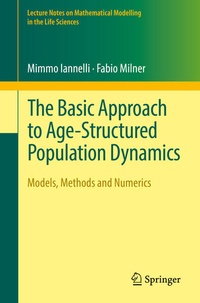
The Basic Approach to Age-Structured Population Dynamics
Models, Methods and Numerics
1st Edition
Published on 6. September 2017
Book
Paperback/Softback
XII, 350 pages
978-94-024-1145-4 (ISBN)
Description
This book provides an introduction to age-structured population modeling which emphasizes the connection between mathematical theory and underlying biological assumptions.
Through the rigorous development of the linear theory and the nonlinear theory alongside numerics, the authors explore classical equations that describe the dynamics of certain ecological systems. Modeling aspects are discussed to show how relevant problems in the fields of demography, ecology and epidemiology can be formulated and treated within the theory. In particular, the book presents extensions of age-structured modeling to the spread of diseases and epidemics while also addressing the issue of regularity of solutions, the asymptotic behavior of solutions, and numerical approximation. With sections on transmission models, non-autonomous models and global dynamics, this book fills a gap in the literature on theoretical population dynamics.
The Basic Approach toAge-Structured Population Dynamics will appeal to graduate students and researchers in mathematical biology, epidemiology and demography who are interested in the systematic presentation of relevant models and mathematical methods.
Through the rigorous development of the linear theory and the nonlinear theory alongside numerics, the authors explore classical equations that describe the dynamics of certain ecological systems. Modeling aspects are discussed to show how relevant problems in the fields of demography, ecology and epidemiology can be formulated and treated within the theory. In particular, the book presents extensions of age-structured modeling to the spread of diseases and epidemics while also addressing the issue of regularity of solutions, the asymptotic behavior of solutions, and numerical approximation. With sections on transmission models, non-autonomous models and global dynamics, this book fills a gap in the literature on theoretical population dynamics.
The Basic Approach toAge-Structured Population Dynamics will appeal to graduate students and researchers in mathematical biology, epidemiology and demography who are interested in the systematic presentation of relevant models and mathematical methods.
More details
Series
Edition
1st ed. 2017
Language
English
Place of publication
Dordrecht
Netherlands
Target group
Professional and scholarly
Illustrations
20 farbige Abbildungen, 57 s/w Abbildungen
XII, 350 p. 77 illus., 20 illus. in color.
Dimensions
Height: 235 mm
Width: 155 mm
Thickness: 20 mm
Weight
552 gr
ISBN-13
978-94-024-1145-4 (9789402411454)
DOI
10.1007/978-94-024-1146-1
Schweitzer Classification
Other editions
Additional editions
Mimmo Iannelli | Fabio Milner
The Basic Approach to Age-Structured Population Dynamics
Models, Methods and Numerics
E-Book
08/2017
Springer
€74.89
Available for download
Persons
Mimmo Iannelli obtained his Laurea degree at the Istituto per le Applicazioni del Calcolo, Italy, in 1968. He was Full Professor at the University of Rome from 1976 to 1978. He then moved to the University of Trento, where he currently holds the title of Senior Professor. His research focuses on evolution equations and the analysis of mathematical methods in population theory. He has authored various publications on evolution equations and mathematical models of ecology and epidemiology, including three books.
Fabio Milner obtained the degree of Licenciado en Ciencias Matemáticas in Argentina in 1976 before moving to the USA in 1978. He obtained his PhD in Numerical Analysis in 1983 from the University of Chicago and joined the faculty of Purdue University immediately thereafter. He left Purdue in 2008 as Full Professor when he joined Arizona State University as Director of Mathematics for STEM Education. He shifted the focus of his research to mathematical biology after meeting Mimmo Iannelli in 1997. Milner is the author of numerous scientific publications, including 14 articles and one book that were co-authored by Mimmo Iannelli.
Fabio Milner obtained the degree of Licenciado en Ciencias Matemáticas in Argentina in 1976 before moving to the USA in 1978. He obtained his PhD in Numerical Analysis in 1983 from the University of Chicago and joined the faculty of Purdue University immediately thereafter. He left Purdue in 2008 as Full Professor when he joined Arizona State University as Director of Mathematics for STEM Education. He shifted the focus of his research to mathematical biology after meeting Mimmo Iannelli in 1997. Milner is the author of numerous scientific publications, including 14 articles and one book that were co-authored by Mimmo Iannelli.
Content
1 Why Age Structure? An Introduction.- 2 The Basic Linear Theory.- 3 Numerical Methods for the Linear Model.- 4 The Time-Dependent Case.- 5 Nonlinear Models.- 6 Stability of Equilibria.- 7 Numerical Methods for the Nonlinear Model.- 8 Global Behavior.- 9 Class-Age Structure for Epidemics.- 10 Epidemics and Demography.- A The Laplace Transform.- B Integral Equations Theory. References.