

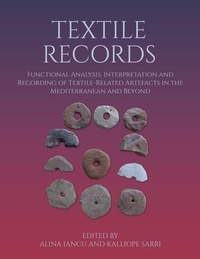
Textile Records
Functional Analysis, Interpretation and Recording of Textile-Related Artefacts in the Mediterranean and Beyond
Published on 15. May 2026
Book
Paperback/Softback
224 pages
979-8-88857-213-9 (ISBN)
Description
Since early prehistoric times, textiles have been essential to human life, providing protection, enabling social display, furnishing homes, supporting transportation and warfare, and fulfilling countless other needs. Although textiles rarely survive except under exceptional environmental conditions, a growing body of archaeological evidence bears witness to their fundamental importance and to the sophisticated crafts that produced them. Fragmentary fabrics, mineralised textiles on metal objects, carbonised fibres and textile imprints offer valuable data on raw materials, techniques and textile quality in the past. Equally important, the rich array of tools recovered from archaeological contexts reveals the techniques used by prehistoric and ancient craftspeople to transform fibres into finished products.
Despite their central role in past societies, textiles and textile-related artefacts remain significantly underrepresented in archaeological literature compared to other categories of finds. Long regarded as a modest domestic craft primarily associated with women, they have suffered from gender bias, general scholarly neglect and limited specialist knowledge. As a result, their publication has often been inconsistent, prone to confusion and subject to misinterpretation.
Recent advances in archaeological textile studies now provide a strong foundation for reassessing earlier research and for developing more rigorous and systematic approaches to the recording, analysis and publication of these artefacts. This volume brings together archaeologists and textile specialists to examine the history of textile recording in archaeology and to propose new methodologies for integrating textile finds into mainstream archaeological publications with the same scholarly rigour and public accessibility granted to other categories of material culture.
Despite their central role in past societies, textiles and textile-related artefacts remain significantly underrepresented in archaeological literature compared to other categories of finds. Long regarded as a modest domestic craft primarily associated with women, they have suffered from gender bias, general scholarly neglect and limited specialist knowledge. As a result, their publication has often been inconsistent, prone to confusion and subject to misinterpretation.
Recent advances in archaeological textile studies now provide a strong foundation for reassessing earlier research and for developing more rigorous and systematic approaches to the recording, analysis and publication of these artefacts. This volume brings together archaeologists and textile specialists to examine the history of textile recording in archaeology and to propose new methodologies for integrating textile finds into mainstream archaeological publications with the same scholarly rigour and public accessibility granted to other categories of material culture.
More details
Language
English
Place of publication
United States
Target group
Professional and scholarly
Product notice
Paperback (trade)
Unsewn / adhesive bound
Illustrations
max 120 b/w
Dimensions
Height: 280 mm
Width: 216 mm
ISBN-13
979-8-88857-213-9 (9798888572139)
Copyright in bibliographic data and cover images is held by Nielsen Book Services Limited or by the publishers or by their respective licensors: all rights reserved.
Schweitzer Classification
Persons
Alina Iancu is a textile archaeologist at the National Institute of Heritage of Romania. Her principal field of study is ancient textile production in the Aegean and Pontic regions, with a focus on weaving and spinning, including the investigation of textile tools and textile fragments as well as written and iconography sources related to this field. Since 2023, she is a co-leader of the EuroWeb Digital Atlas of European Textile Heritage. Kalliope Sarri is an independent researcher specialising in the prehistory of the Aegean. She studied history and archaeology at the Universities of Athens and Heidelberg. Her research interests include landscape archaeology, the development of pottery, burial customs, and textile technology in prehistory, as well as approaches to experimental archaeology.
Content
List of Contributors
Part 1: Textiles in context
1. Unravelling the Record: Towards Standardized Approaches to the Identification, Interpretation and Documentation of Some of the Less Known Prehistoric and Ancient Textile Implements
Alina Iancu and Kalliope Sarri
2. Loom Weights in Context. Examples of Textile Tool Documentation in the History of Aegean Bronze Age Research
Sophia Vakirtzi
3. The Necropolis of the Wielbark Culture in Wilkowo (1st-3rd century AD) as an Example of Successful Collaboration between Field Archaeologists, Conservators, and Textile Archaeologists
Magdalena Przymorska-Sztuczka
Part 2: Spinning and weaving
4. Roman Spinning Tools. A History of Misunderstanding
Ilija Dankovic
5. Anything but a Distaff: The Misidentification of Textile Tools in the North-Eastern Roman Provinces
Anique Hamelink
6. Amber and Jet in the Textile Sphere of Roman Hispania: Import, Circulation, Function, and Identity
Macarena Bustamante-Alvarez and Andrea Menendez Menendez
7. From Text to Loom. Rethinking Complementary Weaving Tools: The Greek kerkis and the Latin radius in Focus
Claudia Vega Medeiros and Leyre Morgado-Roncal
8. Loom Weights through the Ages: An Overview
Elisabeth Trinkl
9. Reassessing Clay Spools. An Overview of Spools in Ancient Greece and Beyond
Alina Iancu
10. Lead Spindle Whorls and Loom Weights in the Aegean and Pontus, 1st Millennium BC: Remarks on Functionality, Production and Use
Liviu Iancu
11. Making textile tools from scratch. A methodological framework for documentation and interpretation of textile tools and weaving structures from recycled materials in archaeology
Alina Iancu and Kalliope Sarri
12. Integrating Tablet-Weaving Evidence into General Archaeology: Tools, Fragments, and Methodologies
Lise Raeder Knudsen
Part 3: Other tools and tool containers
13. Grey Areas in the Identification and Recording of Textile Tools: Some Enigmatic Cases from Aegean Prehistory
Kalliope Sarri
14. Toolbox for Specialized Textile Work. The Enigmatic Chest model from the Tomb of the Rich Athenian Lady (850 BC), Athens
Sanne Houby-Nielsen
Part 4: Interdisciplinary methods of tools research
15. Recording Use-Wear Traces on Textile Tools with Reflectance Transformation Imaging (RTI): A Case Study from Archaic Messapia
Gaia Sabetta
Annex: The Textile Tools Record Sheet: Aiming for a Standardised Documentation of Ancient Textile Tools in General Archaeology
Elisabeth Trinkl; Agata Ulanowska, Alina Iancu and Kalliope Sarri
Part 1: Textiles in context
1. Unravelling the Record: Towards Standardized Approaches to the Identification, Interpretation and Documentation of Some of the Less Known Prehistoric and Ancient Textile Implements
Alina Iancu and Kalliope Sarri
2. Loom Weights in Context. Examples of Textile Tool Documentation in the History of Aegean Bronze Age Research
Sophia Vakirtzi
3. The Necropolis of the Wielbark Culture in Wilkowo (1st-3rd century AD) as an Example of Successful Collaboration between Field Archaeologists, Conservators, and Textile Archaeologists
Magdalena Przymorska-Sztuczka
Part 2: Spinning and weaving
4. Roman Spinning Tools. A History of Misunderstanding
Ilija Dankovic
5. Anything but a Distaff: The Misidentification of Textile Tools in the North-Eastern Roman Provinces
Anique Hamelink
6. Amber and Jet in the Textile Sphere of Roman Hispania: Import, Circulation, Function, and Identity
Macarena Bustamante-Alvarez and Andrea Menendez Menendez
7. From Text to Loom. Rethinking Complementary Weaving Tools: The Greek kerkis and the Latin radius in Focus
Claudia Vega Medeiros and Leyre Morgado-Roncal
8. Loom Weights through the Ages: An Overview
Elisabeth Trinkl
9. Reassessing Clay Spools. An Overview of Spools in Ancient Greece and Beyond
Alina Iancu
10. Lead Spindle Whorls and Loom Weights in the Aegean and Pontus, 1st Millennium BC: Remarks on Functionality, Production and Use
Liviu Iancu
11. Making textile tools from scratch. A methodological framework for documentation and interpretation of textile tools and weaving structures from recycled materials in archaeology
Alina Iancu and Kalliope Sarri
12. Integrating Tablet-Weaving Evidence into General Archaeology: Tools, Fragments, and Methodologies
Lise Raeder Knudsen
Part 3: Other tools and tool containers
13. Grey Areas in the Identification and Recording of Textile Tools: Some Enigmatic Cases from Aegean Prehistory
Kalliope Sarri
14. Toolbox for Specialized Textile Work. The Enigmatic Chest model from the Tomb of the Rich Athenian Lady (850 BC), Athens
Sanne Houby-Nielsen
Part 4: Interdisciplinary methods of tools research
15. Recording Use-Wear Traces on Textile Tools with Reflectance Transformation Imaging (RTI): A Case Study from Archaic Messapia
Gaia Sabetta
Annex: The Textile Tools Record Sheet: Aiming for a Standardised Documentation of Ancient Textile Tools in General Archaeology
Elisabeth Trinkl; Agata Ulanowska, Alina Iancu and Kalliope Sarri