

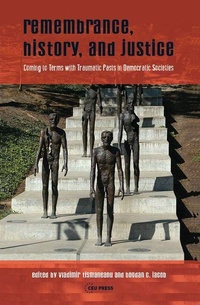
Remembrance, History, and Justice
Coming to terms with traumatic pasts in democratic societies
Published on 1. October 2015
Book
Hardback
516 pages
978-963-386-092-2 (ISBN)
Description
The twentieth century has left behind a painful and complicated legacy of massive trauma, monstrous crimes, radical social engineering, or collective/individual guilt syndromes that were often the premises for and the specters haunting the process of democratization in the various societies that emerged out of these profoundly de-structuring contexts. The present manuscript is a state of the art reassessment and analysis of how the interplay between memory, history, and justice generates insight that is multifariously relevant for comprehending the present and future of democracy without becoming limited to a Europe-centric framework of understanding. The manuscript is structured on three complementary and interconnected trajectories: the public use of history, politics of memory, and transitional justice.
More details
Language
English
Place of publication
Budapest
Hungary
Target group
Professional and scholarly
Academic
Product notice
sewn/stitched
Cloth over boards
Dimensions
Height: 233 mm
Width: 161 mm
Thickness: 35 mm
Weight
817 gr
ISBN-13
978-963-386-092-2 (9789633860922)
Copyright in bibliographic data and cover images is held by Nielsen Book Services Limited or by the publishers or by their respective licensors: all rights reserved.
Schweitzer Classification
Other editions
Additional editions
Bogdan C. Iacob | Vladimir Tismaneanu
Remembrance, History, and Justice
Coming to terms with traumatic pasts in democratic societies
Book
10/2015
Central European University Press
€93.50
Available (delivery time upon request)
Persons
Bogdan C. Iacob is Post Doctoral Research Associate at the University of Exeter.
Vladimir Tismaneanu isProfessor of politics and Director of the Center for the Study of Post-communist Societies at University of Maryland (College Park).
Vladimir Tismaneanu isProfessor of politics and Director of the Center for the Study of Post-communist Societies at University of Maryland (College Park).
Content
Introduction, Part One: Politics of Memory and Constructing Democracy, Daniel Chirot, Part Two : Histories and their Publics, Part Three: Searching for Closure in Democratizing Societies, Part Four : Competing Narratives of Troubled Pasts, List of Contributors, Index