

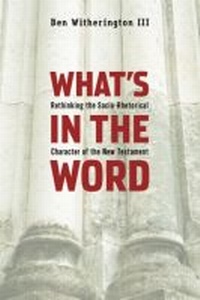
What's in the Word
Rethinking the Socio-Rhetorical Character of the New Testament
Published on 30. August 2009
Book
Paperback/Softback
203 pages
978-1-60258-196-8 (ISBN)
Description
Written in clear, and at times colorful, prose, Ben Witherington's What's in the Word explains how the recognition of the oral and socio-rhetorical character of the New Testament and its environment necessitates a change in how the New Testament literature is read. Expanding on the work in which he has been fruitfully engaged for over a quarter century, Witherington challenges the previously assured results of historical criticism and demonstrates chapter by chapter how the socio-rhetorical study shifts the paradigm.
Taken together, the chapters in What's in the Word coalesce around three of Witherington's ongoing academic concerns: orality and rhetoric; New Testament history, including issues of authenticity and canonicity; and the exegesis of given words in their canonical and socio-cultural contexts. Always unpredictable, this book never fails to pique interest and proffer instruction.
Taken together, the chapters in What's in the Word coalesce around three of Witherington's ongoing academic concerns: orality and rhetoric; New Testament history, including issues of authenticity and canonicity; and the exegesis of given words in their canonical and socio-cultural contexts. Always unpredictable, this book never fails to pique interest and proffer instruction.
Reviews / Votes
"... [Witherington] easily demonstrates that history and theology simply cannot be separated." -- ?Review of Biblical Literature (May 2012) "... a fascinating discussion. ... [Witherington] is correct that social history and Greco-Roman rhetoric are now more purposely employed in interpretation and have made significant advances in our understanding of the NT--advances he masterfully demonstrates throughout this volume. --Duane F. Watson, Interpretation (2011, 65:3) "Witherington here shows how fruitful socio-rhetorical perspective can be. His lively and accessible style make for stimulating reading." --Richard Bauckham, Professor of New Testament, St. Mary's College, University of St. Andrews "This book's fascinating observations give stimuluating guidance in hearing the texts as they were very likely meant to be heard." --Richard J. Erickson, Associate Professor of New Testament, Fuller Theological Seminary "This book tackles a series of contentious subjects with clarity and verve. It may even change your mind on some." --Darrell Bock, Research Professor of New Testament Studies, Dallas Theological Seminary ... interesting, varied, provocative, well written and worthwhile. -- David Wenham -- Journal for the Study of the New TestamentMore details
Language
English
Place of publication
Waco
United States
Target group
Professional and scholarly
Dimensions
Height: 229 mm
Width: 152 mm
Thickness: 15 mm
Weight
354 gr
ISBN-13
978-1-60258-196-8 (9781602581968)
Copyright in bibliographic data and cover images is held by Nielsen Book Services Limited or by the publishers or by their respective licensors: all rights reserved.
Schweitzer Classification
Other editions
Additional editions
Ben Iii Witherington
What's in the Word
Rethinking the Socio-Rhetorical Character of the New Testament
E-Book
05/2011
Baylor University Press
€33.99
Available for download
Person
Ben Witherington III is Professor of New Testament for Doctoral Studies, Asbury Theological Seminary. His publications include Troubled Waters: Rethinking the Theology of Baptism (2007), Making a Meal of It: Rethinking the Theology of the Lord's Supper (2007), The Living Word of God: Rethinking the Theology of the Bible (2007), and The Problem with Evangelical Theology: Testing the Exegetical Foundations of Calvinism, Dispensationalism, Wesleyanism, and Pentecostalism, Revised and Expanded Edition (2015).
Content
Invitation to the Dance
Chapter One: Oral Examination: How Did 'Oral' Texts Function in a Rhetorical Culture?
Chapter Two: Canonical Pseudepigrapha Is It an Oxymoron?
Chapter Three: Rethinking and Redescribing Scribal Culture
Chapter Four: The Question of Sermons and Homilies in the New Testament
Chapter Five: Rom. 7.7-25- Retelling Adam's Tale
Chapter Six: What's in a Name? Rethinking the Historical Figure of the Beloved Disciple in the 4th Gospel
Chapter Seven: What's in a Word? Part One: Eidolothuton
Chapter Eight: What's In A Word? Part Two Porneia
Chapter Nine: What's in a Phrase? 'No Male and Female' (Gal. 3.28)
Chapter Ten: Christianity in the Making': Oral Mystery or Eyewitness History?
Chapter Eleven: Rethinking the Canonizing of the New Testament
Chapter Twelve: Sign Posts along the Way On Taking the Less Travelled Path
Chapter One: Oral Examination: How Did 'Oral' Texts Function in a Rhetorical Culture?
Chapter Two: Canonical Pseudepigrapha Is It an Oxymoron?
Chapter Three: Rethinking and Redescribing Scribal Culture
Chapter Four: The Question of Sermons and Homilies in the New Testament
Chapter Five: Rom. 7.7-25- Retelling Adam's Tale
Chapter Six: What's in a Name? Rethinking the Historical Figure of the Beloved Disciple in the 4th Gospel
Chapter Seven: What's in a Word? Part One: Eidolothuton
Chapter Eight: What's In A Word? Part Two Porneia
Chapter Nine: What's in a Phrase? 'No Male and Female' (Gal. 3.28)
Chapter Ten: Christianity in the Making': Oral Mystery or Eyewitness History?
Chapter Eleven: Rethinking the Canonizing of the New Testament
Chapter Twelve: Sign Posts along the Way On Taking the Less Travelled Path