

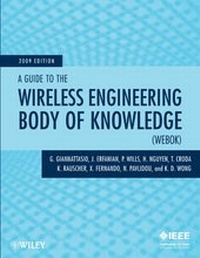
A Guide to the Wireless Engineering Body of Knowledge (WEBOK)
1st Edition
Published on 1. April 2009
Book
Paperback/Softback
268 pages
978-0-470-43366-9 (ISBN)
Description
Responding to requests from industry for a program to ensure consistency and excellence among wireless technical professionals, the IEEE Communications Society (ComSoc) created its Wireless Communication Engineering Technologies (WCET) Certification. Beginning in September 2008, ComSoc is holding the WCET testing twice a year at locations worldwide. The WEBOK is organized according to the areas of expertise in the WCET Delineation, namely RF Engineering; Propagation & Antennas; Wireless Access Technologies; Network & Service Architecture; Network Management & Security; Facilities Infrastructure; Agreements, Standards, Policies & Regulations; and Fundamental Knowledge. Included in the WEBOK is a large list of additional publications and documents that candidates should review to become completely prepared for the WCET exam. The book is also a valuable reference for any wireless professional.
More details
Edition
1., Auflage
Language
English
Place of publication
Hoboken
United States
Publishing group
John Wiley and Sons Ltd
Target group
Professional and scholarly
Illustrations
Illustrations
Dimensions
Height: 28.2 cm
Width: 21.8 cm
Thickness: 13 mm
Weight
621 gr
ISBN-13
978-0-470-43366-9 (9780470433669)
Schweitzer Classification
Other editions
New editions
Andrzej Jajszczyk
A Guide to the Wireless Engineering Body of Knowledge (WEBOK)
Book
11/2012
2nd Edition
Wiley-IEEE Press
€89.50
Article not available at the moment
Person
With more than 40,000 members worldwide, the IEEE Communications Society (ComSoc) provides an international forum for the exchange of ideas on communications and information networking. The society is committed to meeting the educational needs of wireless engineers via publications, conferences, workshops, chapter meetings, and educational programs.
Content
CONTRIBUTING AUTHORS. INTRODUCTION. WIRELESS ACCESS TECHNOLOGIES. 1.1 INTRODUCTION. 1.2 CONTENTS. 1.3 DESIGN FUNDAMENTALS. 1.4 MOBILIT MANAGEMENT. 1.5 WIRELES ASCCESS TECHNOLOGY STANDARDIZATION. 1.6 LOCAL, PERSONAL AND NEAR-FIELD COMMUNICATIONS. 1.7 DIGITAL MOBILE CELLULAR TECHNOLOGY EVOLUTION-2G TO 3G. 1.8 BEYOND 3G AND FUTURE TRENDS. NETWORK AND SERVICE ARCHITECTURE. 2.1 INTRODUCTION. 2.2 CONTENTS. 2.3 CIRCUIT-SWITCHED CELLULAR NETWORK ARCHITECTURE. 2.4 TCP/IP IN PACKET SWITCHED NETWORKS. 2.5 VolP/SIP FOR IP MULTIMEDIA. 2.6 PACKET-SWITCHED MOBILE NETWORKS AND IMS. 2.7 ALTERNATIVE NETWORK ARCHITECTURES-MESH NETWORKS. 2.8 ALTERNATIVE NETWORK ARCHITECTURES-MOBILE AD HOC NETWORKS. 2.9 SERVICE ENABLER EVOLUTION. 2.10 SERVICE FRAMEWORK. 2.11 FUNDAMENTALS OF TRAFFIC ENGINEERING. 2.12 KEY REFERENCES. NETWORK MANAGEMENT AND SECURITY. 3.1 INTRODUCTION. 3.2 CONTENTS. 3.3 THE INFORMATION TECHNOLOGINY INFRASTRUCTURE LIBRARY. 3.4 THE ENHANCED TELECOM OPERATIONS MAP. 3.5 THE SIMPLE NETWORK MANAGEMENT PROTOCOL (SNMP). 3.6 SECURITY REQUIREMENTS. 3.7 REFERENCES. RADIO FREQUENCY ENGINEERING PROPAGATION AND ANTENNAS. 4.1 INTRODUCTION. 4.2 CONTENTS. 4.3 ANTENNAS. 4.4 PROPAGATION. 4.5 RF ENGINEERING. 4.6 KEY REFERENCES. FACILITIES INFRASTRUCTURE. 5.1 INTRODUCTION. 5.2 CONTENTS. 5.3 AC AND DC POWER SYSTEMS. 5.4 ELECTRICAL PROTECTION. 5.5 HEATING, VENTILATION, AND AIR CONDITIONING. 5.6 EQUIPMENT RACKS, RACK MOUNTING SPACES, AND RELATED HARDWARE. 5.7 WAVEGUIDES AND TRANSMISSION LINES. 5.8 TOWER SPECIFICATIONS AND STANDARDS. 5.9 DISTRIBUTED ANTENNA SYSTEMS AND BASE STATION HOTELS. 5.10 PHYSICAL SECURITY, ALARM AND SURVEILIANCE SYSTEMS. 5.11 NATIONAALN D INTERNATIONAL STANDARDS AND SPECIFICATIONS. 5.12 REFERENCES. AGREEMENTS, STANDARDS, POLICIES. AND REGULATIONS. 6.1 INTRODUCTION. 6.2 CONTENTS. 6.3 AGREEMENTS. 6.4 STANDARDS. 6.5 POLICIES. 6.6 REGULATIONS. 6.7 REFERENCES. FUNDAMENTAL KNOWLEDGE. 7.1 INTRODUCTION. 7.2 CONTENTS. 7.3 ELECRICALE NGINEERING BASICS FOR WIRELESS COMMUNICATIONS. 7.4 SIGNAL PROCESSING AND COMMUNICATION SYSTEMS. 7.5 RF ENGINEERING. 7.6 INSTRUMENTS AND MEASUREMENTS [WIT02]. 7.7 COMMUNICATION NETWORKS. 7.8 OTHER COMMUNICATION SYSTEMS. 7.9 GENERAL ENGINEERING MANAGEMENT AND ECONOMICS. 7.10 KEY REFERENCES. APPENDIXES. APPENDIX A: COMPLETE REFERENCES & FURTHER RESOURCES. APPENDIX B: CREATING THE WEBOK. APPENDIX C: SUMMARY OF KNOWLEDGE AREAS. APPENDIX D: GLOSSARY. APPENDIX E: ABOUT THE IEEE COMMUNICATIONS SOCIETY.