

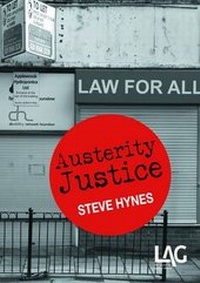
Austerity Justice
Published on 8. November 2012
Book
Paperback/Softback
182 pages
978-1-908407-20-7 (ISBN)
Unfortunately, price unknown
Article is exhausted; no reprint
Description
Austerity Justice looks at how the civil legal safety net was established and why it is now under threat, due to a combination of austerity policies and the casual indifference of a few powerful politicians to the state's responsibility to provide a civil justice system that guarantees equality before the law regardless of means. Over the last 40 years, the civil legal aid system provided by solicitors and barristers developed in parallel with the expansion of not for profit advice centres such as Citizens Advice Bureaux. These services, though not originally conceived as such, evolved into an important arm of the welfare state. They ensure effective redress for people facing the everyday problems that a crisis in their lives such as a divorce, long-term disability or losing a job can throw at them. The austerity measures of the current coalition government mean that from next year this will become a much reduced service. Access to justice policy might be at its lowest ebb, but the campaign against the Legal Aid, Sentencing and Punishment of Offenders (LASPO) Act 2012 could have sown the seeds of recovery.
The debate over the Act led to a tipping point between members of the coalition government. Some ministers wanted a once-and-for-all redesign, closing off any chance that the legal aid system could expand again to meet the civil legal needs of the public. lndividual Liberal Democrat and Conservative parliamentarians, the Labour Opposition, and the weight of informed non-party political opinion, represented by crossbenchers in the Lords, were opposed to this. Key concessions were won including a section in the LASPO Act which allows amendments to the scope of legal aid to be made in the future.
The debate over the Act led to a tipping point between members of the coalition government. Some ministers wanted a once-and-for-all redesign, closing off any chance that the legal aid system could expand again to meet the civil legal needs of the public. lndividual Liberal Democrat and Conservative parliamentarians, the Labour Opposition, and the weight of informed non-party political opinion, represented by crossbenchers in the Lords, were opposed to this. Key concessions were won including a section in the LASPO Act which allows amendments to the scope of legal aid to be made in the future.
More details
Language
English
Place of publication
London
United Kingdom
Target group
Professional and scholarly
Dimensions
Height: 210 mm
Width: 148 mm
Thickness: 10 mm
ISBN-13
978-1-908407-20-7 (9781908407207)
Copyright in bibliographic data and cover images is held by Nielsen Book Services Limited or by the publishers or by their respective licensors: all rights reserved.
Schweitzer Classification
Person
Steve Hynes is the director of Legal Action Group (LAG). Previously he was the director of Law Centres Federation, the national organisation for Law Centres, and worked as co-ordinator at Rochdale Law Centre where he also undertook casework in employment and discrimination law.
Content
The big society - civil legal advice prior to 1949 / Legal aid from Rushcliffe to Mackay 1949 - 1997 / The legal rights - chicken and egg / New Labour reforms 1997 - 2002 / The politicians take control 2003 - 2010 / Coalition proposals for reform / A rump service / Campaigners get their ducks in a line / Amendments and concessions / Austerity justice