

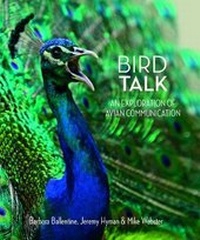
Bird Talk
An exploration of avian communication
Book
Hardback
192 pages
978-1-78240-982-3 (ISBN)
Description
Bird Talk begins by defining the wide variety of ways birds communicate, using songs, calls, plumes and dances. The variety of communication uses are outlined, and the way that birds detect and receive signals. Birds have keen eyesight, and see a broader colour spectrum than the human eye to include UV light, so that plumage pattern and use on its own or in combination with dancing and strutting can convey a wealth of information.
Birds communicate to defend their territory and to attract mates. Chicks and parents rely on communication for recognition, begging and signs of quality. Birds have sophisticated warning calls, with some able to tell their flock what kind of predator is threatening them. A good number of birds - the corvids, hummingbirds and the songbirds - actually learn songs and calls so that different flocks have different dialects. This has concerning implications for bird survival if environment loss demands forced migration. Today's world is noisy for birds, and Bird Talk explores how avian life is adapting to these new challenges.
Birds communicate to defend their territory and to attract mates. Chicks and parents rely on communication for recognition, begging and signs of quality. Birds have sophisticated warning calls, with some able to tell their flock what kind of predator is threatening them. A good number of birds - the corvids, hummingbirds and the songbirds - actually learn songs and calls so that different flocks have different dialects. This has concerning implications for bird survival if environment loss demands forced migration. Today's world is noisy for birds, and Bird Talk explores how avian life is adapting to these new challenges.
More details
Language
English
Place of publication
United Kingdom
Publishing group
Quarto Publishing PLC
Illustrations
150
Dimensions
Height: 254 mm
Width: 203 mm
ISBN-13
978-1-78240-982-3 (9781782409823)
Copyright in bibliographic data and cover images is held by Nielsen Book Services Limited or by the publishers or by their respective licensors: all rights reserved.
Schweitzer Classification
Persons
Jeremy Hyman, PhD, teaches ornithology and animal behavior at Western Carolina University in Cullowhee, NC. He studies the interplay of cooperative and competitive interactions in territorial communication in birds. He has written birding columns for a regional newspaper and gives talks to birding enthusiasts.Barbara Ballentine is Associate Professor at Western Carolina University. Ballentine's work focuses on the evolutionary mechanisms underlying phenotypic variation and population divergence in animals, primarily birds. Using highly-integrative and experimental approaches with both field and laboratory studies Ballentine specifically addresses how sexual selection favours reliable mating signals; how natural selection constrains the expression of mating signals and mechanisms of phenotypic (morphological and behavioural) variation between populations.Dr. Mike Webster is the Robert G. Engel Professor of Ornithology in the Department of Neurobiology and Behaviour at Cornell University, and also Director of the Macaulay Library at the Cornell Lab of Ornithology. He has studied the effects of ecological factors on bird breeding behaviour, the ways that sexual selection shapes courtship signals like plumage colour and song and the effects of those signals on the process of speciation. His research focuses primarily on Australian fairy-wrens, North American wood warblers and Neotropical blackbirds.
Content
Foreword by Mike Webster
Introduction
Ch.1
What is Communication?
Songs, calls, plumes and dances (variety of signs and signals)
Manipulation, deceit or information transfer? (Variety of communication uses)
How birds detect signals (sensory systems and how the bird receives the info)
Ch.2
Sound and Sight
Songs
Calls
Plumage (pigments, structure, UV)
Displays, dances and combinations
Ch.3
Territory Defence
Aggression
Neighbour and stranger recognition
Ch.4
Mate Attraction
What makes a successful mating song?
What do females look for in male plumage?
Female strategies (? Added in)
Ch.5
Chicks & Parents
Recognition (penguins & fairy wrens)
Begging (need versus a sign of quality(?) )
Juvenile plumage signs (quality)
Ch.6
Warning Calls
Alarm versus distress
Graded alarm calls
Encoded alarm calls (?)
Eavesdropping
Ch.7
The Social Flock(?)
( _ ?) (parrots)
( _ ?) (stripe-backed wrens)
Food calls
Ch.8
The Cultural Life of Birds
Learning songs and calls
Learning and the brain
Dialects (functional significance, evolutionary significance?)
Ch.9
Communication in a noisy world
Urbanization (? General outline of increased human influence that affects avian life)
The characteristics of noise
Noise, air and light pollution
Further reading
Index
Acknowledgements
Introduction
Ch.1
What is Communication?
Songs, calls, plumes and dances (variety of signs and signals)
Manipulation, deceit or information transfer? (Variety of communication uses)
How birds detect signals (sensory systems and how the bird receives the info)
Ch.2
Sound and Sight
Songs
Calls
Plumage (pigments, structure, UV)
Displays, dances and combinations
Ch.3
Territory Defence
Aggression
Neighbour and stranger recognition
Ch.4
Mate Attraction
What makes a successful mating song?
What do females look for in male plumage?
Female strategies (? Added in)
Ch.5
Chicks & Parents
Recognition (penguins & fairy wrens)
Begging (need versus a sign of quality(?) )
Juvenile plumage signs (quality)
Ch.6
Warning Calls
Alarm versus distress
Graded alarm calls
Encoded alarm calls (?)
Eavesdropping
Ch.7
The Social Flock(?)
( _ ?) (parrots)
( _ ?) (stripe-backed wrens)
Food calls
Ch.8
The Cultural Life of Birds
Learning songs and calls
Learning and the brain
Dialects (functional significance, evolutionary significance?)
Ch.9
Communication in a noisy world
Urbanization (? General outline of increased human influence that affects avian life)
The characteristics of noise
Noise, air and light pollution
Further reading
Index
Acknowledgements