

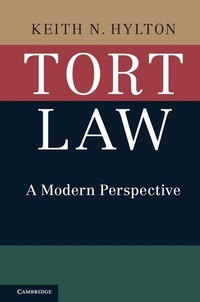
Tort Law
A Modern Perspective
Published on 6. June 2016
Book
Paperback/Softback
460 pages
978-1-107-56342-1 (ISBN)
Description
Tort Law: A Modern Perspective is an advanced yet accessible introduction to tort law for lawyers, law students, and others. Reflecting the way tort law is taught today, it explains the cases and legal doctrines commonly found in casebooks using modern ideas about public policy, economics, and philosophy. With an emphasis on policy rationales, Tort Law encourages readers to think critically about the justifications for legal doctrines. Although the topic of torts is specific, the conceptual approach should pay dividends to those who are interested broadly in regulatory policy and the role of law. Incorporating three decades of advancements in tort scholarship, Tort Law is the textbook for modern torts classrooms.
More details
Language
English
Place of publication
Cambridge
United Kingdom
Target group
Professional and scholarly
Product notice
Paperback (trade)
Illustrations
4 Tables, black and white; 15 Line drawings, black and white
Dimensions
Height: 229 mm
Width: 152 mm
Thickness: 25 mm
Weight
667 gr
ISBN-13
978-1-107-56342-1 (9781107563421)
Copyright in bibliographic data and cover images is held by Nielsen Book Services Limited or by the publishers or by their respective licensors: all rights reserved.
Schweitzer Classification
Other editions
Person
Keith N. Hylton is William Fairfield Warren Distinguished Professor and a Professor of Law at Boston University specializing in tort law, antitrust law, intellectual property law, and labor law. His latest book, a utilitarian defense of the intellectual property laws, is Laws of Creation: Property Rights in the World of Ideas (2013).
Content
1. Introduction; 2. Policy and tort law; 3. Evolution of tort law; 4. Intentional torts; 5. Theoretical foundations of strict liability; 6. The reasonable person; 7. Customs, statutes, and the reasonable person; 8. Inferring negligence; 9. Contributory negligence and assumption of risk; 10. Contributory negligence, comparative negligence, and incentives for care; 11. Joint and several liability and vicarious liability; 12. Factual causation; 13. Proximate cause; 14. Duty to rescue and special relationships; 15. Strict liability: conversion, abnormally dangerous activities, and nuisance; 16. Defamation; 17. Products liability; 18. Damages.