

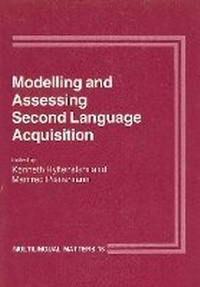
Modelling and Assessing Second Language Acquisition
Published on 15. August 1985
Book
Paperback/Softback
408 pages
978-0-905028-41-5 (ISBN)
Description
This book forms an invaluable reference work for all teachers of second languages and researchers in the field of L2 acquisition. In the first section of the book, the authors of the various chapters discuss the contribution that modern research into L2 acquisition has to make in the curriculum development process. In particular, the book provides the reader with arguments for and against the various approaches to teaching. In the second part of the book, the contributors concern themselves with the various assessment tests and their validity, discussing them in particular on psycholinguistic grounds. They also discuss the political function of such assessment and how tests are used or abused in many different contexts around the world.
More details
Series
Language
English
Place of publication
Bristol
United Kingdom
Publishing group
Channel View Publications Ltd
Target group
College/higher education
Professional and scholarly
Dimensions
Height: 210 mm
Width: 149 mm
Thickness: 21 mm
Weight
562 gr
ISBN-13
978-0-905028-41-5 (9780905028415)
Copyright in bibliographic data and cover images is held by Nielsen Book Services Limited or by the publishers or by their respective licensors: all rights reserved.
Schweitzer Classification
Other editions
Additional editions
Kenneth Hyltenstam | Manfred Pienemann
Modelling and Assessing Second Language Acquisition
Book
08/1985
Multilingual Matters
€133.63
Article exhausted; check different version
Persons
Kenneth Hyltenstam is Professor Emeritus of Bilingualism at Stockholm University. He has published extensively in the area of second language acquisition, specifically on topics such as age and ultimate L2 attainment, markedness, developmental sequences and variability, but his research also covers other topics within the area of bilingualism such as polyglotism and bilingualism and dementia. Edited volumes covering these areas are Modelling and Assessing Second Language Acquisition (Multilingual Matters 1985, with Manfred Pienemann); Bilingualism Across the Lifespan (Cambridge University Press 1989, with Loraine K. Obler); Progression and Regression in Language (Cambridge University Press 1993, with Ake Viberg); Advanced Proficiency and Exceptional Ability in Second Languages (Mouton de Gruyter, 2016); High-Level Language Proficiency in Second Language and Multilingual Contexts (Cambridge University Press, 2018, with Inge Bartning and Lars Fant). In addition, he has contributed to multilingualism in the sociolinguistic and educational fields (co-edited volume Entangled Discourses (Routledge, 2017, with Caroline Kerfoot). Issues dealt with here include language policy as well as language maintenance, shift and revitalization with respect to minority languages in Sweden and Norway. He has published widely on language and education issues in the Nordic context as well as in the global South (Bolivia, Mozambique). He served as the Director of the Centre for Research on Bilingualism at Stockholm University 1981-2007 and 2012-2013.
Content
PART I
1. Introduction: Kenneth Hyltenstam and Manfred Pienemann
2. Manfred Pienemann: Learnability and Syllabus Construction
3. Michael H. Long: A Role for Instruction in Second Language Acquisition: Task-Based Language Training
4. Patsy M. Lightbown: Can Language Acquisition be Altered by Instruction?
5. Kenneth Hyltenstam: L2 Learners' Variable Output and Language Teaching
6. Teresa Pica: Linguistic Simplicity and Learnability: Implications for Language Syllabus Design
7. Bjorn Hammarberg: Learnability and Learner Strategies in Second Language Syntax and Phonology
8. Howard Nicholas: Learner Variations and the Teachability Hypothesis
9. Michael C. Clyne: Medium or Object - Different Contexts of (School-based) Second Language Acquisition
PART II
10. David E. Ingram: Assessing Proficiency: An Overview on Some Aspects of Testing
11. Jan H. Hulstijn: Testing Second Language Proficiency with Direct Procedures: A Comment on Ingram
12. Harald Clahsen: Profiling Second Language Development: A Procedure for Assessing L2 Proficiency
13. Sharon Lapkin: Pedagogical Implications of Direct Second Language Testing: A Canadian Example
14. Lilian Fried: On the Validity of Second Language Tests
15. Jan H. Hulstijn: Second Language Proficiency: An Interactive Approach
16. Wilfried Stolting: Language Assessment as a Social Activity
1. Introduction: Kenneth Hyltenstam and Manfred Pienemann
2. Manfred Pienemann: Learnability and Syllabus Construction
3. Michael H. Long: A Role for Instruction in Second Language Acquisition: Task-Based Language Training
4. Patsy M. Lightbown: Can Language Acquisition be Altered by Instruction?
5. Kenneth Hyltenstam: L2 Learners' Variable Output and Language Teaching
6. Teresa Pica: Linguistic Simplicity and Learnability: Implications for Language Syllabus Design
7. Bjorn Hammarberg: Learnability and Learner Strategies in Second Language Syntax and Phonology
8. Howard Nicholas: Learner Variations and the Teachability Hypothesis
9. Michael C. Clyne: Medium or Object - Different Contexts of (School-based) Second Language Acquisition
PART II
10. David E. Ingram: Assessing Proficiency: An Overview on Some Aspects of Testing
11. Jan H. Hulstijn: Testing Second Language Proficiency with Direct Procedures: A Comment on Ingram
12. Harald Clahsen: Profiling Second Language Development: A Procedure for Assessing L2 Proficiency
13. Sharon Lapkin: Pedagogical Implications of Direct Second Language Testing: A Canadian Example
14. Lilian Fried: On the Validity of Second Language Tests
15. Jan H. Hulstijn: Second Language Proficiency: An Interactive Approach
16. Wilfried Stolting: Language Assessment as a Social Activity