

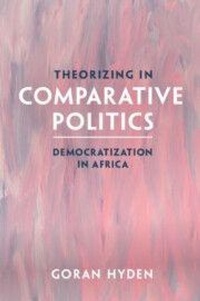
Theorizing in Comparative Politics
Democratization in Africa
Published on 18. January 2024
Book
Paperback/Softback
186 pages
978-1-009-42949-8 (ISBN)
Description
This book addresses a pertinent issue in comparative politics: how can the discipline do analytical justice to regions of the world that differ historically from the Western experience? For decades the West has served as a baseline against which all other regions are assessed, most recently in studies of democratization. Structural differences between regions have been ignored in favour of explanations based on human agency and institutions. In Theorizing in Comparative Politics, Goran Hyden uses the countries of Africa as an empirical case to demonstrate what a structural approach adds to the comparative study of democracy. Priorities like state-building challenge the effort to shape democratic regimes and call for explanations that recognize the impact of local power dynamics on the prospects for democratic development. Informative and thoughtful, this book sheds light on issues that have been underexplored in the field in recent years.
Reviews / Votes
'Hyden brings six decades of wide-ranging research, teaching, and reflection on African politics to this new volume. He revisits the first wave of political development research in the 1960s and connects this to the study of democratization in the 1990s and 2000s. Hyden reworks several leitmotifs of his most impactful contributions to the field, questioning the inevitability of democracy in the Western mould and calling for new ways of conceptualizing political development in African countries. A reflective and humane account.' Catherine Boone, Professor of Comparative Politics, London School of Economics 'Goran Hyden has offered keen insight into African politics for decades. This retrospective speaks more broadly to the field of comparative politics from a place of deeply informed perspective, providing a welcome reminder of the ongoing need to balance generality with context. Comparativists will be the better for reading it.' Benjamin Smith, UF Term Professor of Political Science, University of Florida 'Hyden's book provides a trenchant, non-statistical approach to contemporary African politics - a worthy summation of a distinguished career ... Highly recommended. C. E. Welch, CHOICE 'The book is written with pace, wit, and authority, the author bringing to bear a lifetime of reflection and publishing on the issues under study ... an ambitious, accessible, and thought-provoking book which will be important reading for students of African politics, and Comparative Politics more generally, and will no doubt be an essential reference point for both graduate and undergraduate course convenors on these topics.' Jonathan Fisher, Perspectives on PoliticsMore details
Language
English
Place of publication
Cambridge
United Kingdom
Product notice
Paperback (trade)
Illustrations
Worked examples or Exercises
Dimensions
Height: 229 mm
Width: 152 mm
Thickness: 11 mm
Weight
281 gr
ISBN-13
978-1-009-42949-8 (9781009429498)
Copyright in bibliographic data and cover images is held by Nielsen Book Services Limited or by the publishers or by their respective licensors: all rights reserved.
Schweitzer Classification
Other editions
Additional editions
Book
01/2024
Cambridge University Press
€101.50
Shipment within 15-20 days
E-Book
01/2024
Cambridge University Press
€31.99
Available for download
Person
Goran Hyden is a Distinguished Professor Emeritus in the Department of Political Science at the University of Florida. Theorizing in Comparative Politics is the result of sixty years of research and teaching shared between East Africa and Florida. Earlier iterations of the work include Political Development in Rural Tanzania (1969), No Shortcuts to Progress (1983), and African Politics in Comparative Perspective (2006).
Content
1. Three theoretical spurts; 2. How history matters; 3. Relevance of social formations; 4. Nation-states and state-nations; 5. Regimes and institutions; 6. Parties and ideology; 7. Culture and the public sphere; 8. Four neighbours, four regimes; 9. What Africa teaches us.