

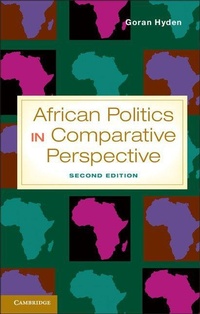
African Politics in Comparative Perspective
2nd Edition
Published on 15. October 2012
Book
Hardback
322 pages
978-1-107-03047-3 (ISBN)
Description
This revised and expanded second edition of African Politics in Comparative Perspective reviews fifty years of research on politics in Africa and addresses some issues in a new light, keeping in mind the changes in Africa since the first edition was written in 2004. The book synthesizes insights from different scholarly approaches and offers an original interpretation of the knowledge accumulated in the field. Goran Hyden discusses how research on African politics relates to the study of politics in other regions and mainstream theories in comparative politics. He focuses on such key issues as why politics trumps economics, rule is personal, state is weak and policies are made with a communal rather than an individual lens. The book also discusses why in the light of these conditions agriculture is problematic, gender contested, ethnicity manipulated and relations with Western powers a matter of defiance.
Reviews / Votes
Review of the first edition: 'A most useful book that could be assigned for both graduate and undergraduate courses on African politics. Highly recommended.' Choice Review of the first edition: 'African Politics in Comparative Perspective avoids the sort of confusing litany of superficial references to cases found in many texts on African politics.' Amy R. Poteete, Canadian Journal of Political Science Review of the first edition: 'This is a well-developed assessment of important themes in the study of African politics. With one very bold step, Hyden systematically integrates important aspects of the literature on African politics and society into the historically and theoretically rich Eurocentric tradition of state and society, which dominated the field of comparative politics in earlier decades.' Connie Anthony, African Studies Review 'In this synthetic work pulling together decades worth of scholarship, especially in his discipline of political science, Hyden puts forth his best efforts ... Policy makers and journalists who find themselves dropped into Africa without any particular training should place this book on their shelves after reading it closely so that they can refer to it often.' Derek Catsam, Association for the Study of the Middle East and AfricaMore details
Edition
2nd Revised edition
Language
English
Place of publication
Cambridge
United Kingdom
Target group
College/higher education
Professional and scholarly
Edition type
Revised edition
Illustrations
9 Tables, unspecified; 5 Line drawings, unspecified
Dimensions
Height: 235 mm
Width: 157 mm
Thickness: 22 mm
Weight
624 gr
ISBN-13
978-1-107-03047-3 (9781107030473)
Copyright in bibliographic data and cover images is held by Nielsen Book Services Limited or by the publishers or by their respective licensors: all rights reserved.
Schweitzer Classification
Other editions
Additional editions
Goran Hyden
African Politics in Comparative Perspective
E-Book
10/2012
2nd Edition
Cambridge University Press
€26.49
Available for download
Goran Hyden
African Politics in Comparative Perspective
E-Book
10/2012
Cambridge University Press
€21.99
Available for download
Previous edition
Goran Hyden
African Politics in Comparative Perspective
Book
12/2005
Cambridge University Press
€66.85
Article exhausted; check for reprint
Person
Goran Hyden is Distinguished Professor Emeritus in the Department of Political Science at the University of Florida. His publications include Governance and Politics in Africa (co-edited with Michael Bratton, 1992), Agencies in Foreign Aid (co-edited with Rwekaza Mukandala, 1997), Making Sense of Governance (co-authored with Julius Court and Kenneth Mease, 2004) and Making the State Responsive (co-edited with John Samuel, 2011). He is a past president of the African Studies Association and has served as a consultant on African development to many international agencies.
Content
1. The study of politics and Africa; 2. The supremacy of politics; 3. The problematic state; 4. The economy of affection; 5. Big man rule; 6. The policy paradox; 7. The agrarian question; 8. The gender issue; 9. The ethnic factor; 10. The external dimension; 11. What we know and how; 12. Quo vadis Africa?