

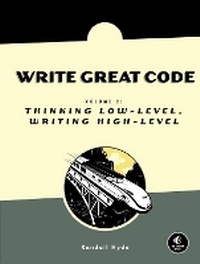
Write Great Code
Volume 2: Thinking Low-Level, Writing High-Level
1st Edition
Published on 3. June 2006
Book
Paperback/Softback
664 pages
978-1-59327-065-0 (ISBN)
Description
In the beginning, most softare was written in assembly, the CPU´s low-level language, in order to achieve acceptable performance on relatively slow hardware. Early programmers were sparing in their use of high-level language code, knowing that a high-level language compiler would generate crummy, low-level machine code for their software. Today, however, many programmers write in high-level languages like C, C++, Pascal, Java, or BASIC. The result is often sloppy, inefficient code. You don´t need to give up the productivity and portability of high-level languages in order to produce more effecient software.
In this second volume of the Write Great Code series, you´ll learn:
- How to analyze the output of a compiler to verify that your code does, indeed, generate
good machine code
- The types of machine code statements that compilers typically generate for common
control structures, so you can chosse the best statements when writing HLL code
- Just enough 80x86 and PowerPC assembly language to read compiler output
- How compilers convert various constant and variable objects into machine data, and
how to use these objects to write faster and shorter pograms
With an understanding of how compilers work, you´ll be able to write source code that they can translate into elegante machine code. That understanding starts right here, with Write Great Code, Volume 2: Thinking Low-Level, Writing High-Level.
Praise for Write Great Code, Volume 1: Understanding the machine:
"If you are programming without benefit of formal training, or if you lack the aegis of a mentor, Randall Hyde´s Write Great Code series should rouse your interest."
Key selling points:
- From the author of The Art of Assembly Language, one of the most highly
recommended resources on assembly (No Starch Press)
- First volume in three-part Write Great Code series was favorably reviewed by
Unix Review, MacCompanion, SecurityITWorld.com, and others
- Teaches programmers how to use a better mix of high-level language
statements to write more efficient applications
In this second volume of the Write Great Code series, you´ll learn:
- How to analyze the output of a compiler to verify that your code does, indeed, generate
good machine code
- The types of machine code statements that compilers typically generate for common
control structures, so you can chosse the best statements when writing HLL code
- Just enough 80x86 and PowerPC assembly language to read compiler output
- How compilers convert various constant and variable objects into machine data, and
how to use these objects to write faster and shorter pograms
With an understanding of how compilers work, you´ll be able to write source code that they can translate into elegante machine code. That understanding starts right here, with Write Great Code, Volume 2: Thinking Low-Level, Writing High-Level.
Praise for Write Great Code, Volume 1: Understanding the machine:
"If you are programming without benefit of formal training, or if you lack the aegis of a mentor, Randall Hyde´s Write Great Code series should rouse your interest."
Key selling points:
- From the author of The Art of Assembly Language, one of the most highly
recommended resources on assembly (No Starch Press)
- First volume in three-part Write Great Code series was favorably reviewed by
Unix Review, MacCompanion, SecurityITWorld.com, and others
- Teaches programmers how to use a better mix of high-level language
statements to write more efficient applications
More details
Edition
1., Aufl.
Language
English
Place of publication
San Francisco
United States
Target group
- Software engineers who have mastered at least one high-level language - College- and university-level programming language or software engineering courses
Dimensions
Height: 234 mm
Width: 178 mm
ISBN-13
978-1-59327-065-0 (9781593270650)
Schweitzer Classification
Other editions
New editions
Book
08/2020
No Starch Press
€47.00
Shipment within 3-4 weeks
Content
Chapter 1: Thinking Low-Level, Writing High-Level Chapter 2: Shouldn't You Learn Assembly Language? Chapter 3: 80x86 Assembly for the HLL Programmer Chapter 4: PowerPC Assembly for the HLL Programmer Chapter 5: Compiler Operation and Code Generation Chapter 6: Tools for Analyzing Compiler Output Chapter 7: Constants and High-Level Languages Chapter 8: Variables in a High-Level Language Chapter 9: Array Data Types Chapter 10: String Data Types Chapter 11: Pointer Data Types Chapter 12: Record, Union, and Class Data Types Chapter 13: Arithmetic and Logical Expressions Chapter 14: Control Structures and Programmatic Decisions Chapter 15: Iterative Control Structures Chapter 16: Functions and Procedures Engineering Software Appendix: A Brief Comparison of the 80x86 and PowerPC CPU Families Index Online Appendix A: The Minimal 80x86 Instruction Set Online Appendix B: The Minimal PowerPC Instruction Set