

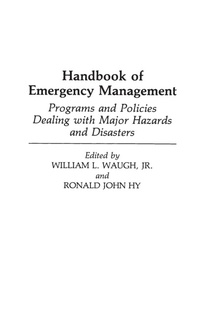
Handbook of Emergency Management
Programs and Policies Dealing with Major Hazards and Disasters
Published on 11. December 1990
Book
Hardback
352 pages
978-0-313-25691-2 (ISBN)
Description
During the 1980's, many Americans participated directly and indirectly in the drama and tragedy of major catastrophes, from volcanic eruptions to air crashes, closing the decade with the devastating Exxon Valdez oil spill, Hurricane Hugo, and the San Francisco earthquake. The objective of this volume is to examine how we have addressed some of the major hazards and, to the extent possible, assess the effectiveness of these efforts. This volume inventories and evaluates the major programs and policies designed to deal with the most common and destructive natural and man-made disasters, dividing them into four categories: mitigation, preparedness, response, and recovery. Disaster-types included in the handbook are earthquakes, volcanoes, hurricanes, floods, tornadoes, fires, droughts, hazardous materials accidents, nuclear facility accidents, structural failures, and transportation accidents. Following the analyses of specific disaster-types, the book considers the utility of all-hazard programs, such as the Federal Emergency Management Agency's Integrated Emergency Management System and documents the status of present emergency management efforts in the United States. A list of emergency management organizations is also included.
Each disaster-type is evaluated in terms of the frequency of occurrence, potential for property loss and human casualties, predictability of events, and the history of such disasters in the United States. In addition to analyzing the disasters themselves, the book outlines the development of emergency management efforts by federal, state, and local governments; the major problems in designing policy to respond to the specific risks and hazards, as well as some of the major policy alternatives. The analyses address questions of issue salience, levels of program funding, and technical problems. Due to the wide variety of responses at the state and local levels, the primary focus is on federal emergency management program. This book will serve students, officials, and academic researchers by providing an overview of the major emergency management program areas. The addition of graphs, tables, and maps will assist nonspecialists in understanding the nature of the disasters and risks being discussed.
Each disaster-type is evaluated in terms of the frequency of occurrence, potential for property loss and human casualties, predictability of events, and the history of such disasters in the United States. In addition to analyzing the disasters themselves, the book outlines the development of emergency management efforts by federal, state, and local governments; the major problems in designing policy to respond to the specific risks and hazards, as well as some of the major policy alternatives. The analyses address questions of issue salience, levels of program funding, and technical problems. Due to the wide variety of responses at the state and local levels, the primary focus is on federal emergency management program. This book will serve students, officials, and academic researchers by providing an overview of the major emergency management program areas. The addition of graphs, tables, and maps will assist nonspecialists in understanding the nature of the disasters and risks being discussed.
More details
Language
English
Place of publication
United States
Publishing group
Bloomsbury Publishing Plc
Target group
College/higher education
Dimensions
Height: 240 mm
Width: 161 mm
Thickness: 23 mm
Weight
690 gr
ISBN-13
978-0-313-25691-2 (9780313256912)
Copyright in bibliographic data and cover images is held by Nielsen Book Services Limited or by the publishers or by their respective licensors: all rights reserved.
Schweitzer Classification
Persons
WILLIAM L. WAUGH, JR., is Associate Professor of Public Administration and Political Science at Georgia State University. He is the author of International Terrorism: How Nations Respond to Terrorists, Terrorism and Emergency Management, and is the coeditor of Cities and Disaster: North American Studies in Emergency Management, and Antiterrorism Policies(forthcoming). In addition, he is the editor of Emergency Management Dispatch.
RONALD JOHN HY is Director of the Division of Governmental Studies and Professor of Public Administration at the Universtiy of Arkansas at Little Rock. He is the author of Financial Management for Health Care Administrators (Quorum Books, 1989) and the coauthor of Research Methods and Statistics. He has also written numerous articles, reports, and chapters in books.
RONALD JOHN HY is Director of the Division of Governmental Studies and Professor of Public Administration at the Universtiy of Arkansas at Little Rock. He is the author of Financial Management for Health Care Administrators (Quorum Books, 1989) and the coauthor of Research Methods and Statistics. He has also written numerous articles, reports, and chapters in books.
Content
Preface Introduction to Emergency Management by William L. Waugh, Jr., and Ronald John Hy The Function of Emergency Management by Ronald John Hy and William L. Waugh, Jr. Earthquakes by Richard T. Sylves Volcanic Hazards by William L. Waugh, Jr. Hurricanes by William L. Waugh, Jr. Floods by Beverly A. Cigler and Raymond J. Burby Tornadoes by Loran B. Smith and David T. Jervis Wildfire Hazards by Diane Moskow-McKenzie and John C. Freemuth Drought by Donald A. Wilhite Hazardous Material Transport Accidents by and Jeanette M. Trauth and Thomas J. Pavlak Nuclear Emergencies by Joan Aron Air Disasters by Margaret Baty Structural Failures by Ronald John Hy Public Health Emergencies by Caffilene Allen Civil Defense by Loran B. Smith The Utility of All-Hazard Programs by William L. Waugh, Jr., and Ronald John Hy Selected Bibliography Emergency Management Organizations and Information Sources Index