

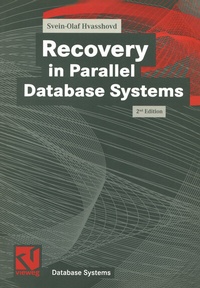
Recovery in Parallel Database Systems
2nd Edition
Published on 29. September 1999
Book
Paperback/Softback
XX, 302 pages
978-3-528-15411-0 (ISBN)
Description
The relational DBMS technology is a success in the commercial market. This success has led to the use of DBMS technology in application environments requesting their traditional virtues but at the same time adding new requirements such as: Very high transaction rates, real-time transaction response, and continuous availability. New multi-processor hardware architectures lay the foundation making it possible to meet these requirements. This book presents and analysis in a systematic way the main recovery approaches for centralised DBMSs developed over the last two decades, in particular to how well they fulfil the requirements for availability and soft real-time response. The analysis relates specifically to approaches used in current commercial and research systems. The element in particular lacking in the current methods is the ability to on-line re-establish the faulttolerance level automatically and without blocking. A set of novel recovery methods for parallel DBM's based on multi-computer shared nothing hardware is presented. The recovery methods are intended to support: Continuously available transaction services, very high transaction loads, and soft real-time transaction response. Dieses Buch gibt einen guten, systematisch gegliederten Einblick in die maßgeblichen Methoden des Recovery ("Wiederherstellung"), eines der wichtigsten Themen im Bereich des Handlings großer Datenbanksysteme. Dabei geht es darum, wie die Verfügbarkeit korrekter Daten gewährleistet sowie Transaktionen und Änderungen von Daten hinsichtlich Echtzeit möglichst optimal bewerkstelligt werden können. Behandelt werden sowohl kommerzielle wie auch in der Forschung verwandte parallele Systeme.
More details
Series
Edition
2. Auflage 1999
Language
German
Place of publication
Wiesbaden
Germany
Publishing group
Vieweg & Teubner
Target group
Upper undergraduate
Illustrations
46 s/w Abbildungen
XX, 302 S. 46 Abb.
Dimensions
Height: 244 mm
Width: 170 mm
Thickness: 18 mm
Weight
568 gr
ISBN-13
978-3-528-15411-0 (9783528154110)
DOI
10.1007/978-3-322-91534-4
Schweitzer Classification
Other editions
Additional editions
Svein-Olaf Hvasshovd
Recovery in Parallel Database Systems
E-Book
11/2013
2nd Edition
Vieweg+Teubner Verlag
€49.99
Available for download
Previous edition
Svein-Olaf Hvasshovd
Recovery in Parallel Database Systems
Book
02/1996
Vieweg+Teubner Verlag
€49.95
Article exhausted; check for reprint
Person
Dr.-Ing. Svein-Olaf Hvasshovd wurde 1954 in Norwegen geboren. Er ist forschender Wissenschaftler bei SINTEF, DELAB in Tronheim, Norwegen.
Dr. Ing. Svein-Olaf Hvasshovd, born 1954 in Kongsberg, Norway, is working as Research Scientist in Trondheim, Norway.
Dr. Ing. Svein-Olaf Hvasshovd, born 1954 in Kongsberg, Norway, is working as Research Scientist in Trondheim, Norway.
Content
I Introduction.- 1 A Continuously Available, High Transaction Capacity, Soft Real-Time DBMS Server.- 2 DBMS Recovery Requirements.- II Analysis of Centralised DBMS Transaction and Node Crash Recovery Approaches.- 3 Introduction.- 4 The Block Oriented Approach.- 5 The Record Oriented Approach.- 6 The Compensation Oriented Approach.- 7 The Table Oriented Approach.- III The HypRa Recovery Approach.- 8 Introduction.- 9 The Hardware and Basic Software Design.- 10 The HypRa DBMS Server Software Design.- 11 The Location and Replication Independent Tuple Recovery Strategy.- 12 The Log Distribution Strategy.- 13 The Neighbour Write-Ahead Logging Strategy.- 14 The Recovery Strategies.- IV Other High Availability DBMS Approaches.- 15 High Availability Approaches.- 16 Shared Disc Approaches.- 17 Shared-Nothing Approaches.- V Conclusion and Future Work.- 18 Conclusion.- 19 Future Work.- VI Appendices.- A Basic Concepts.- A.1 Datamodel, Database, and Database Management System Concepts.- A.2 Distributed Database Concepts.- A.3 The DBMS Mapping Architecture.- A.4 The Table Datamodel.- A.5 Table Datamodel Operations.- A.6 The Record Datamodel.- A.7 The Block Datamodel.- A.8 The Transaction Model.- A.9 Concurrency Control Concepts.