

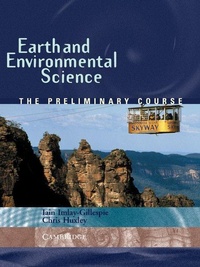
Earth and Environmental Science: The Preliminary Course
The Preliminary Course
Published on 13. June 2002
Book
Paperback/Softback
274 pages
978-0-521-89020-5 (ISBN)
Description
Earth and Environmental Science uses global and Australian contexts to explore interactions between humans and the environments they inhabit. Beautiful in design and practical in layout, students are provided with a comprehensive and thorough understanding of environmental science and human impact.
More details
Language
English
Place of publication
Cambridge
United Kingdom
Target group
Primary & secondary/elementary & high school
Interest Age: From 14 to 16 years
Product notice
Paperback (trade)
Illustrations
Worked examples or Exercises; 50 Tables, unspecified; 30 Maps; 35 Halftones, unspecified; 140 Line drawings, unspecified
Dimensions
Height: 280 mm
Width: 216 mm
Thickness: 15 mm
Weight
697 gr
ISBN-13
978-0-521-89020-5 (9780521890205)
Copyright in bibliographic data and cover images is held by Nielsen Book Services Limited or by the publishers or by their respective licensors: all rights reserved.
Schweitzer Classification
Persons
Iain Imlay- Gillespie has taught science and environmental science at all levels in NSW and overseas and is currently head of science at Nagle College, Blacktown. He has extensive experience as an examiner, marker and curriculum developer. Chris Huxley has had wide experience in teaching all branches of science at the senior level. He is currently Head of Science at Blue Mountains Grammar, and has been an examiner, marker and curriculum designer.
Content
Introduction; Part I. Planet Earth and its Environment: 1. Observing our universe; 2. The origin of the universe; 3. The Sun and the solar system; 4. The early Earth and its atmosphere; 5. The early Earth and the start of life; Part II. Dynamic Earth: 6. Dating rocks and other materials; 7. Plate movements; 8. Magnetism and the wandering poles; 9. Tectonic forces; Part III. The Local Environment: 10. The local environment as a system; 11. The elements of lithosphere and landscape; 12. Soils - features and formations; 13. Adaptations and survival in disturbed habitats; 14. Human impacts on the environment; 15. Balancing development and conservation; 16. Biodiversity; Part IV. Water Issues: 17. Water movements on the Earth; 18. Water and Australian environments; 19. Water and weathering; 20. Water resources - past and present; Part V. Effective Research: Answering and asking questions; Glossary; Index.