

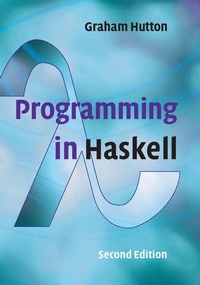
Programming in Haskell
2nd Edition
Published on 1. September 2016
Book
Paperback/Softback
318 pages
978-1-316-62622-1 (ISBN)
Description
Haskell is a purely functional language that allows programmers to rapidly develop clear, concise, and correct software. The language has grown in popularity in recent years, both in teaching and in industry. This book is based on the author's experience of teaching Haskell for more than twenty years. All concepts are explained from first principles and no programming experience is required, making this book accessible to a broad spectrum of readers. While Part I focuses on basic concepts, Part II introduces the reader to more advanced topics. This new edition has been extensively updated and expanded to include recent and more advanced features of Haskell, new examples and exercises, selected solutions, and freely downloadable lecture slides and example code. The presentation is clean and simple, while also being fully compliant with the latest version of the language, including recent changes concerning applicative, monadic, foldable, and traversable types.
Reviews / Votes
'The skills you acquire by studying this book will make you a much better programmer no matter what language you use to actually program in.' Erik Meijer, Facebook, from the Foreword Review of previous edition: 'The best introduction to Haskell available. There are many paths towards becoming comfortable and competent with the language but I think studying this book is the quickest path. I urge readers of this magazine to recommend Programming in Haskell to anyone who has been thinking about learning the language.' Duncan Coutts, The Monad.Reader Review of previous edition: 'Where this book excels is in the order and style of its exposition ... With its ripe selection of examples and its careful clarity of exposition, the book is a welcome addition to the introductory functional programming literature.' Journal of Functional ProgrammingMore details
Edition
2nd Revised edition
Language
English
Place of publication
Cambridge
United Kingdom
Target group
College/higher education
Professional and scholarly
Academic/professional/technical: Research and professional
Edition type
Revised edition
Product notice
Paperback (trade)
Illustrations
Worked examples or Exercises; 1 Line drawings, black and white
Dimensions
Height: 244 mm
Width: 170 mm
Thickness: 17 mm
Weight
584 gr
ISBN-13
978-1-316-62622-1 (9781316626221)
Copyright in bibliographic data and cover images is held by Nielsen Book Services Limited or by the publishers or by their respective licensors: all rights reserved.
Schweitzer Classification
Other editions
Additional editions
Graham Hutton
Programming in Haskell
E-Book
09/2016
Cambridge University Press
€30.49
Available for download
Graham Hutton
Programming in Haskell
E-Book
08/2016
2nd Edition
Cambridge University Press
€36.99
Available for download
Previous edition
Graham Hutton
Programming in Haskell
Book
01/2007
Cambridge University Press
€82.94
Article exhausted; check for reprint
Person
Graham Hutton is Professor of Computer Science at the University of Nottingham. He has taught Haskell to thousands of students and received numerous best lecturer awards. Hutton has served as an editor of the Journal of Functional Programming, Chair of the Haskell Symposium and the International Conference on Functional Programming, and Vice-Chair of the Association for Computing Machinery (ACM) Special Interest Group on Programming Languages, and is an ACM Distinguished Scientist.
Content
Foreword; Preface; Part I. Basic Concepts: 1. Introduction; 2. First steps; 3. Types and classes; 4. Defining functions; 5. List comprehensions; 6. Recursive functions; 7. Higher-order functions; 8. Declaring types and classes; 9. The countdown problem; Part II. Going Further: 10. Interactive programming; 11. Unbeatable tic-tac-toe; 12. Monads and more; 13. Monadic parsing; 14. Foldables and friends; 15. Lazy evaluation; 16. Reasoning about programs; 17. Calculating compilers; Appendix A. Selected solutions; Appendix B. Standard prelude; Bibliography; Index.