

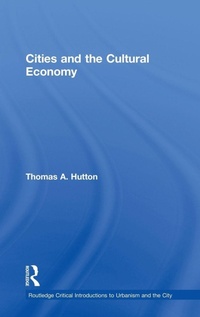
Cities and the Cultural Economy
1st Edition
Published on 10. September 2015
Book
Hardback
380 pages
978-0-415-62408-4 (ISBN)
Description
The cultural economy forms a leading trajectory of urban development, and has emerged as a key facet of globalizing cities. Cultural industries include new media, digital arts, music and film, and the design industries and professions, as well as allied consumption and spectacle in the city. The cultural economy now represents the third-largest sector in many metropolitan cities of the West including London, Berlin, New York, San Francisco, and Melbourne, and is increasingly influential in the development of East Asian cities (Tokyo, Shanghai, Hong Kong and Singapore), as well as the mega-cities of the Global South (e.g. Mumbai, Capetown, and Sao Paulo).
Cities and the Cultural Economy provides a critical integration of the burgeoning research and policy literatures in one of the most prominent sub-fields of contemporary urban studies. Policies for cultural economy are increasingly evident within planning, development and place-marketing programs, requiring large resource commitments, but producing - on the evidence - highly uneven results. Accordingly the volume includes a critical review of how the new cultural economy is reshaping urban labour, housing and property markets, contributing to gentrification and to 'precarious employment' formation, as well as to broadly favorable outcomes, such as community regeneration and urban vitality.
The volume acknowledges the important growth dynamics and sustainability of key creative industries. Written primarily as a text for upper-level undergraduate and Masters students in urban, economic and social geography; sociology; cultural studies; and planning, this provocative and compelling text will also be of interest to those studying urban land economics, architecture, landscape architecture and the built environment.
Cities and the Cultural Economy provides a critical integration of the burgeoning research and policy literatures in one of the most prominent sub-fields of contemporary urban studies. Policies for cultural economy are increasingly evident within planning, development and place-marketing programs, requiring large resource commitments, but producing - on the evidence - highly uneven results. Accordingly the volume includes a critical review of how the new cultural economy is reshaping urban labour, housing and property markets, contributing to gentrification and to 'precarious employment' formation, as well as to broadly favorable outcomes, such as community regeneration and urban vitality.
The volume acknowledges the important growth dynamics and sustainability of key creative industries. Written primarily as a text for upper-level undergraduate and Masters students in urban, economic and social geography; sociology; cultural studies; and planning, this provocative and compelling text will also be of interest to those studying urban land economics, architecture, landscape architecture and the built environment.
Reviews / Votes
A great textbook is one where the author skillfully brings together the major issues, key texts in the field, and important case examples and weaves this together with a masterful commentary. Tom Hutton has done just that, bringing his research expertise in North American, European and Asian cities to bear in this highly useful volume.Professor K.C. Ho, National University of Singapore
In its ceaseless quest to profit by disinvesting in some places and re-investing in others, the built environment industry (developers, banks, city governments, real estate agents) intentionally disrupts communities in favour of moneyed residents and profitable businesses, often riding demographic upheavals. Hutton demonstrates how these placemakers prey upon cultural work and trends using case studies from Europe, North America and Asia, integrating masterfully a relatively new and exploding literature.
Professor Ann Markusen, Director of the Arts Economy Initiative, University of Minnesota, USA
Shorn of the celebratory 'creative city' boosterism, this book provides us with a much needed solid foundation, pulling together seminal texts and a wealth of case study material, from which to apprehend one of the most striking trends in cities in recent times: the growth of the cultural economy.
Professor Andy C Pratt, Professor of Cultural Economy, City University London, UK
More details
Series
Language
English
Place of publication
London
United Kingdom
Publishing group
Taylor & Francis Ltd
Target group
College/higher education
Postgraduate and Undergraduate
Illustrations
66 s/w Abbildungen, 39 s/w Photographien bzw. Rasterbilder, 27 s/w Zeichnungen, 4 s/w Tabellen
4 Tables, black and white; 27 Line drawings, black and white; 39 Halftones, black and white; 66 Illustrations, black and white
Dimensions
Height: 240 mm
Width: 161 mm
Thickness: 26 mm
Weight
766 gr
ISBN-13
978-0-415-62408-4 (9780415624084)
Copyright in bibliographic data and cover images is held by Nielsen Book Services Limited or by the publishers or by their respective licensors: all rights reserved.
Schweitzer Classification
Other editions
Additional editions
Thomas A. Hutton
Cities and the Cultural Economy
Book
09/2015
1st Edition
Routledge
€62.00
Shipment within 15-20 days
Thomas A. Hutton
Cities and the Cultural Economy
E-Book
08/2015
Routledge
€64.49
Available for download
Thomas A. Hutton
Cities and the Cultural Economy
E-Book
08/2015
Routledge
€64.49
Available for download
Person
Thomas A. Hutton is Professor of Urban Studies and City Planning in the Centre for Human Settlements, School of Community and Regional Planning, University of British Columbia, Canada. His research interests include new industry formation in the inner city and the role of service industries in urban transformation within the Asia-Pacific.
Content
1. Introduction - Cities and the New Cultural Economy 2. The New Cultural Economy and Globalizing Cities 3. The Political Economy of Culture: Governance and Agency 4. The Cultural Economy and the Urban Labour Market 5. The Cultural Economy, Urban Housing Markets and Gentrification 6. Space and Place: Cultural Quarters as the 'new' new industrial district? 7. Assessing the Policy Record in the New Cultural Economy 8. Conclusion: Critical Reflections on Theory and Practice