

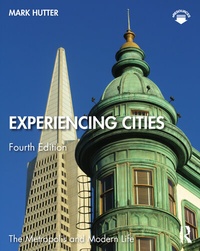
Experiencing Cities
4th Edition
Published on 22. October 2020
Book
Paperback/Softback
626 pages
978-0-367-21807-2 (ISBN)
Description
The fourth edition of Mark Hutter's Experiencing Cities examines cities and larger metropolitan areas within a truly global framework, lending readers much to understand and appreciate about the variety of urban structures and processes and their effect on the everyday lives of people residing in cities.
Beginning with the emergence of the first urban centers and continuing to examine the present day and the future of smart cities, this book explores the changing cultural and domestic character of the metropolis and offers readers a complete historical and theoretical overview of municipal life. The new edition seamlessly integrates issues of gender, race, ethnicity, sexuality, and class in its examination of city and suburban life, and further extends the Chicago School of Sociology perspective by combining its traditions with a distinct social psychological orientation derived from symbolic interaction and macro-level examination of social organization, social change, and power in the urban context.
With this strong and sweeping interdisciplinary approach, the new edition of Experiencing Cities will continue to enrich students' understandings of urban life and offer new, forward-looking perspective to those working in the fields of urban sociology, history, politics, geography, and the arts.
Beginning with the emergence of the first urban centers and continuing to examine the present day and the future of smart cities, this book explores the changing cultural and domestic character of the metropolis and offers readers a complete historical and theoretical overview of municipal life. The new edition seamlessly integrates issues of gender, race, ethnicity, sexuality, and class in its examination of city and suburban life, and further extends the Chicago School of Sociology perspective by combining its traditions with a distinct social psychological orientation derived from symbolic interaction and macro-level examination of social organization, social change, and power in the urban context.
With this strong and sweeping interdisciplinary approach, the new edition of Experiencing Cities will continue to enrich students' understandings of urban life and offer new, forward-looking perspective to those working in the fields of urban sociology, history, politics, geography, and the arts.
Reviews / Votes
"Hutter's Experiencing Cities provides an excellent introduction to the study of cities and urban life using the sociological perspective. He connects micro-level analysis on how people experience cities with the macro-level analysis of how and why cities were built and the conditions that structure urban residents' daily lives past and present. Importantly, in his analysis, public spaces are not merely spaces for social interaction but instead structure social interaction and are a part of who we are as individuals and as members of different communities as we live and experience city life."Connie Robinson is Senior Lecturer at the Department of Sociology, Central Washington University
Updated with new statistics, references, and studies, Experiencing Cities keeps the best of previous editions, with a focus on both the macro and micro of city development and social life. Coverage of topics is excellent, with both Classical Urban Sociology (Chicago School) and newer theories given through treatment. In my view, this textbook is still one of the best on the market today.
Richard Adams, Professor and Chair at the Department of Sociology, Kent State University
From the industrial to the post-industrial era, the material conditions to the non-material imagery, and classical urban theory to more contemporary treatments, this text brims with sociological knowledge on the city. Hutter has once again written a go-to learning tool and reference for students.
Richard E. Ocejo, Associate Professor of Sociology at John Jay College and the Graduate Center, CUNY
In this latest edition of Experiencing Cities, Hutter offers an engaging view of city life that invites the reader to experience familiar cities in new ways and travel to distant ones. Hutter understands urbanism through a sociological perspective that examines urban development as a dynamic interplay between political and economic forces and social and individual experiences of city life.
Michele Wakin, Center for Urban Poverty at Bridgewater State University
More details
Series
Edition
4th edition
Language
English
Place of publication
London
United Kingdom
Publishing group
Taylor & Francis Ltd
Target group
College/higher education
Illustrations
248 s/w Abbildungen, 2 s/w Zeichnungen, 12 s/w Tabellen
12 Tables, black and white; 2 Line drawings, black and white; 248 Illustrations, black and white
Dimensions
Height: 235 mm
Width: 187 mm
Weight
1160 gr
ISBN-13
978-0-367-21807-2 (9780367218072)
Copyright in bibliographic data and cover images is held by Nielsen Book Services Limited or by the publishers or by their respective licensors: all rights reserved.
Schweitzer Classification
Other editions
Additional editions
Previous edition
Person
Mark Hutter is Professor of Sociology and Anthropology at Rowan University, Glassboro, New Jersey, USA.
Content
Preface Part One: Historical Developments 1 . Introduction to Experiencing Cities 2 . The Emergence of Cities 3. The Industrial Revolution and the Rise of Urban Sociology Part Two: Disciplinary Perspectives 4 . Chicago School: Urbanism and Urban Ecology 5. Urban Planning 6 . Urban Political Economy, the New Urban Sociology, and the Power of Place Part Three: City Imagery 7 . City Imagery 8. The Skyscraper as Icon Part Four. The Social Psychology of City Life 9. Experiencing Strangers and the Quest for Public Order 10. "Seeing" Disorder and the Ecology of Fear Part Five: City People and Places 11 . Urban Communities and Social Policies 12. Families, Gender, and Singles in the City 13. The Consumer City: Shopping and Sports Part Six: The Urban World 14. American Suburbanization Patterns 15 . Social Capital and Healthy Places 16. Experiencing Cities Globally