

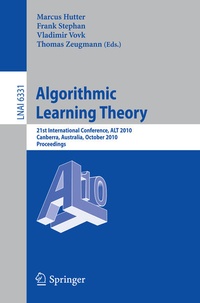
Algorithmic Learning Theory
21st International Conference, ALT 2010, Canberra, Australia, October 6-8, 2010. Proceedings
1st Edition
Published on 27. September 2010
Book
Paperback/Softback
XIII, 421 pages
978-3-642-16107-0 (ISBN)
Description
This volume contains the papers presented at the 21st International Conf- ence on Algorithmic Learning Theory (ALT 2010), which was held in Canberra, Australia, October 6-8, 2010. The conference was co-located with the 13th - ternational Conference on Discovery Science (DS 2010) and with the Machine Learning Summer School, which was held just before ALT 2010. The tech- cal program of ALT 2010, contained 26 papers selected from 44 submissions and ?ve invited talks. The invited talks were presented in joint sessions of both conferences. ALT 2010 was dedicated to the theoretical foundations of machine learning and took place on the campus of the Australian National University, Canberra, Australia. ALT provides a forum for high-quality talks with a strong theore- cal background and scienti?c interchange in areas such as inductive inference, universal prediction, teaching models, grammatical inference, formal languages, inductive logic programming, query learning, complexity of learning, on-line learning and relative loss bounds, semi-supervised and unsupervised learning, clustering,activelearning,statisticallearning,supportvectormachines,Vapnik- Chervonenkisdimension,probablyapproximatelycorrectlearning,Bayesianand causal networks, boosting and bagging, information-based methods, minimum descriptionlength,Kolmogorovcomplexity,kernels,graphlearning,decisiontree methods, Markov decision processes, reinforcement learning, and real-world - plications of algorithmic learning theory. DS 2010 was the 13th International Conference on Discovery Science and focused on the development and analysis of methods for intelligent data an- ysis, knowledge discovery and machine learning, as well as their application to scienti?c knowledge discovery. As is the tradition, it wasco-located and held in parallel with Algorithmic Learning Theory.
More details
Series
Language
English
Place of publication
Berlin
Germany
Publishing group
Springer Berlin
Target group
Professional and scholarly
Research
Illustrations
45 s/w Abbildungen
XIII, 421 p. 45 illus.
Dimensions
Height: 0 mm
Width: 0 mm
Weight
656 gr
ISBN-13
978-3-642-16107-0 (9783642161070)
DOI
10.1007/978-3-642-16108-7
Schweitzer Classification
Other editions
Additional editions
Marcus Hutter | Frank Stephan | Vladimir Vovk
Algorithmic Learning Theory
21st International Conference, ALT 2010, Canberra, Australia, October 6-8, 2010. Proceedings
E-Book
09/2010
Springer
€53.49
Available for download
Content
Editors' Introduction.- Editors' Introduction.- Invited Papers.- Towards General Algorithms for Grammatical Inference.- The Blessing and the Curse of the Multiplicative Updates.- Discovery of Abstract Concepts by a Robot.- Contrast Pattern Mining and Its Application for Building Robust Classifiers.- Optimal Online Prediction in Adversarial Environments.- Regular Contributions.- An Algorithm for Iterative Selection of Blocks of Features.- Bayesian Active Learning Using Arbitrary Binary Valued Queries.- Approximation Stability and Boosting.- A Spectral Approach for Probabilistic Grammatical Inference on Trees.- PageRank Optimization in Polynomial Time by Stochastic Shortest Path Reformulation.- Inferring Social Networks from Outbreaks.- Distribution-Dependent PAC-Bayes Priors.- PAC Learnability of a Concept Class under Non-atomic Measures: A Problem by Vidyasagar.- A PAC-Bayes Bound for Tailored Density Estimation.- Compressed Learning with Regular Concept.- A Lower Bound for Learning Distributions Generated by Probabilistic Automata.- Lower Bounds on Learning Random Structures with Statistical Queries.- Recursive Teaching Dimension, Learning Complexity, and Maximum Classes.- Toward a Classification of Finite Partial-Monitoring Games.- Switching Investments.- Prediction with Expert Advice under Discounted Loss.- A Regularization Approach to Metrical Task Systems.- Solutions to Open Questions for Non-U-Shaped Learning with Memory Limitations.- Learning without Coding.- Learning Figures with the Hausdorff Metric by Fractals.- Inductive Inference of Languages from Samplings.- Optimality Issues of Universal Greedy Agents with Static Priors.- Consistency of Feature Markov Processes.- Algorithms for Adversarial Bandit Problems with Multiple Plays.- Online Multiple KernelLearning: Algorithms and Mistake Bounds.- An Identity for Kernel Ridge Regression.