

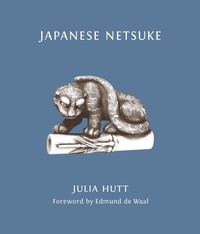
Japanese Netsuke
Published on 3. September 2019
Book
Paperback/Softback
112 pages
978-1-85177-922-2 (ISBN)
Description
'You will have a moment of quiet delight and a mood of introspection to carry you away.' Edmund de Waal.
Prized by collectors from East to West, Japanese netsuke are tiny objects of wonder that originated as utilitarian accessories for traditional Japanese dress. Over the centuries these small carved toggles, designed to hook over the top of the kimono sash, evolved into high-fashion depictions of all aspects of Japanese life.
In this richly illustrated and highly accessible book, Julia Hutt draws on the V&A's world-famous netsuke collection to explore the origins and techniques of this captivating art form.
Prized by collectors from East to West, Japanese netsuke are tiny objects of wonder that originated as utilitarian accessories for traditional Japanese dress. Over the centuries these small carved toggles, designed to hook over the top of the kimono sash, evolved into high-fashion depictions of all aspects of Japanese life.
In this richly illustrated and highly accessible book, Julia Hutt draws on the V&A's world-famous netsuke collection to explore the origins and techniques of this captivating art form.
More details
Language
English
Place of publication
London
United Kingdom
Illustrations
128 Illustrations
Dimensions
Height: 244 mm
Width: 210 mm
Thickness: 12 mm
Weight
465 gr
ISBN-13
978-1-85177-922-2 (9781851779222)
Copyright in bibliographic data and cover images is held by Nielsen Book Services Limited or by the publishers or by their respective licensors: all rights reserved.
Schweitzer Classification
Persons
Julia Hutt is Curator of Japanese Art in the Asian Department at the Victoria and Albert Museum.
Edmund de Waal is a world-renowned ceramics artist and author of The Hare with the Amber Eyes.
Edmund de Waal is a world-renowned ceramics artist and author of The Hare with the Amber Eyes.
Content
Foreword -- 1. Netsuke: An Introduction -- 2. Origins and Early Development of Netsuke -- 3. Function and Form of Netsuke -- 4. Materials, Techniques and Manufacture of Netsuke -- 5. Netsuke Subjects and Design Sources -- 6. Aspects of Dating Netsuke and Chronological Groupings -- 7. Netsuke Craftsmen and Centres of Production -- 8. Collecting Netsuke -- Chronologies -- Acknowledgements -- Glossary -- Select Bibliography -- Index