

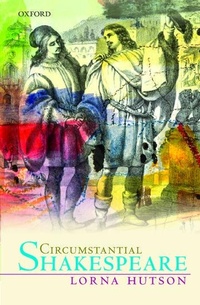
Circumstantial Shakespeare
Published on 15. October 2015
Book
Hardback
202 pages
978-0-19-965710-0 (ISBN)
Description
Shakespeare's characters are thought to be his greatest achievement--imaginatively autonomous, possessed of depth and individuality, while his plots are said to be second-hand and careless of details of time and place. . This view has survived the assaults of various literary theories and has even, surprisingly, been revitalized by the recent emphasis on the collaborative nature of early modern theatre. But belief in the autonomous imaginative life of Shakespeare's characters depends on another unexamined myth: the myth that Shakespeare rejected neoclassicism, playing freely with theatrical time and place. Circumstantial Shakespeare explodes these venerable critical commonplaces. Drawing on sixteenth-century rhetorical pedagogy, it reveals the importance of topics of circumstance (of Time, Place and Motive, etc.) in the conjuring of compelling narratives and vivid mental images. 'Circumstances'--which we now think of as incalculable contingencies--were originally topics of forensic inquiry into human intention or passion. In drawing on the Roman forensic tradition of circumstantial proof, Shakespeare did not ignore time and place. His brilliant innovation was to use the topics of circumstance to imply offstage actions, times and places in terms of the motives and desires we attribute to the characters. His plays thus create both their own vivid and coherent dramatic worlds and a sense of the unconscious feelings of characters inhabiting them.
Circumstantial Shakespeare offers new readings of Romeo and Juliet, King Lear, Lucrece, Two Gentlemen of Verona and Macbeth, as well as new interpretations of Sackville and Norton's Gorboduc and Beaumont and Fletcher's The Maid's Tragedy. It engages with eighteenth-century Shakespeare criticism, contemporary Shakespeare criticism, semiotics of theatre, Roman forensic rhetoric, humanist pedagogy, the prehistory of modern probability, psychoanalytic criticism and sixteenth-century constitutional thought.
Circumstantial Shakespeare offers new readings of Romeo and Juliet, King Lear, Lucrece, Two Gentlemen of Verona and Macbeth, as well as new interpretations of Sackville and Norton's Gorboduc and Beaumont and Fletcher's The Maid's Tragedy. It engages with eighteenth-century Shakespeare criticism, contemporary Shakespeare criticism, semiotics of theatre, Roman forensic rhetoric, humanist pedagogy, the prehistory of modern probability, psychoanalytic criticism and sixteenth-century constitutional thought.
Reviews / Votes
Hutson examines the subtle ways in which the language of the drama inflects sensory experience to produce vivid notions of happening. Arguing against the largely accepted critical commonplace that Shakespeare was disinterested in neo-classical expectations of time and place, Hutson shows how circumstances produced often very dense narratives of experience in which both time and place are clearly and carefully defined. * Charlotte Scott, Shakespeare Survey * In this highly original study ... Hutson raises the question of whether Shakespeare's fellow playwrights also used circumstances to compose "character" and "world." As we might expect, it is Jonson who most fully savors the inferential probabilities of the topics. Although she offers some observations regarding Marlowe's and Lyly's practices, and a fascinating analysis of the psychological and political reach of "how" and "where" in Beaumont and Fletcher's The Maid's Tragedy, these accounts, she admits, are just placeholders for future investigation. Given the vast erudition she manifests here, and her talent for ferreting out fresh meaning from familiar material, let us hope she will take up her own suggestion. * Joel B. Altman, Modern Philology * In this highly original study, Lorna Hutson makes a compelling case that Shakespeare fashioned the fully imagined worlds of his plays out of bits of language that Tudor grammar school students learned to insert in their orations and written compositions to render arguments coherent, probable, and vivid. * Joel B. Altman, Modern philology * ... a book that offers a genuinely new way to historicize what is at once the most distinctive and most elusive quality of Shakespeare's art: its almost uncanny ability to represent inner life ... Hutson is an expert in the art of scholarly argument. * Kevin Curran, Shakespeare Quarterly * Hutson's newest book, Circumstantial Shakespeare continues to refine her impressive insights about theatrical and legal culture in early modern England ... impressive [and] powerful. * Matthew Ritger, Los Angeles Review of Books * brilliant ... For such a slim volume, this punches above its weight in terms of the impact it will have on how we think about Shakespeare's artistry, and the rhetorical techniques that make words feel like lives. * Derek Dunne, Renaissance Studies * richly and compactly argued ... The implications of the thesis are far-reaching ... Written in an engaging, cerebral style by one of the foremost scholars of Renaissance humanism and theatre, Circumstantial Shakespeare urges a new perspective on Shakespeareas artistry. * William Weaver, Review of English Studies *More details
Series
Language
English
Place of publication
Oxford
United Kingdom
Target group
College/higher education
Product notice
sewn/stitched
Cloth over boards
Dimensions
Height: 198 mm
Width: 132 mm
Thickness: 15 mm
Weight
318 gr
ISBN-13
978-0-19-965710-0 (9780199657100)
Copyright in bibliographic data and cover images is held by Nielsen Book Services Limited or by the publishers or by their respective licensors: all rights reserved.
Schweitzer Classification
Other editions
Additional editions
Lorna Hutson
Circumstantial Shakespeare
Book
02/2018
Oxford University Press
€36.10
Shipment within 15-20 days
Lorna Hutson
Circumstantial Shakespeare
E-Book
10/2015
1st Edition
OUP eBook
€12.49
Available for download
Person
Lorna Hutson is the Merton Professor of English Literature at the University of Oxford. She was educated in San Francisco, Edinburgh and Oxford and has taught at Queen Mary, University of London and at the University of California at Berkeley. Her books include Thomas Nashe in Context (1989), The Usurer's Daughter (1994), Feminism and Renaissance Studies (1999), Rhetoric and Law in Early Modern Europe (with Victoria Kahn, 2001) and The Invention of Suspicion (2007), which won the Roland H. Bainton prize for literature in 2008. She has held fellowships from the Guggenheim, the Folger, the Huntington, the AHRC and the Leverhulme Trust.
Content
Introduction ; 1. 'Quando?' (When?) in Romeo and Juliet ; 2. 'Imaginary Work': Opportunity in Lucrece and in King Lear ; 3. Where and how? Two Gentlemen of Verona and The Maid's Tragedy ; 4. 'The Innocent Sleepe': Motive in Macbeth ; Conclusion