

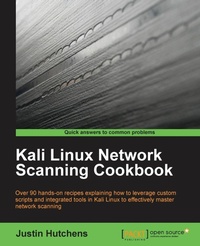
KALI LINUX NETWORK SCANNING COOKBOOK
Over 90 hands-on recipes explaining how to leverage custom scripts, and integrated tools in Kali Linux to effectively master network scanning
Published on 21. August 2014
Book
Paperback/Softback
452 pages
978-1-78398-214-1 (ISBN)
Description
Key Features
Book DescriptionKali Linux Network Scanning Cookbook is intended for information security professionals and casual security enthusiasts alike. It will provide the foundational principles for the novice reader but will also introduce scripting techniques and in-depth analysis for the more advanced audience. Whether you are brand new to Kali Linux or a seasoned veteran, this book will aid in both understanding and ultimately mastering many of the most powerful and useful scanning techniques in the industry. It is assumed that the reader has some basic security testing experience.What you will learn
Develop a networktesting environment that can be used to test scanning tools and techniques
Understand the underlying principles of network scanning technologies by building custom scripts and tools
Perform comprehensive scans to identify listening on TCP and UDP sockets
Examine remote services to identify type of service, vendor, and version
Evaluate denial of service threats and develop an understanding of how common denial of service attacks are performed
Identify distinct vulnerabilities in both web applications and remote services and understand the techniques that are used to exploit them
Who this book is for
Book DescriptionKali Linux Network Scanning Cookbook is intended for information security professionals and casual security enthusiasts alike. It will provide the foundational principles for the novice reader but will also introduce scripting techniques and in-depth analysis for the more advanced audience. Whether you are brand new to Kali Linux or a seasoned veteran, this book will aid in both understanding and ultimately mastering many of the most powerful and useful scanning techniques in the industry. It is assumed that the reader has some basic security testing experience.What you will learn
Develop a networktesting environment that can be used to test scanning tools and techniques
Understand the underlying principles of network scanning technologies by building custom scripts and tools
Perform comprehensive scans to identify listening on TCP and UDP sockets
Examine remote services to identify type of service, vendor, and version
Evaluate denial of service threats and develop an understanding of how common denial of service attacks are performed
Identify distinct vulnerabilities in both web applications and remote services and understand the techniques that are used to exploit them
Who this book is for
More details
Language
English
Place of publication
Birmingham
United Kingdom
Target group
Professional and scholarly
US School Grade: College Graduate Student
Dimensions
Height: 235 mm
Width: 191 mm
Thickness: 25 mm
Weight
838 gr
ISBN-13
978-1-78398-214-1 (9781783982141)
Copyright in bibliographic data and cover images is held by Nielsen Book Services Limited or by the publishers or by their respective licensors: all rights reserved.
Schweitzer Classification
Other editions
Additional editions
Justin Hutchens
KALI LINUX NETWORK SCANNING COOKBOOK
Over 90 hands-on recipes explaining how to leverage custom scripts, and integrated tools in Kali Linux to effectively master network scanning
E-Book
10/2025
Packt Publishing
from
€43.19
Available for download
Person
Justin Hutchens currently works as an intrusion detection specialist, network vulnerability analyst and malware forensic investigator for a large enterprise network with over 55,000 networked systems. He has filled numerous different roles in the Information Technology field to include network design, system development, database administration and network security. He has previously written articles on forensic analysis and ethical hacking and has been published in both eForensics Magazine and Hakin9 Magazine. He currently holds a Bachelor's degree in Information Technology and multiple professional information security certifications, to include OSCP (Offensive Security Certified Professional), CISSP (Certified Information Systems Security Professional), CNDA (Certified Network Defense Architect), CEH (Certified Ethical Hacker), ECSA (EC-Council Certified Security Analyst) and CHFI (Computer Hacking Forensic Investigator).
Content
Table of Contents
Introduction
Discovery Scanning
TCP Scanning
Service / OS Identification
Network Reconnaissance
Service Vulnerability Mapping
Web-Application Vulnerability Mapping
Automating Industry Tools
Introduction
Discovery Scanning
TCP Scanning
Service / OS Identification
Network Reconnaissance
Service Vulnerability Mapping
Web-Application Vulnerability Mapping
Automating Industry Tools