

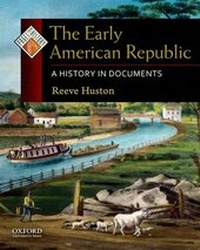
The Early American Republic
A History in Documents
Published on 9. January 2014
Book
Hardback
256 pages
978-0-19-510812-5 (ISBN)
Description
The early years of the American republic witnessed wrenching conflict and change. Northerners created an industrial order, which brought with it troubled relationships at work and within families. White southerners extended plantation slavery while the anti-slavery movement grew above the Mason-Dixon line. In the West, Native Americans battled newly arrived yeomen, entrepreneurs, and planters for control over land. Throughout the young nation numerous groups--African Americans, poor white men, women--fought for full citizenship, while others vigorously opposed their bids for equality. The Mexican-American War (1846-1848) marked the end of the period with violence that prefigured the Civil War.
Using such primary sources as diaries, letters, political cartoons, photographs, speeches, engravings, newspaper debates, paintings, and the memoirs of participants, The Early American Republic: A History in Documents recreates the drama of that era. Englishwoman Rebecca Burlend recounts the hardships and victories of her life on the Illinois frontier. In a letter to an ally, Thomas Jefferson explains his Indian policy, while the Native American leader Tecumseh makes his case for Indian unity against white Americans. James Henry Hammond, a wealthy planter, instructs his overseer on how to manage slaves, and Joseph Taper writes his former master about the freedom he enjoys after escaping to Canada. A blackface minstrel tune and Frederick Douglass's account of being beaten up by white ship workers illustrate the emergence of a virulent form of racism. A list of instructions from New York Democratic leaders shows how parties drew ordinary voters into politics, and Congressional speeches reveal the fierce emotions that fueled the sectional crisis. A picture essay explores the complexities of American families in ten group portraits. By weaving these historical documents together, Reeve Huston conveys the challenges and culture of the foundational years of the nation.
Using such primary sources as diaries, letters, political cartoons, photographs, speeches, engravings, newspaper debates, paintings, and the memoirs of participants, The Early American Republic: A History in Documents recreates the drama of that era. Englishwoman Rebecca Burlend recounts the hardships and victories of her life on the Illinois frontier. In a letter to an ally, Thomas Jefferson explains his Indian policy, while the Native American leader Tecumseh makes his case for Indian unity against white Americans. James Henry Hammond, a wealthy planter, instructs his overseer on how to manage slaves, and Joseph Taper writes his former master about the freedom he enjoys after escaping to Canada. A blackface minstrel tune and Frederick Douglass's account of being beaten up by white ship workers illustrate the emergence of a virulent form of racism. A list of instructions from New York Democratic leaders shows how parties drew ordinary voters into politics, and Congressional speeches reveal the fierce emotions that fueled the sectional crisis. A picture essay explores the complexities of American families in ten group portraits. By weaving these historical documents together, Reeve Huston conveys the challenges and culture of the foundational years of the nation.
More details
Series
Language
English
Place of publication
New York
United States
Illustrations
107 b/w halftones
Dimensions
Height: 208 mm
Width: 262 mm
Thickness: 18 mm
Weight
808 gr
ISBN-13
978-0-19-510812-5 (9780195108125)
Copyright in bibliographic data and cover images is held by Nielsen Book Services Limited or by the publishers or by their respective licensors: all rights reserved.
Schweitzer Classification
Other editions
Additional editions
Book
10/2010
Oxford University Press Inc
€73.30
Shipment within 15-20 days
Person
Reeve Huston is Associate Professor of History at Duke University. He is the author of Land and Freedom: Rural Society, Popular Protest, and Party Politics in Antebellum New York (OUP, 2002), which was the winner of the 2001 Theodore Saloutos Prize of the Agricultural History Society and the New York State Historical Association's 1999 Dixon Ryan Fox Manuscript Prize.
Content
What Is a Document? ; How to Read a Document ; Introduction ; Note on Sources and Interpretation ; Chapter 1: The People Rule, But Who Are the People? ; The Founders' Social Vision ; Poor White Men's Bid for Equality ; Middle- and Upper-Class Women's Bid for Intellectual Equality ; The Attack on Slavery ; Chapter 2: Creating a Political Order ; The Federalists' Political Vision ; An Elite Opposition Emerges ; A Popular Opposition Emerges ; The Clash of Parties ; President Jefferson ; Chapter 3: Expanding the National Territory ; Acquiring the Land ; Indians, White Settlers, and the Federal Government ; Squatters and the Federal Government ; Life in the Western Farm Settlements ; Expanding Slavery ; Beyond the Mississippi ; Chapter 4: The Transformation of the North ; Before the Industrial Revolution ; Economic Innovators ; Religious Innovators ; Innovators in Family Life ; A New World of Wage Labor ; Origins of the American Labor Movement ; The Beginnings of Mass Immigration ; Chapter 5: Masters and Slaves ; The Struggle for Control ; The World of the Enslaved ; Resistance, Repression, and Rebellion ; Chapter 6: Picture Essay: Picturing Families ; Chapter 7: The Triumph of Partisan Democracy ; Creating a White Male Electorate ; Re-creating Party Politics ; Party Issues, Party Principles ; Politics without Parties ; Chapter 8: Race, Reform, and Sectional Conflict ; A New Anti-Slavery Movement ; The Re-emergence of American Feminism ; A Woman's Rights Movement Emerges ; Southern Leaders Defend Slavery ; Anti-Abolitionism and a New Racial Regime in the North ; Epilogue: Becoming a Continental Nation ; Refiguring American Nationalism ; Anglos and Mexicans in the Conquered Territories ; The Sectional Conflict Deepens ; Timeline ; Further Reading ; Websites ; Text Credits ; Picture Credits ; Index