

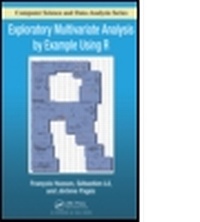
Exploratory Multivariate Analysis by Example Using R
1st Edition
Published on 15. November 2010
Book
Hardback
240 pages
978-1-4398-3580-7 (ISBN)
Description
Full of real-world case studies and practical advice, Exploratory Multivariate Analysis by Example Using R focuses on four fundamental methods of multivariate exploratory data analysis that are most suitable for applications. It covers principal component analysis (PCA) when variables are quantitative, correspondence analysis (CA) and multiple correspondence analysis (MCA) when variables are categorical, and hierarchical cluster analysis.
The authors take a geometric point of view that provides a unified vision for exploring multivariate data tables. Within this framework, they present the principles, indicators, and ways of representing and visualizing objects that are common to the exploratory methods. The authors show how to use categorical variables in a PCA context in which variables are quantitative, how to handle more than two categorical variables in a CA context in which there are originally two variables, and how to add quantitative variables in an MCA context in which variables are categorical. They also illustrate the methods and the ways they can be exploited using examples from various fields.
Throughout the text, each result correlates with an R command accessible in the FactoMineR package developed by the authors. All of the data sets and code are available at http://factominer.free.fr/book
By using the theory, examples, and software presented in this book, readers will be fully equipped to tackle real-life multivariate data.
The authors take a geometric point of view that provides a unified vision for exploring multivariate data tables. Within this framework, they present the principles, indicators, and ways of representing and visualizing objects that are common to the exploratory methods. The authors show how to use categorical variables in a PCA context in which variables are quantitative, how to handle more than two categorical variables in a CA context in which there are originally two variables, and how to add quantitative variables in an MCA context in which variables are categorical. They also illustrate the methods and the ways they can be exploited using examples from various fields.
Throughout the text, each result correlates with an R command accessible in the FactoMineR package developed by the authors. All of the data sets and code are available at http://factominer.free.fr/book
By using the theory, examples, and software presented in this book, readers will be fully equipped to tackle real-life multivariate data.
Reviews / Votes
Exploratory Multivariate Analysis by Example Using R provides a very good overview of the application of three multivariate analysis techniques ... There is a clear exposition of the use of [R] code throughout ... this book does not express the mathematical concepts in matrix form. This is clearly advantageous for those who are considering the book from an applied perspective. This, I think, is refreshing and is done well. ... I therefore recommend the book to those who are interested in an introduction to these multivariate techniques. ... the book does provide a solid starting point for those who are just starting out. ... definitely a book to have in one's ... library.-Eric J. Beh, Journal of Applied Statistics, June 2012
Its strength is its detailed advice on interpretation, in the context of varied examples. It is written in a pleasant and engaging style ... This text is a great source of worked examples and accompanying commentary.
-John H. Maindonald, International Statistical Review (2011), 79
It is an excellent book which I would strongly recommend as a secondary text, supporting or accompanying the main text for any advanced undergraduate or graduate course in multivariate analysis. ... this is a compact book with a plethora of visualizations teaching all subtleties of major data exploratory methods. It would supplement well any primary textbook in an advanced undergraduate or graduate course in multivariate analysis.
-MAA Reviews, July 2011
... a truly excellent [chapter] on clustering ... is an example of what upper-division undergraduate writing should aspire to. ... this enjoyable book and the FactoMineR package are highly recommended for an upper-division undergraduate or beginning graduate-level course in MVA. The acid test for such a work must be whether it is likely to spark an interest in students and prepare them adequately for more detailed, serious study of the subject and this book easily passes that test.
-Journal of Statistical Software, April 2011, Vol. 40
More details
Series
Language
English
Place of publication
Bosa Roca
United States
Publishing group
Taylor & Francis Inc
Target group
College/higher education
Practitioners and graduate students in statistics or who analyze data in other scientific disciplines, such as biology, epidemiology, economics, and the social sciences.
Illustrations
50 s/w Tabellen, 87 s/w Abbildungen
50 Tables, black and white; 87 Illustrations, black and white
Dimensions
Height: 235 mm
Width: 156 mm
Weight
499 gr
ISBN-13
978-1-4398-3580-7 (9781439835807)
Copyright in bibliographic data and cover images is held by Nielsen Book Services Limited or by the publishers or by their respective licensors: all rights reserved.
Schweitzer Classification
Other editions
New editions
Francois Husson | Sebastien Le | Jerome Pages
Exploratory Multivariate Analysis by Example Using R
Book
04/2017
2nd Edition
CRC Press
€155.90
Shipment within 10-20 days
Persons
Francois Husson is an assistant professor of statistics at Agrocampus Ouest in France. Sebastien Le is an assistant professor of statistics at Agrocampus Ouest in France. Jerome Pages is a professor of statistics and head of the applied mathematics department at Agrocampus Ouest in France.
They are all developers of the FactoMineR package dedicated to multivariate exploratory data analysis.
They are all developers of the FactoMineR package dedicated to multivariate exploratory data analysis.
Content
Principal Component Analysis (PCA)
Data - Notation - Examples
Objectives
Studying Individuals
Studying Variables
Relationships between the Two Representations NI and NK
Interpreting the Data
Implementation with FactoMineR
Additional Results
Example: The Decathlon Dataset
Example: The Temperature Dataset
Example of Genomic Data: The Chicken Dataset
Correspondence Analysis (CA)
Data - Notation - Examples
Objectives and the Independence Model
Fitting the Clouds
Interpreting the Data
Supplementary Elements (= Illustrative)
Implementation with FactoMineR
CA and Textual Data Processing
Example: The Olympic Games Dataset
Example: The White Wines Dataset
Example: The Causes of Mortality Dataset
Multiple Correspondence Analysis (MCA)
Data - Notation - Examples
Objectives
Defining Distances between Individuals and Distances between Categories
CA on the Indicator Matrix
Interpreting the Data
Implementation with FactoMineR
Addendum
Example: The Survey on the Perception of Genetically Modified Organisms
Example: The Sorting Task Dataset
Clustering
Data - Issues
Formalising the Notion of Similarity
Constructing an Indexed Hierarchy
Ward's Method
Direct Search for Partitions: K-means Algorithm
Partitioning and Hierarchical Clustering
Clustering and Principal Component Methods
Example: The Temperature Dataset
Example: The Tea Dataset
Dividing Quantitative Variables into Classes
Appendix
Percentage of Inertia Explained by the First Component or by the First Plane
R Software
Bibliography of Software Packages
Bibliography
Index
Data - Notation - Examples
Objectives
Studying Individuals
Studying Variables
Relationships between the Two Representations NI and NK
Interpreting the Data
Implementation with FactoMineR
Additional Results
Example: The Decathlon Dataset
Example: The Temperature Dataset
Example of Genomic Data: The Chicken Dataset
Correspondence Analysis (CA)
Data - Notation - Examples
Objectives and the Independence Model
Fitting the Clouds
Interpreting the Data
Supplementary Elements (= Illustrative)
Implementation with FactoMineR
CA and Textual Data Processing
Example: The Olympic Games Dataset
Example: The White Wines Dataset
Example: The Causes of Mortality Dataset
Multiple Correspondence Analysis (MCA)
Data - Notation - Examples
Objectives
Defining Distances between Individuals and Distances between Categories
CA on the Indicator Matrix
Interpreting the Data
Implementation with FactoMineR
Addendum
Example: The Survey on the Perception of Genetically Modified Organisms
Example: The Sorting Task Dataset
Clustering
Data - Issues
Formalising the Notion of Similarity
Constructing an Indexed Hierarchy
Ward's Method
Direct Search for Partitions: K-means Algorithm
Partitioning and Hierarchical Clustering
Clustering and Principal Component Methods
Example: The Temperature Dataset
Example: The Tea Dataset
Dividing Quantitative Variables into Classes
Appendix
Percentage of Inertia Explained by the First Component or by the First Plane
R Software
Bibliography of Software Packages
Bibliography
Index