

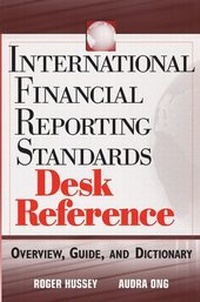
International Financial Reporting Standards Desk Reference
Overview, Guide, and Dictionary
Published on 1. April 2005
Book
Hardback
382 pages
978-0-471-71450-7 (ISBN)
Description
"This book is written by authors who clearly understand the challenges facing all who seek to understand and apply international standards. I recommend it to you."
--From the Foreword by Sir David Tweedie Chair of the International Accounting Standards Board
In this defining resource, authors Roger Hussey and Audra Ong have compiled everything accountants, executives, and organizations in different countries need to reach agreement on accounting rules and standards. International Financial Reporting Standards Desk Reference includes a background on how the movement toward a common language for international accounting evolved to its present state, summarizes existing standards highlighting the key issues covered, and captures those terms and phrases that are fundamental to an understanding of the common language of global business.
Written to help readers fully comprehend this global language, International Financial Reporting Standards Desk Reference includes:
* An overview of the International Accounting Standards (IAS) and Inter-national Financial Reporting Standards (IFRS) and their impact
* A dictionary of words and phrases used in the international business world, with a strong emphasis on terms used by the International Accounting Standards Board
* History of the International Accounting Standards Board: how it was formed, its structure, and the way it operates
* Insights on future trends of the International Accounting Standards Board
--From the Foreword by Sir David Tweedie Chair of the International Accounting Standards Board
In this defining resource, authors Roger Hussey and Audra Ong have compiled everything accountants, executives, and organizations in different countries need to reach agreement on accounting rules and standards. International Financial Reporting Standards Desk Reference includes a background on how the movement toward a common language for international accounting evolved to its present state, summarizes existing standards highlighting the key issues covered, and captures those terms and phrases that are fundamental to an understanding of the common language of global business.
Written to help readers fully comprehend this global language, International Financial Reporting Standards Desk Reference includes:
* An overview of the International Accounting Standards (IAS) and Inter-national Financial Reporting Standards (IFRS) and their impact
* A dictionary of words and phrases used in the international business world, with a strong emphasis on terms used by the International Accounting Standards Board
* History of the International Accounting Standards Board: how it was formed, its structure, and the way it operates
* Insights on future trends of the International Accounting Standards Board
Reviews / Votes
"...the authors have clearly met their quite ambitious objectives...serves as a valuable reference..." (International Accountant, July 2006)More details
Series
Edition
1. Auflage
Language
English
Place of publication
New York
United States
Publishing group
John Wiley and Sons Ltd
Target group
Professional and scholarly
Dimensions
Height: 23.6 cm
Width: 16.1 cm
Thickness: 3.5 cm
Weight
703 gr
ISBN-13
978-0-471-71450-7 (9780471714507)
Schweitzer Classification
Persons
ROGER HUSSEY, PhD, MSc, FCCA, is the Dean for the Odette School of Business at the University of Windsor, Canada. He has a PhD in financial communications and an MSc in industrial relations from University of Bath (U.K.). He is a Fellow of the Association of Chartered Certified Accountants (ACCA) and is Visiting Professor at Bristol Business School (U.K.) and Niagara University (U.S.). He has published extensively on financial reporting regulations and international accounting.
AUDRA ONG, PhD, MBA, BSc, is an accounting professor at the University of Windsor, Canada. She received her PhD in accounting from Bristol Business School (U.K.) and MBA and undergraduate degrees from the University of Wales, Cardiff, and the Queen's University of Belfast (U.K.), respectively. She has a Certificate in International Financial Reporting from the Association of Chartered Certified Accountants (ACCA) and has also published in professional and research journals.
AUDRA ONG, PhD, MBA, BSc, is an accounting professor at the University of Windsor, Canada. She received her PhD in accounting from Bristol Business School (U.K.) and MBA and undergraduate degrees from the University of Wales, Cardiff, and the Queen's University of Belfast (U.K.), respectively. She has a Certificate in International Financial Reporting from the Association of Chartered Certified Accountants (ACCA) and has also published in professional and research journals.
Content
FOREWORD.
PREFACE.
ACKNOWLEDGMENTS.
Part One: OVERVIEW: STANDARD SETTING NATIONALLY AND GLOBALLY.
CHAPTER 1: The Growth of National Standards.
Early Developments.
The Advent of Regulation.
CHAPTER 2: Developing International Accounting Standards.
The Emergence of National Similarities.
The Impetus for Global Standards.
The International Accounting Standards Committee.
CHAPTER 3: The International Accounting Standards Board.
Formation of the IASB.
Structure of the IASB.
Funding and Operation of the IASB.
Enforcement.
The Path to Convergence.
CHAPTER 4: Internationalization and the G4+1 Countries.
Introduction.
Australia and New Zealand.
Canada.
United Kingdom.
United States.
CHAPTER 5: Different Views of Convergence.
Introduction.
Japan.
Malaysia.
People's Republic of China.
Taiwan, Republic of China.
Islamic Finance and Standard Setting.
CHAPTER 6: Responding to Internationalization.
Progress and Problems.
Effects and Action.
CHAPTER 7: The Role of the Accountant.
The Ripple Effect.
The Main Changes.
The Link with Corporate Governance.
Final Check.
Bibliography.
Part Two: GUIDE TO INTERNATIONAL FINANCIAL REPORTING STANDARDS.
Introduction to the Guide.
Framework for the Preparation and Presentation of Financial Statements.
Summary of Individual Standards.
Part Three: DICTIONARY.
How to Use the Dictionary.
Dictionary.
APPENDIX A: List of Acronyms.
APPENDIX B: Accounting Standard Setting Bodies.
INDEX.
PREFACE.
ACKNOWLEDGMENTS.
Part One: OVERVIEW: STANDARD SETTING NATIONALLY AND GLOBALLY.
CHAPTER 1: The Growth of National Standards.
Early Developments.
The Advent of Regulation.
CHAPTER 2: Developing International Accounting Standards.
The Emergence of National Similarities.
The Impetus for Global Standards.
The International Accounting Standards Committee.
CHAPTER 3: The International Accounting Standards Board.
Formation of the IASB.
Structure of the IASB.
Funding and Operation of the IASB.
Enforcement.
The Path to Convergence.
CHAPTER 4: Internationalization and the G4+1 Countries.
Introduction.
Australia and New Zealand.
Canada.
United Kingdom.
United States.
CHAPTER 5: Different Views of Convergence.
Introduction.
Japan.
Malaysia.
People's Republic of China.
Taiwan, Republic of China.
Islamic Finance and Standard Setting.
CHAPTER 6: Responding to Internationalization.
Progress and Problems.
Effects and Action.
CHAPTER 7: The Role of the Accountant.
The Ripple Effect.
The Main Changes.
The Link with Corporate Governance.
Final Check.
Bibliography.
Part Two: GUIDE TO INTERNATIONAL FINANCIAL REPORTING STANDARDS.
Introduction to the Guide.
Framework for the Preparation and Presentation of Financial Statements.
Summary of Individual Standards.
Part Three: DICTIONARY.
How to Use the Dictionary.
Dictionary.
APPENDIX A: List of Acronyms.
APPENDIX B: Accounting Standard Setting Bodies.
INDEX.