

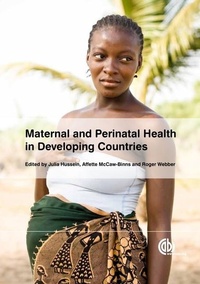
Maternal and Perinatal Health in Developing Countries
Published on 1. June 2012
Book
Hardback
256 pages
978-1-84593-745-4 (ISBN)
Description
The promotion of maternal health and mortality reduction is of worldwide importance, and constitutes a vital part of the UN Millennium Development Goals. The highest maternal mortality rates are in developing countries, where global and regional initiatives are needed to improve the systems and practices involved in maternal care and medical access. Taking a practical policy approach, this book covers the background and concepts underlying efforts to improve maternal and perinatal mortality, the current global situation and problems that prevent progress. It includes case studies and examples of successful strategies, recommends good practices, and provides a critical analysis of knowledge gaps to inform areas for future research.
More details
Language
English
Place of publication
Wallingford
United Kingdom
Target group
Professional and scholarly
College/higher education
Product notice
sewn/stitched
Cloth over boards
Dimensions
Height: 244 mm
Width: 173 mm
Thickness: 20 mm
Weight
726 gr
ISBN-13
978-1-84593-745-4 (9781845937454)
Copyright in bibliographic data and cover images is held by Nielsen Book Services Limited or by the publishers or by their respective licensors: all rights reserved.
Schweitzer Classification
Persons
Julia Hussein trained as an obstetrician and gynaecologist in Ireland and the UK. She worked in Afghanistan as a clinician and then in 'public health obstetrics', implementing maternal mortality reduction programmes for UNICEF and the UK government in several countries in Asia and sub Saharan Africa. Currently at the University of Aberdeen, she is a senior researcher with interests in programme implementation, monitoring and evaluation, quality of maternity care and capacity strengthening. Research activities on vitamin and trace element status of population groups, genotyping of single nucleotide polymorphisms, post processing of experimental and epidemiological data, 16 years of academic experience in Germany, Austria and New Zealand. Ann Starrs is co-founder and president of Family Care International, a non-governmental organization dedicated to making pregnancy and childbirth safer in the developing world. During the more than two decades since FCI's founding in 1987, Ann has launched and headed field programs in Africa, managed FCI's crucial role as coordinator of the Safe Motherhood Inter-Agency Group, and authored numerous seminal publications and articles. She assumed the presidency of FCI in 2008.
Ann is widely recognized as a leading advocate and technical expert on maternal health, and currently is co-chair of the Partnership for Maternal, Newborn & Child Health and member of steering committees and advisory boards for a broad range of international maternal and reproductive health initiatives. Before joining FCI, Ann worked with the International Planned Parenthood Federation and Carnegie Corporation of New York. She is trained in development economics and demography, with a Masters degree from Princeton University's Woodrow Wilson School of Public and International Affairs and a certificate in Demography from Princeton's Office of Population Research.
Ann is widely recognized as a leading advocate and technical expert on maternal health, and currently is co-chair of the Partnership for Maternal, Newborn & Child Health and member of steering committees and advisory boards for a broad range of international maternal and reproductive health initiatives. Before joining FCI, Ann worked with the International Planned Parenthood Federation and Carnegie Corporation of New York. She is trained in development economics and demography, with a Masters degree from Princeton University's Woodrow Wilson School of Public and International Affairs and a certificate in Demography from Princeton's Office of Population Research.
Editor
formerly University of Aberdeen, UK
Formerly The University of the West Indies at Mona, Jamaica
University of Vienna, Austria
University of Arizona, USA
Contributions
Stanford University School of Medicine, USA
Medical College of Wisconsin, USA
Johns Hopkins University, USA
Institute for Clinical Effectiveness and Health Policy (IECS), Argentina
Trinity College, Dublin, Ireland
Content
PART I: THE GLOBAL CONTEXT 1: An introduction to maternal and perinatal health 2: The millennium development goals 3: The politics of progress: the story of maternal mortality 4: The epidemiology of maternal mortality 5: The epidemiology of stillbirths and early neonatal deaths PART II: PROGRAME IMPLEMENTATION 6: Health systems 7: Financing maternity care 8: Implementing clinical interventions within maternal health programmes 9: Medical conditions in pregnancy: preventing and managing indirect obstetric morbidity 10: Improving the availability of services 11: Geographical access, transport and referral systems 12: Demand for maternity care: beliefs, behaviour and social access 13: Empowering the community: BRAC's approach in Bangladesh 14: Quality of care 15: Monitoring and evaluation 16: Addressing maternal health in emergency settings