

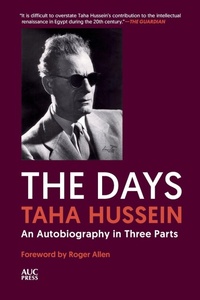
The Days
An Autobiography in Three Parts
Published on 13. January 2026
Book
Paperback/Softback
370 pages
978-1-64903-261-4 (ISBN)
Description
Taha Hussein's classic autobiographical novel The Days helped usher in the era of modern Arabic writing and remains one of the most influential and best-known works of Arabic literature
"It is difficult to overstate Taha Hussein's contribution to the intellectual renaissance in Egypt during the 20th century."-The Guardian
The monumental three-part autobiography of one of modern Egypt's greatest writers and thinkers is again available in a single paperback in this classic reissue. The first part, An Egyptian Childhood (1929), is full of the sounds and smells of rural Egypt. It tells of Hussein's childhood and early education in a small village in Upper Egypt, as he learns not only to come to terms with his blindness but to excel in spite of it and win a place at the prestigious Azhar University in Cairo. The second part, The Stream of Days: A Student at the Azhar (1939), is an enthralling picture of student life in Egypt in the early 1900s, and the record of the growth of an unusually gifted personality. More than forty years later, Hussein published A Passage to France (1973), carrying the story on to his final attainment of a doctorate at the Sorbonne, a saga of perseverance in the face of daunting odds.
"It is difficult to overstate Taha Hussein's contribution to the intellectual renaissance in Egypt during the 20th century."-The Guardian
The monumental three-part autobiography of one of modern Egypt's greatest writers and thinkers is again available in a single paperback in this classic reissue. The first part, An Egyptian Childhood (1929), is full of the sounds and smells of rural Egypt. It tells of Hussein's childhood and early education in a small village in Upper Egypt, as he learns not only to come to terms with his blindness but to excel in spite of it and win a place at the prestigious Azhar University in Cairo. The second part, The Stream of Days: A Student at the Azhar (1939), is an enthralling picture of student life in Egypt in the early 1900s, and the record of the growth of an unusually gifted personality. More than forty years later, Hussein published A Passage to France (1973), carrying the story on to his final attainment of a doctorate at the Sorbonne, a saga of perseverance in the face of daunting odds.
Reviews / Votes
"It is difficult to overstate Taha Hussein's contribution to the intellectual renaissance in Egypt during the 20th century. . . . His most striking and widely read work (outside the Arab world, at least) is his three-part autobiography The Days, with its vivid recreations of village and city life in Egypt."-The Guardian"One of the most important autobiographies in modern Arabic literature. . . . Told in a reflective third-person voice, the narrative blends intimate memory with sharp social observation, quietly critiquing poverty, superstition, and the limits of traditional learning."-Fast Company (Middle East)
"I have read this beautiful book with great emotion. It breathes humanity and a deep fraternal sympathy that finds an immediate echo in my heart."-Andre Gide, Nobel Laureate-winning author of The Immoralist
"No other work of modern Arabic literature is so familiar to readers in both the Arab world and the West."-Fedwa Malti-Douglas, Indiana University
More details
Language
English
Place of publication
United States
Product notice
Paperback (trade)
Dimensions
Height: 229 mm
Width: 152 mm
Thickness: 21 mm
Weight
536 gr
ISBN-13
978-1-64903-261-4 (9781649032614)
Copyright in bibliographic data and cover images is held by Nielsen Book Services Limited or by the publishers or by their respective licensors: all rights reserved.
Schweitzer Classification
Other editions
Previous edition
Taha Hussein
The Days: His Autobiography in Three Parts
Book
10/2010
The American University in Cairo Press
€33.61
Article exhausted; check for reprint
Persons
Taha Hussein (1889-1973) was one of the most influential Egyptian intellectuals of the twentieth century and a towering figure of educational reform in Egypt, best known through his voluminous, varied, and controversial writings. Blind from early childhood, he rose from humble beginnings to pursue a distinguished career in Egyptian public life, serving as academic advisor to the Minister of Education and then as Minister of Education (1950-1952). A leading figure of the Arab Renaissance (Nahda) and the modernist movement in the Arab world, he was unofficially known as "The Dean of Arabic Letters."