

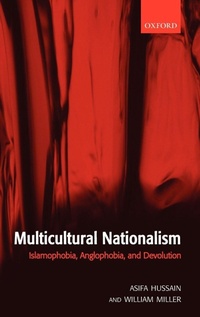
Multicultural Nationalism
Islamophobia, Anglophobia, and Devolution
Published on 20. July 2006
Book
Hardback
230 pages
978-0-19-928071-1 (ISBN)
Description
When the focus is on black or Asian minorities, Britain is frequently described as a multi-cultural state. But when the focus is on Scotland, England and Wales, Britain is also described as a multi-national state. Yet debates about multiculturalism and nationalism have been held in parallel without sharing even a common vocabulary. This book is a pioneering study of how multiculturalism interacts with multinationalism, especially within post-devolution Scotland.
It gives equal attention to Scotland's largest 'visible' and 'invisible' minorities: ethnic Pakistanis (almost all of them Muslim) and English immigrants. Rising Scottish self-consciousness could have posed a challenge both these minorities. But in practice, potential problems have proved themselves to be solutions, integrating rather than alienating.
In the eyes of the minorities, devolution has made Scots at once more proud and less xenophobic. Even English immigrants feel devolution has defused tensions, calmed frustrations, and forced Scots to blame themselves rather than others for their problems. Pakistanis have suffered increasing harassment - but they attribute that to 9/11 not to devolution. And Muslims adopt Scottish identities, Scottish attitudes, even Scottish nationalism - consciously or unconsciously using these as tools of integration.
The book is based in part on large-scale surveys: of Pakistani and English minorities within Scotland, and of the majority populations in Scotland and England. But it is also based on systematic analysis of transcripts of focus-group discussions with minorities revealing the variety of opinion within minorities as well as the contrasts between them. In particular, it presents a unique account of how Scottish Muslims express their feelings in a time of crisis.
It gives equal attention to Scotland's largest 'visible' and 'invisible' minorities: ethnic Pakistanis (almost all of them Muslim) and English immigrants. Rising Scottish self-consciousness could have posed a challenge both these minorities. But in practice, potential problems have proved themselves to be solutions, integrating rather than alienating.
In the eyes of the minorities, devolution has made Scots at once more proud and less xenophobic. Even English immigrants feel devolution has defused tensions, calmed frustrations, and forced Scots to blame themselves rather than others for their problems. Pakistanis have suffered increasing harassment - but they attribute that to 9/11 not to devolution. And Muslims adopt Scottish identities, Scottish attitudes, even Scottish nationalism - consciously or unconsciously using these as tools of integration.
The book is based in part on large-scale surveys: of Pakistani and English minorities within Scotland, and of the majority populations in Scotland and England. But it is also based on systematic analysis of transcripts of focus-group discussions with minorities revealing the variety of opinion within minorities as well as the contrasts between them. In particular, it presents a unique account of how Scottish Muslims express their feelings in a time of crisis.
Reviews / Votes
...highly interesting. * Political Studies Review *More details
Language
English
Place of publication
Oxford
United Kingdom
Target group
College/higher education
Professional and scholarly
Illustrations
Numerous tables
Dimensions
Height: 240 mm
Width: 161 mm
Thickness: 17 mm
Weight
514 gr
ISBN-13
978-0-19-928071-1 (9780199280711)
Copyright in bibliographic data and cover images is held by Nielsen Book Services Limited or by the publishers or by their respective licensors: all rights reserved.
Schweitzer Classification
Persons
Content
1. Multicultural Nationalism ; 2. What's Best and Worst about Scotland ; 3. Islamophobia - In England and Scotland ; 4. The Auld Enemy ; 5. Eyes Wide Open ; 6. Harassment, Discrimination, Abuse ; 7. History, Culture, Symbols ; 8. Identity and Identifying ; 9. After Devolution: Parliament and People