

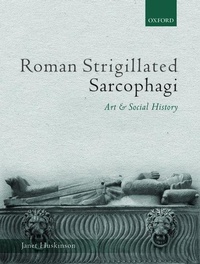
Roman Strigillated Sarcophagi
Art and Social History
Published on 5. November 2015
Book
Hardback
366 pages
978-0-19-920324-6 (ISBN)
Description
This is the first full study of Roman strigillated sarcophagi, which are the largest group of decorated marble sarcophagi to survive in the city of Rome. Characterized by panels of carved fluting - hence the description 'strigillated', after the curved strigil used by Roman bathers to scrape off oil - and limited figure scenes, they were produced from the mid-second to the early fifth century AD, and thus cover a critical period in Rome, from empire to early Christianity. Roman Strigillated Sarcophagi focuses on their rich potential as an historical source for exploring the social and cultural life of the city in the later empire.
The first part of the volume examines aspects of their manufacture, use, and viewing, emphasizing distinctive features. The second part looks at the figured representations carved on the sarcophagi, and at their social significance and creativity, concentrating on how their various arrangements allowed viewers to develop their own interpretations. The subjects represented by the figures and the flexibility with which they might be read, provide invaluable insights into how Romans thought about life and death during these changing times.
The final part of the volume surveys how later societies responded to Roman strigillated sarcophagi. From as early as the fifth century AD their distinctive decoration and allusions to the Roman past made them especially attractive for reuse in particular contemporary contexts, notably for elite burials and the decoration of prominent buildings. The motif of curved fluting was also adopted and adapted: it decorated neo-classical memorials to Captain Cook, Napoleon's sister-in-law Christine Boyer, and Penelope Boothby, and its use continues into this century, well over one and a half millennia since it first decorated Roman sarcophagi.
The first part of the volume examines aspects of their manufacture, use, and viewing, emphasizing distinctive features. The second part looks at the figured representations carved on the sarcophagi, and at their social significance and creativity, concentrating on how their various arrangements allowed viewers to develop their own interpretations. The subjects represented by the figures and the flexibility with which they might be read, provide invaluable insights into how Romans thought about life and death during these changing times.
The final part of the volume surveys how later societies responded to Roman strigillated sarcophagi. From as early as the fifth century AD their distinctive decoration and allusions to the Roman past made them especially attractive for reuse in particular contemporary contexts, notably for elite burials and the decoration of prominent buildings. The motif of curved fluting was also adopted and adapted: it decorated neo-classical memorials to Captain Cook, Napoleon's sister-in-law Christine Boyer, and Penelope Boothby, and its use continues into this century, well over one and a half millennia since it first decorated Roman sarcophagi.
Reviews / Votes
In Roman Strigillated Sarcophagi an accomplished scholar provides a grammar for reading (below) the surfaces of Rome's most popular and long-lived sarcophagus type. She also realizes, however, that the inherent ambiguity of images, many evoking a range of meanings now "unknowable", makes translation a fraught enterprise. Still, this comprehensive study clarifies the syntax of a type whose "greatest creative strength" derives from the interplay of its discrete figural fields and the accommodation therein of endless permutations of novel and conventional images. * Dennis Trout, University of Missouri , CJ-Online *More details
Language
English
Place of publication
Oxford
United Kingdom
Target group
College/higher education
Product notice
sewn/stitched
Cloth over boards
Illustrations
87 black and white illustrations
Dimensions
Height: 252 mm
Width: 200 mm
Thickness: 25 mm
Weight
999 gr
ISBN-13
978-0-19-920324-6 (9780199203246)
Schweitzer Classification
Other editions
Additional editions
E-Book
11/2015
1st Edition
OUP eBook
€79.49
Available for download
Person
Janet Huskinson was Reader in Classical Studies at the Open University where, since her retirement, she has been a Visiting Research Fellow.
Content
INTRODUCTION ; PART 1: PRODUCTION, USE, AND VIEWING ; PART 2: REPRESENTATIONS ; PART 3: RECEPTION AND REUSE