

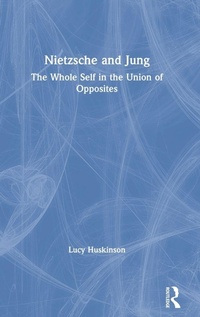
Nietzsche and Jung
The Whole Self in the Union of Opposites
1st Edition
Published on 22. July 2004
Book
Hardback
248 pages
978-1-58391-832-6 (ISBN)
Description
Was Jung's interpretation and assessment of Nietzsche accurate?
Nietzsche and Jung considers the thought and personalities of two icons of twentieth century philosophical and psychological thought, and reveals the extraordinary connections between them. Through a thorough examination of their work, Nietzsche and Jung succeeds in illuminating complex areas of Nietzsche's thought and resolving ambiguities in Jung's reception of these theories. The location and analysis of the role played by opposites in the whole self according to Jung is considered, revealing the full extent of Nietzsche's influence. This rigorous and original analysis of Jungian theory and its philosophical roots, supported by Jung's seminars on Nietzsche's Zarathustra, leads to the development of a fresh interpretation of the theories of both. The shared model of selfhood is put into practice as the personalities of Nietzsche and Jung are evaluated according to the other's criteria for mental health, attempting to determine whether Nietzsche and Jung were themselves whole.
Nietzsche and Jung demonstrates how our understanding of analytical psychology can be enriched by investigating its philosophical roots, and considers whether the whole self is a realistic possibility for each of us. This book will prove fascinating reading for students in psychology, philosophy and religion as well as practicing Jungian analysts.
Nietzsche and Jung considers the thought and personalities of two icons of twentieth century philosophical and psychological thought, and reveals the extraordinary connections between them. Through a thorough examination of their work, Nietzsche and Jung succeeds in illuminating complex areas of Nietzsche's thought and resolving ambiguities in Jung's reception of these theories. The location and analysis of the role played by opposites in the whole self according to Jung is considered, revealing the full extent of Nietzsche's influence. This rigorous and original analysis of Jungian theory and its philosophical roots, supported by Jung's seminars on Nietzsche's Zarathustra, leads to the development of a fresh interpretation of the theories of both. The shared model of selfhood is put into practice as the personalities of Nietzsche and Jung are evaluated according to the other's criteria for mental health, attempting to determine whether Nietzsche and Jung were themselves whole.
Nietzsche and Jung demonstrates how our understanding of analytical psychology can be enriched by investigating its philosophical roots, and considers whether the whole self is a realistic possibility for each of us. This book will prove fascinating reading for students in psychology, philosophy and religion as well as practicing Jungian analysts.
More details
Language
English
Place of publication
London
United Kingdom
Publishing group
Taylor & Francis Ltd
Target group
College/higher education
Professional and scholarly
Dimensions
Height: 240 mm
Width: 161 mm
Thickness: 18 mm
Weight
540 gr
ISBN-13
978-1-58391-832-6 (9781583918326)
Copyright in bibliographic data and cover images is held by Nielsen Book Services Limited or by the publishers or by their respective licensors: all rights reserved.
Schweitzer Classification
Other editions
Additional editions
E-Book
07/2004
Routledge
€63.49
Available for download
E-Book
07/2004
Routledge
€63.49
Available for download
Book
07/2004
1st Edition
Brunner-Routledge
€69.40
Shipment within 3-4 weeks
Person
Lucy Huskinson is a fellow of the Centre for Psychoanalytic Studies, University of Essex. She has contributed articles for the Journal of Analytical Psychology and Harvest Journal for Jungian Studies.
Content
Introduction. PartI: Opposites in the Whole Self. Opposites in Early Nietzsche: Metaphysical, Aesthetic, and Psychological Opposites. Opposites in Nietzsche Post-1878: The Denial of Metaphysical Opposites. The UEbermensch as a Union of Opposites. Opposites in the Jungian Model of the Psyche. The Self as a Union of Opposites. Part II: The Potential Influence of Nietzsche's Model on Jung. The Disagreement Between Nietzsche and Jung: The Process of Uniting Opposites. The Similarities Between Nietzsche and Jung: The Whole Self in the Union of Opposites. Part III: Jung's Rejection of Nietzsche's Model. Nietzsche's Madness: A Jungian Critique of Nietzsche's Model. Nietzsche's Absolution: A Metacritique of Jung's Critique of Nietzsche's Model. Jung's Shadow: The Ambiguities of Jung's Reception of Nietzsche Resolved. Jung's Madness: A Nietzschean Critique of Jung's Model. Part IV: Conclusion.