

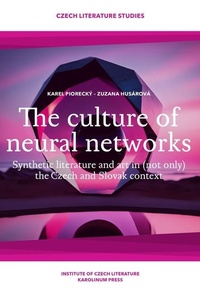
The Culture of Neural Networks
Synthetic Literature and Art in (Not Only) the Czech and Slovak Context
Published on 25. April 2025
Book
Paperback/Softback
230 pages
978-80-246-5783-7 (ISBN)
Description
Contextualizes literary texts and other cultural artifacts generated using the latest technological techniques.
The possibilities of generated cultural production have undergone fundamental changes in recent years, leading to a rethinking of existing approaches to the text and the artwork as such. To grasp this process, Zuzana Husarova and Karel Piorecky propose the term "neural network culture," which captures a wide range of generative practices and reception mechanisms. The Culture of Neural Networks contextualizes the phenomenon of literary texts and other artifacts generated using the latest technological techniques. The generation of literary texts using neural networks is part of a broader cultural process, to which this publication formulates a position through the lens of literary science, media theory, and art theory.
The scholarly debate over this topic has been inconsistent-on the one hand, it underestimates the diachronic connections between generated texts and the tradition of experimental and conceptual literature; on the other hand, it does not sufficiently clarify the new-generation procedures and the contribution of human and technological actors in them. Therefore, Husarova and Piorecky propose the notion of synthetic textual art, which reflects the specific roles of the different actors involved in generative practice and its intermedial nature. In doing so, they approach the topic from both historical and theoretical perspectives, analyzing the current state of generative practice in all three basic literary types and in the intermedial space using selected foreign and Czech-Slovak projects. This state of affairs is often distorted in media discourse and even mythicized in terms of the capabilities of "artificial intelligence"; therefore, a critical analysis of this media discourse is essential. Finally, the authors summarize the implications of this stage in the development of generative practice on creativity theory and literary theory.
The possibilities of generated cultural production have undergone fundamental changes in recent years, leading to a rethinking of existing approaches to the text and the artwork as such. To grasp this process, Zuzana Husarova and Karel Piorecky propose the term "neural network culture," which captures a wide range of generative practices and reception mechanisms. The Culture of Neural Networks contextualizes the phenomenon of literary texts and other artifacts generated using the latest technological techniques. The generation of literary texts using neural networks is part of a broader cultural process, to which this publication formulates a position through the lens of literary science, media theory, and art theory.
The scholarly debate over this topic has been inconsistent-on the one hand, it underestimates the diachronic connections between generated texts and the tradition of experimental and conceptual literature; on the other hand, it does not sufficiently clarify the new-generation procedures and the contribution of human and technological actors in them. Therefore, Husarova and Piorecky propose the notion of synthetic textual art, which reflects the specific roles of the different actors involved in generative practice and its intermedial nature. In doing so, they approach the topic from both historical and theoretical perspectives, analyzing the current state of generative practice in all three basic literary types and in the intermedial space using selected foreign and Czech-Slovak projects. This state of affairs is often distorted in media discourse and even mythicized in terms of the capabilities of "artificial intelligence"; therefore, a critical analysis of this media discourse is essential. Finally, the authors summarize the implications of this stage in the development of generative practice on creativity theory and literary theory.
More details
Series
Language
English
Place of publication
Ovocny
Czech Republic
Target group
Professional and scholarly
Product notice
Paperback (trade)
Unsewn / adhesive bound
Illustrations
12 halftones
Dimensions
Height: 214 mm
Width: 138 mm
Thickness: 22 mm
Weight
431 gr
ISBN-13
978-80-246-5783-7 (9788024657837)
Copyright in bibliographic data and cover images is held by Nielsen Book Services Limited or by the publishers or by their respective licensors: all rights reserved.
Schweitzer Classification
Persons
Zuzana Husarova is a researcher and author of electronic literature, pedagogue at the Digital Arts Department of the Academy of Fine Arts and Design in Bratislava, Slovakia, and editor of the gender magazine Glosolalia. Karel Piorecky is a senior researcher in the Institute of Czech Literature, Czech Academy of Sciences, focusing on twentieth-century and contemporary Czech poetry, literature, and new media.