

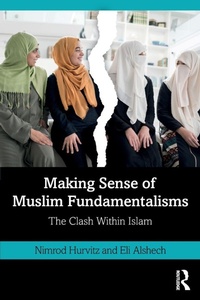
Making Sense of Muslim Fundamentalisms
The Clash Within Islam
1st Edition
Published on 26. June 2020
Book
Paperback/Softback
262 pages
978-0-367-85646-5 (ISBN)
Description
Studying Muslim fundamentalisms, this book compares key movements, examining their commonalities, differences, and intricate relations, as well as their achievements and failures. Muslim fundamentalisms have the sympathy of approximately half of the Muslim population in the world. Yet, they are divided among themselves and are in a constant state of controversy.
The research dwells on the leading fundamentalist movements, such as the Muslim Brothers, Tablighi-Jama?at, al-Qaeda, and ISIS, and illustrates how differently they think about the West and its culture, democracy, and women's presence in the public sphere. By identifying these trends, and studying them comparatively, the book enables the interested reader to make sense of the plethora of fundamentalist movements, which are otherwise lumped together by the media and are barely discernible for the reader. Whereas most studies of Muslim fundamentalism focus on organizational or militant actions that the movements perform, this study concentrates on their efforts to Islamize society through everyday life in a peaceful manner.
Identifying the different strands of Muslim fundamentalisms, the book will be a key resource to a wide range of readers including researchers and students interested in politics, religious, Islamic and Middle Eastern Studies.
The research dwells on the leading fundamentalist movements, such as the Muslim Brothers, Tablighi-Jama?at, al-Qaeda, and ISIS, and illustrates how differently they think about the West and its culture, democracy, and women's presence in the public sphere. By identifying these trends, and studying them comparatively, the book enables the interested reader to make sense of the plethora of fundamentalist movements, which are otherwise lumped together by the media and are barely discernible for the reader. Whereas most studies of Muslim fundamentalism focus on organizational or militant actions that the movements perform, this study concentrates on their efforts to Islamize society through everyday life in a peaceful manner.
Identifying the different strands of Muslim fundamentalisms, the book will be a key resource to a wide range of readers including researchers and students interested in politics, religious, Islamic and Middle Eastern Studies.
More details
Language
English
Place of publication
London
United Kingdom
Publishing group
Taylor & Francis Ltd
Target group
College/higher education
Dimensions
Height: 234 mm
Width: 156 mm
Thickness: 15 mm
Weight
418 gr
ISBN-13
978-0-367-85646-5 (9780367856465)
Copyright in bibliographic data and cover images is held by Nielsen Book Services Limited or by the publishers or by their respective licensors: all rights reserved.
Schweitzer Classification
Other editions
Additional editions
Book
06/2020
1st Edition
Routledge
€206.60
Shipment within 15-20 days
E-Book
06/2020
1st Edition
Routledge
€53.99
Available for download
E-Book
06/2020
1st Edition
Routledge
€53.99
Available for download
Persons
Nimrod Hurvitz teaches at the Department of Middle East Studies at Ben Gurion University of the Negev. His areas of interest are medieval and modern religio-political movements. His publications have appeared in The American Historical Review, and in the Islamic Legal Studies Program at Harvard Law School.
Eli Alshech is a visiting scholar at the Hebrew University and a government consultant. His research focuses on Islamic fundamentalism, Salafi-Jihadism, "Lone wolf" Terrorism, and Cyber Terrorism. His recent publications pertain to the ideological rift within the Salafi-Jihadi camp, and to the way Jihadists build their authority and legitimacy.
Eli Alshech is a visiting scholar at the Hebrew University and a government consultant. His research focuses on Islamic fundamentalism, Salafi-Jihadism, "Lone wolf" Terrorism, and Cyber Terrorism. His recent publications pertain to the ideological rift within the Salafi-Jihadi camp, and to the way Jihadists build their authority and legitimacy.
Content
Introduction
Part I: Histories
1. Moderate fundamentalists
2. Militant fundamentalists
Part II: Mobilization
3. Authority and leadership
4. The art and means of persuasion
Part III: Moral order
5. Images of the West
6. Culture wars
7. Women in the public sphere
Concluding observations
Part I: Histories
1. Moderate fundamentalists
2. Militant fundamentalists
Part II: Mobilization
3. Authority and leadership
4. The art and means of persuasion
Part III: Moral order
5. Images of the West
6. Culture wars
7. Women in the public sphere
Concluding observations