

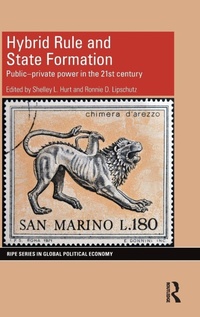
Hybrid Rule and State Formation
Public-Private Power in the 21st Century
1st Edition
Published on 9. July 2015
Book
Hardback
258 pages
978-1-138-79911-0 (ISBN)
Description
Neoliberalism has been the reigning ideology of our era. For the past four decades, almost every real-world event of any consequence has been traced to the supposedly omnipresent influence of neoliberalism. Instead, this book argues that states across the world have actually grown in scope and reach.
The authors in this volume contest the view that the past three decades have been marked by the diminution of the state in the face of neoliberalism. They argue instead that we are witnessing a new phase of state formation, which revolves around hybrid rule-that is, a more expansive form of state formation that works through privatization and seeks pacification and depoliticization as instrumental to enhancing state power. Contributors argue that that the process of hybridization, and hybrid rule point towards a convergence on a more authoritarian capitalist regime type, possibly, but not necessarily, more closely aligned with the Beijing model-one toward which even the United States, with its penchant for surveillance and discipline, appears to be moving.
This volume will shed new light on evolving public-private relations, and the changing nature of power and political authority in the 21st century and will be of interest to students and scholars of IPE, international relations and political theory.
The authors in this volume contest the view that the past three decades have been marked by the diminution of the state in the face of neoliberalism. They argue instead that we are witnessing a new phase of state formation, which revolves around hybrid rule-that is, a more expansive form of state formation that works through privatization and seeks pacification and depoliticization as instrumental to enhancing state power. Contributors argue that that the process of hybridization, and hybrid rule point towards a convergence on a more authoritarian capitalist regime type, possibly, but not necessarily, more closely aligned with the Beijing model-one toward which even the United States, with its penchant for surveillance and discipline, appears to be moving.
This volume will shed new light on evolving public-private relations, and the changing nature of power and political authority in the 21st century and will be of interest to students and scholars of IPE, international relations and political theory.
More details
Series
Language
English
Place of publication
London
United Kingdom
Publishing group
Taylor & Francis Ltd
Target group
College/higher education
Illustrations
2 s/w Abbildungen, 2 s/w Photographien bzw. Rasterbilder
2 Halftones, black and white; 2 Illustrations, black and white
Dimensions
Height: 240 mm
Width: 161 mm
Thickness: 19 mm
Weight
558 gr
ISBN-13
978-1-138-79911-0 (9781138799110)
Copyright in bibliographic data and cover images is held by Nielsen Book Services Limited or by the publishers or by their respective licensors: all rights reserved.
Schweitzer Classification
Other editions
Additional editions
Shelley Hurt | Ronnie Lipschutz
Hybrid Rule and State Formation
Public-Private Power in the 21st Century
Book
06/2020
1st Edition
Routledge
€51.98
Shipment within 15-20 days
Shelley Hurt | Ronnie Lipschutz
Hybrid Rule and State Formation
Public-Private Power in the 21st Century
E-Book
06/2015
Routledge
€59.49
Available for download
Shelley Hurt | Ronnie Lipschutz
Hybrid Rule and State Formation
Public-Private Power in the 21st Century
E-Book
06/2015
Routledge
€59.49
Available for download
Persons
Shelley L Hurt is Associate Professor of Political Science in the Department of Political Science at the California Polytechnic State University, San Luis Obispo, California.
Ronnie Lipschutz is Professor of Politics and Provost of College Eight at the University of California, Santa Cruz, California.
Ronnie Lipschutz is Professor of Politics and Provost of College Eight at the University of California, Santa Cruz, California.
Content
Introduction: Section I: Analytics 1. Bringing Politics Back In. 2. Roving Elites and Sedentary Subjects: The Hybridized Origins of the State. 3. Neoliberal Bureaucracy as an Expression of Hybrid Rule.4. Hybridized Condensations: A Historical-Materialist Approach to two Modes of State Transformation. Section II: Empirics 5. What's at Stake in the Privatization Debate? Enclosing the Public Domain through Hybrid Rule. 6. Sovereign Wealth Funds and Sovereign Wiles: Varieties of Hybridization. 7. Security Seen and Unseen. 8. World War Infinity: Security through Economy, Economy through Security.9. Recombinant Relations: A Molecular View of Hybridization. Section III: Reflections 10. Hybrid Rule and State Formation: Some Preliminary Thoughts, Arguments and Research Items.