

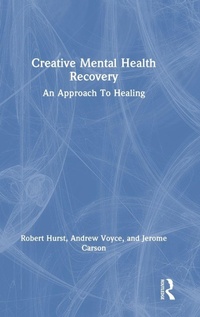
Creative Mental Health Recovery
An Approach To Healing
1st Edition
Published on 12. November 2024
Book
Hardback
162 pages
978-1-032-33371-7 (ISBN)
Description
This book presents the importance of the role of creativity, particularly everyday creativity, in the lives of people on a mental health recovery journey.
Through a review of historical and contemporary literature and research findings on the topic, the book starts by giving readers an idea of the state of play of conceptualisations of both creativity and recovery. The authors arrive at and present their own definitions of these concepts, using autoethnography to bring their own experiences into the text. They then illustrate to the reader what creativity in recovery looks like in practice, through interviews with and written accounts from creative individuals who have experienced a mental health recovery journey, grounding the theory with tangible stories of application. The interviews are analysed, with themes picked out and a model of creativity and recovery produced by the authors. Implications and possible future directions are then discussed.
This unique presentation of creative recovery will be of interest to a wide range of mental health professionals, specifically those studying or practising mental health recovery and creative therapies.
Through a review of historical and contemporary literature and research findings on the topic, the book starts by giving readers an idea of the state of play of conceptualisations of both creativity and recovery. The authors arrive at and present their own definitions of these concepts, using autoethnography to bring their own experiences into the text. They then illustrate to the reader what creativity in recovery looks like in practice, through interviews with and written accounts from creative individuals who have experienced a mental health recovery journey, grounding the theory with tangible stories of application. The interviews are analysed, with themes picked out and a model of creativity and recovery produced by the authors. Implications and possible future directions are then discussed.
This unique presentation of creative recovery will be of interest to a wide range of mental health professionals, specifically those studying or practising mental health recovery and creative therapies.
Reviews / Votes
This fascinating text achieves its intention of providing an accessible and informed perspective on the relationship between creativity and mental health recovery. The content is evocative and challenging and seeks to arouse the reader to explore their own relationship with creativity, whilst enabling the storyteller's narrative to explore how creativity has influenced their recovery. The authors' mutual respect for one another's lived experience is evident and provides a unique perspective.--Annette Feakes, Senior Lecturer, University of Brighton
This book shows how lived experiences constitute an invaluable source of knowledge. It is a book of showing and telling, and of making meaning of the past, present, and possible futures. These concepts are beautifully woven together through the tapestry that this book offers, demonstrating how creativity is something lived, personal and accessible, providing a powerful resource to mental health and well-being.
--Trude Klevan, Professor of Mental Health and Substance Use, University of South-Eastern Norway
This book opens up exciting new vistas in understanding mental health recovery, by extending the Connectedness, Hope, Identity, Meaning and Empowerment (CHIME) Framework to incorporate the transformative and healing potential of Creativity (C-CHIME). Skillfully weaving individual accounts of how creative activities have impacted on recovery, a particular strength is the balanced focus both on benefits and possible harms. This book shows how creativity can bring light to the darkest of mental health experiences.
--Mike Slade, Professor of Mental Health Recovery and Social Inclusion, University of Nottingham
More details
Language
English
Place of publication
London
United Kingdom
Publishing group
Taylor & Francis Ltd
Target group
Professional and scholarly
Professional
Illustrations
2 s/w Abbildungen, 2 s/w Zeichnungen, 6 s/w Tabellen
6 Tables, black and white; 2 Line drawings, black and white; 2 Illustrations, black and white
Dimensions
Height: 240 mm
Width: 161 mm
Thickness: 14 mm
Weight
432 gr
ISBN-13
978-1-032-33371-7 (9781032333717)
Copyright in bibliographic data and cover images is held by Nielsen Book Services Limited or by the publishers or by their respective licensors: all rights reserved.
Schweitzer Classification
Other editions
Additional editions
E-Book
11/2024
1st Edition
Routledge
€37.99
Available for download
E-Book
11/2024
1st Edition
Routledge
€37.99
Available for download
Book
11/2024
1st Edition
Routledge
€43.80
Shipment within 10-20 days
Persons
Robert Hurst is an associate lecturer in the School of Psychology, University of Bolton. Alongside this, he is a practising person- centred counsellor, registered with the British Association for Counselling and Psychotherapy.
Andrew Voyce is a researcher and lived experience consultant. He is the author of several peer reviewed papers and two books. He has guest lectured on mental health recovery to a wide array of university students in the UK. In 2024, Andrew was awarded an honorary doctorate from the University of Bolton.
Jerome Carson is professor of psychology at the University of Bolton. A qualified clinical psychologist, Jerome's main research interests are mental health recovery, positive psychology, autoethnography, and alcohol addiction.
Andrew Voyce is a researcher and lived experience consultant. He is the author of several peer reviewed papers and two books. He has guest lectured on mental health recovery to a wide array of university students in the UK. In 2024, Andrew was awarded an honorary doctorate from the University of Bolton.
Jerome Carson is professor of psychology at the University of Bolton. A qualified clinical psychologist, Jerome's main research interests are mental health recovery, positive psychology, autoethnography, and alcohol addiction.
Content
Chapter 1. Introduction
Robert Hurst, Heather Harrison, Andrew Voyce and Jerome Carson
Chapter 2. Recovery Journeys in Mental Health
Jerome Carson
Chapter 3. CHIME
Robert Hurst
Chapter 4. Creativity and Recovery
Robert Hurst
Chapter 5. What Has Brought Us Here?
Robert Hurst, Andrew Voyce and Jerome Carson
Chapter 6. StoryTeller: Jo Mullen
Jo Mullen and Robert Hurst
Chapter 7. StoryTeller: Michelle McNary
Michelle McNary and Robert Hurst
Chapter 8. StoryTeller: Peter Bullimore
Peter Bullimore and Robert Hurst
Chapter 9. StoryTeller: ANON
ANON and Robert Hurst
Chapter 10. StoryTeller: Anna Sexton
Anna Sexton and Robert Hurst
Chapter 11. Andrew's Story
Andrew Voyce
Chapter 12. A New Model of Creativity In Recovery and C-CHIME
Robert Hurst
Chapter 13. Conclusions
Robert Hurst, Andrew Voyce and Jerome Carson
Robert Hurst, Heather Harrison, Andrew Voyce and Jerome Carson
Chapter 2. Recovery Journeys in Mental Health
Jerome Carson
Chapter 3. CHIME
Robert Hurst
Chapter 4. Creativity and Recovery
Robert Hurst
Chapter 5. What Has Brought Us Here?
Robert Hurst, Andrew Voyce and Jerome Carson
Chapter 6. StoryTeller: Jo Mullen
Jo Mullen and Robert Hurst
Chapter 7. StoryTeller: Michelle McNary
Michelle McNary and Robert Hurst
Chapter 8. StoryTeller: Peter Bullimore
Peter Bullimore and Robert Hurst
Chapter 9. StoryTeller: ANON
ANON and Robert Hurst
Chapter 10. StoryTeller: Anna Sexton
Anna Sexton and Robert Hurst
Chapter 11. Andrew's Story
Andrew Voyce
Chapter 12. A New Model of Creativity In Recovery and C-CHIME
Robert Hurst
Chapter 13. Conclusions
Robert Hurst, Andrew Voyce and Jerome Carson