

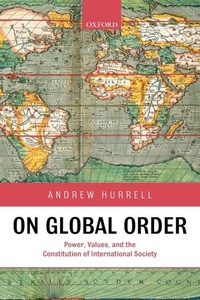
On Global Order
Power, Values, and the Constitution of International Society
Published on 8. November 2007
Book
Paperback/Softback
364 pages
978-0-19-923311-3 (ISBN)
Description
How is the world organized politically? How should it be organized? What forms of political organization are required to deal with such global challenges as climate change, terrorism, or nuclear proliferation? Drawing on work in international law, international relations, and global governance, this book provides a clear and wide-ranging introduction to the analysis of global political order -- how patterns of governance and institutionalization in world politics have already changed; what the most important challenges are; and what the way forward might look like.
The first section develops three analytical frameworks: a world of sovereign states capable of only limited cooperation; a world of ever-denser international institutions embodying the idea of an international community; and a world in which global governance moves beyond the state and into the realms of markets, civil society and networks. Part II examines five of the most important issues facing contemporary international society: nationalism and the politics of identity; human rights and democracy; war, violence and collective security; the ecological challenge; and the management of economic globalization in a highly unequal world. Part III considers the idea of an emerging multi-regional system; and the picture of global order built around US empire. The conclusion looks at the normative implications. If international society has indeed been changing in the ways discussed in this book, what ought we to do? And, still more crucially, who is the 'we' that is to be at the centre of this drive to create a morally better world?
This book is concerned with the fate of international society in an era of globalization and the ability of the inherited society of sovereign states to provide a practically viable and normatively acceptable framework for global political order. It lays particular emphasis on the different forms of global inequality and the problems of legitimacy that these create and on the challenges posed by cultural diversity and value conflict.
The first section develops three analytical frameworks: a world of sovereign states capable of only limited cooperation; a world of ever-denser international institutions embodying the idea of an international community; and a world in which global governance moves beyond the state and into the realms of markets, civil society and networks. Part II examines five of the most important issues facing contemporary international society: nationalism and the politics of identity; human rights and democracy; war, violence and collective security; the ecological challenge; and the management of economic globalization in a highly unequal world. Part III considers the idea of an emerging multi-regional system; and the picture of global order built around US empire. The conclusion looks at the normative implications. If international society has indeed been changing in the ways discussed in this book, what ought we to do? And, still more crucially, who is the 'we' that is to be at the centre of this drive to create a morally better world?
This book is concerned with the fate of international society in an era of globalization and the ability of the inherited society of sovereign states to provide a practically viable and normatively acceptable framework for global political order. It lays particular emphasis on the different forms of global inequality and the problems of legitimacy that these create and on the challenges posed by cultural diversity and value conflict.
Reviews / Votes
This is one of the finest books on the normative dimension of global governance published in the past decade. Utilizing insights from the English School, liberal institutionalism, and constructivism, the author addresses some of the most profound questions on the nature, limitations, and possibilities of global order in the twenty-first century...On Global Order should serve as a resource for a wide range of readers, including scholars and students of international relations and international law, international civil servants, diplomats, and journalists. * Samuel M. Makinda, Ethics and International Affairs * On Global Order consciously and successfully sets out to be the twenty-first-century version of The Anarchical Society...a major statement and required reading for anyone interested in the theory and practice of international relations. * Chris Brown Political Studies Review * stands out as an oasis of clarity, intellectual honesty and wisdom in the desert of obscure platitudes ... * Survival * This book has been eagerly anticipated and it does not disappoint. Its principal concern is with the challenges of global order: capturing shared interests, managing unequal power, and mediating value conflict This is a subtle and challenging book at every level, and its prime characteristic is its consistent eschewal of facile options, either analytical or prescriptive. * Perspectives on Politics * Hurrell avows himself explicitly to the tradition of neo-Grotianism established in particular by Hedley Bull and, more generally, by the English School of International Relations. He delivers, however, an essential contribution to the overcoming of a conceptual shortcoming which affected Bull's theory of the 'international society' ... [and] Hurrell consistently improves and substantiates the conceptual instruments traditionally used by the English School of International Relations. * The European Journal of International Law *More details
Language
English
Place of publication
Oxford
United Kingdom
Target group
College/higher education
Professional and scholarly
Dimensions
Height: 234 mm
Width: 156 mm
Thickness: 20 mm
Weight
553 gr
ISBN-13
978-0-19-923311-3 (9780199233113)
Copyright in bibliographic data and cover images is held by Nielsen Book Services Limited or by the publishers or by their respective licensors: all rights reserved.
Schweitzer Classification
Other editions
Additional editions
E-Book
11/2007
OUP eBook
€36.99
Available for download
Book
11/2007
Oxford University Press
€75.90
Shipment within 15-20 days
Person
Andrew Hurrell is Director of the Centre for International Studies at Oxford University and a Fellow of Nuffield College, Oxford. He has written extensively on international institutions and governance at both the global and regional levels and on the role of major developing countries in contemporary international relations.
Content
1. Governing the globe ; PART I: FRAMEWORKS ; 2. The anarchical society revisited ; 3. State solidarism and global liberalism ; 4. Complex governance beyond the state ; PART II: ISSUES ; 5. Nationalism and the politics of identity ; 6. Human rights and democracy ; 7. War, violence and collective security ; 88. Economic globalization in an unequal world ; 9. The ecological challenge ; PART III: ALTERNATIVES ; 10. One world? Many worlds? ; 11. Empire reborn? ; PART IV: CONCLUSIONS ; 12. The state of international society and the pursuit of justice ; Biobliography