

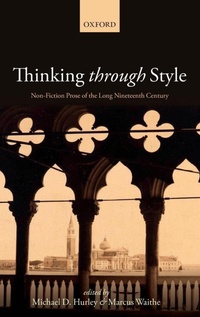
Thinking Through Style
Non-Fiction Prose of the Long Nineteenth Century
Published on 11. January 2018
Book
Hardback
374 pages
978-0-19-873782-7 (ISBN)
Description
What is 'style', and how does it relate to thought in language? It has often been treated as something merely linguistic, independent of thought, ornamental; stylishness for its own sake. Or else it has been said to subserve thought, by mimicking, delineating, or heightening ideas that are already expressed in the words. This ambitious and timely book explores a third, more radical possibility in which style operates as a verbal mode of thinking through. Rather than figure thought as primary and pre-verbal, and language as a secondary delivery system, style is conceived here as having the capacity to clarify or generate thinking. The book's generic focus is on non-fiction prose, and it looks across the long nineteenth century.
Leading scholars survey twenty authors to show where writers who have gained reputations as either 'stylists' or as 'thinkers' exploit the interplay between 'the what' and 'the how' of their prose. The study demonstrates how celebrated stylists might, after all, have thoughts worth attending to, and that distinguished thinkers might be enriched for us if we paid more due to their style. More than reversing the conventional categories, this innovative volume shows how 'style' and 'thinking' can be approached as a shared concern. At a moment when, especially in nineteenth-century studies, interest in style is re-emerging, this book revaluates some of the most influential figures of that age, re-imagining the possible alliances, interplays, and generative tensions between thinking, thinkers, style, and stylists.
Leading scholars survey twenty authors to show where writers who have gained reputations as either 'stylists' or as 'thinkers' exploit the interplay between 'the what' and 'the how' of their prose. The study demonstrates how celebrated stylists might, after all, have thoughts worth attending to, and that distinguished thinkers might be enriched for us if we paid more due to their style. More than reversing the conventional categories, this innovative volume shows how 'style' and 'thinking' can be approached as a shared concern. At a moment when, especially in nineteenth-century studies, interest in style is re-emerging, this book revaluates some of the most influential figures of that age, re-imagining the possible alliances, interplays, and generative tensions between thinking, thinkers, style, and stylists.
Reviews / Votes
impressive ... artfully remind[s] us that prose is the principle medium of thinking and of getting along in the world, and that literary criticism therefore matters not as a dilettantish pastime but as a model for how to handle the prose of the world without being bullied or commodified by it. * Jonathan Farina, Victorian Studies * Thinking through Style amounts to a thoughtfully stylish demonstration of the at once serious and pleasurable insights to be gained from a close attention to how style both "simulates" and "stimulates" thought. Whatever it is that we do when we think "through" style, the collection compellingly shows that in prose as in thinking, il ny a pas de hors style. * Yasmin Solomonescu, Modern Philology * Overall, this broad collection reminds us ... of the intellectual weight of the nineteenth century, and at its best it articulates its innovative point that, in Stevenson's words, 'style is the essence of thinking'. * David Greenham, Modern Language Review * Conclusively, if not explicitly, the volume makes the case for the virtues and value of a stylish criticism. Thinking through Style represents English literary criticism at its best and acts as a salutary reminder of why we choose to do it. * Uttara Natarajan, Review of English Studies * Thinking through Style is to be welcomed for its demonstration of the centrality and amplitude of style as a critical concern. It furnishes an advanced and eloquent education in the kinds of thinking and attention involved in a literary study of prose. * Andrew Hodgson, BARS * making a wonderful case not only for twenty prose stylists of the long nineteenth century, from Coleridge to T.S. Eliot, but also for the close analysis of prose more generally, as an illuminating and suggestive field of study. * Hazlitt Review *More details
Language
English
Place of publication
Oxford
United Kingdom
Target group
College/higher education
Illustrations
1 Illustration
Dimensions
Height: 240 mm
Width: 161 mm
Thickness: 25 mm
Weight
725 gr
ISBN-13
978-0-19-873782-7 (9780198737827)
Copyright in bibliographic data and cover images is held by Nielsen Book Services Limited or by the publishers or by their respective licensors: all rights reserved.
Schweitzer Classification
Other editions
Additional editions
Michael D. Hurley | Marcus Waithe
Thinking Through Style
Non-Fiction Prose of the Long Nineteenth Century
E-Book
01/2018
1st Edition
OUP eBook
€62.99
Available for download
Michael D. Hurley | Marcus Waithe
Thinking Through Style
Non-Fiction Prose of the Long Nineteenth Century
E-Book
01/2018
1st Edition
OUP eBook
€62.99
Available for download
Persons
Michael D. Hurley teaches English at the University of Cambridge, where he is a University Lecturer and a Fellow of St Catharine's College. He has written widely on literary style and its relationship with feeling and thinking. His books include Faith in Poetry: Verse Style as a Mode of Religious Belief (Bloomsbury, 2017), G. K. Chesterton (Northcote House, 2012), and (co-authored with Michael O'Neill) Poetic Form (CUP, 2012).
Marcus Waithe is a Fellow in English and University Senior Lecturer at Magdalene College, Cambridge. He is the author of William Morris's Utopia of Strangers: Victorian Medievalism and the Ideal of Hospitality (2006), and of numerous essays and articles on Victorian and twentieth-century topics. A collection of essays, co-edited with Claire White, entitled The Labour Literature in Britain and France, 1830-1930: Authorial Work Ethics is forthcoming with Palgrave. He is also completing a monograph entitled The Work of Words: Literature and the Labour of Mind in Britain, 1830-1930.
Marcus Waithe is a Fellow in English and University Senior Lecturer at Magdalene College, Cambridge. He is the author of William Morris's Utopia of Strangers: Victorian Medievalism and the Ideal of Hospitality (2006), and of numerous essays and articles on Victorian and twentieth-century topics. A collection of essays, co-edited with Claire White, entitled The Labour Literature in Britain and France, 1830-1930: Authorial Work Ethics is forthcoming with Palgrave. He is also completing a monograph entitled The Work of Words: Literature and the Labour of Mind in Britain, 1830-1930.
Content
Michael D. Hurley and Marcus Waithe: Introduction: Thinking, Thinkers, Style, Stylists
1: James Engell: 'A Hare in Every Nettle': Coleridge's Prose
2: Matthew Bevis: Charles Lamb . . . Seriously
3: Freya Johnston: Keeping to William Hazlitt
4: Michael O'Neill: 'Pictures' and 'Signs': Creative Thinking in Shelley's Prose, 1816-1821
5: Ruth Scurr: 'The greatest irregular': Thomas Carlyle's Re-Creative Purpose in The French Revolution
6: Michael D. Hurley: John Henry Newman, Thinking Out Into Language
7: Valerie Sanders: 'Things Pressing to be said': Harriet Martineau's Mission to Inform
8: Adam Phillips: Emerson and the Impossibilities of Style
9: James Williams: Darwin's Theological Virtues
10: Dinah Birch: 'Just Proportions': The Material of George Eliot's Writing
11: Marcus Waithe: Ruskin's Style of Thought: Animating Re-description in the Late Writings
12: David Russell: The Idea of Matthew Arnold
13: Angela Leighton: Walter Pater's Dream Rhythms
14: Philip Davis: Cashing In on William James
15: Adrian Poole: Touch-and-go with Robert Louis Stevenson
16: Hugh Haughton: Oscar Wilde: Thinking Style
17: Catherine Maxwell: Vernon Lee's Handling of Words
18: Simon Jarvis: Chesterton and the Superman: Chesterton's Levitations
19: Susan Sellers: Virginia Woolf: Writing and the Ordinary Mind
20: Stefan Collini: Vexing the thoughtless: T.S. Eliot's early criticism
1: James Engell: 'A Hare in Every Nettle': Coleridge's Prose
2: Matthew Bevis: Charles Lamb . . . Seriously
3: Freya Johnston: Keeping to William Hazlitt
4: Michael O'Neill: 'Pictures' and 'Signs': Creative Thinking in Shelley's Prose, 1816-1821
5: Ruth Scurr: 'The greatest irregular': Thomas Carlyle's Re-Creative Purpose in The French Revolution
6: Michael D. Hurley: John Henry Newman, Thinking Out Into Language
7: Valerie Sanders: 'Things Pressing to be said': Harriet Martineau's Mission to Inform
8: Adam Phillips: Emerson and the Impossibilities of Style
9: James Williams: Darwin's Theological Virtues
10: Dinah Birch: 'Just Proportions': The Material of George Eliot's Writing
11: Marcus Waithe: Ruskin's Style of Thought: Animating Re-description in the Late Writings
12: David Russell: The Idea of Matthew Arnold
13: Angela Leighton: Walter Pater's Dream Rhythms
14: Philip Davis: Cashing In on William James
15: Adrian Poole: Touch-and-go with Robert Louis Stevenson
16: Hugh Haughton: Oscar Wilde: Thinking Style
17: Catherine Maxwell: Vernon Lee's Handling of Words
18: Simon Jarvis: Chesterton and the Superman: Chesterton's Levitations
19: Susan Sellers: Virginia Woolf: Writing and the Ordinary Mind
20: Stefan Collini: Vexing the thoughtless: T.S. Eliot's early criticism