

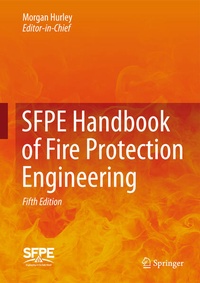
SFPE Handbook of Fire Protection Engineering
5th Edition
Published on 7. November 2015
Book
Hardback
LIII, 3493 pages
978-1-4939-2564-3 (ISBN)
Description
About the Editor-in-Chief: Morgan Hurley is a project director for Aon Fire Protection Engineering. He also serves as adjunct faculty at the University of Maryland and California Polytechnic University. He holds bachelors and masters degrees in fire protection engineering, is a licensed professional engineer and he is a Fellow of the Society of Fire Protection Engineers. About the Society: SFPE's mission is to define, develop and advance the use of engineering best practices; expand the scientific and technical knowledge base; and educate the global fire safety community, in order to reduce fire risk.
More details
Edition
Fifth Edition 2016
Language
English
Place of publication
New York
United States
Target group
Professional and scholarly
Professional/practitioner
Edition type
Revised edition
Product notice
sewn/stitched
Cloth over boards
Illustrations
1626 s/w Abbildungen
LIII, 3493 p. 1626 illus. In 3 volumes, not available separately.
Dimensions
Height: 261 mm
Width: 179 mm
Thickness: 157 mm
Weight
6584 gr
ISBN-13
978-1-4939-2564-3 (9781493925643)
DOI
10.1007/978-1-4939-2565-0
Schweitzer Classification
Other editions
New editions
Society of Fire Protection Engineers
SFPE Handbook of Fire Protection Engineering
Book
approx. 07/2026
6th Edition
Springer
€909.49
Not yet published
Additional editions
Morgan J. Hurley | Daniel T. Gottuk | John R. Hall Jr.
SFPE Handbook of Fire Protection Engineering
Book
10/2016
5th Edition
Springer
€849.99
The article will not be published
Morgan J. Hurley | Daniel T. Gottuk | John R. Hall Jr.
SFPE Handbook of Fire Protection Engineering
E-Book
10/2015
5th Edition
Springer
€1,165.23
Available for download
Persons
About the Editor-in-Chief: Morgan Hurley is a project director for Aon Fire Protection Engineering. He also serves as adjunct faculty at the University of Maryland and California Polytechnic University. He holds bachelors and masters degrees in fire protection engineering, is a licensed professional engineer and he is a Fellow of the Society of Fire Protection Engineers. About the Society: SFPE's mission is to define, develop and advance the use of engineering best practices; expand the scientific and technical knowledge base; and educate the global fire safety community, in order to reduce fire risk.
Content
Introduction to Fluid Mechanics.- Conduction of Heat in Solids.- Convection Heat Transfer.- Radiation Heat Transfer.- Thermochemistry.- Chemical Equilibrium.- Thermal Decomposition of Polymeric Materials.- Structural Mechanics.- Properties of Building Materials.- Chemical Kinetics and Fire.- Diffusion Flames.- Fundamentals of Premixed Flames.- Fire Plumes, Flame Height, and Air Entrainment.- Ceiling Jet Flows.- Vent Flows.- Effect of Combustion Conditions on Species Production.- Flammability Limits of Premixed and Diffusion Flames.- Ignition of Liquids.- Smoldering Combustion.- Spontaneous Combustion and Self-Heating.- Flaming Ignition of Solid Fuels.- Electrical Fires.- Surface Flame Spread.- Smoke Characterization and Damage Potential.- Heat Fluxes from Fires to Surfaces.- Heat Release Rates.- Calorimetry.- The Cone Calorimeter.- Compartment Fire Modeling.- Estimating Temperatures in Compartment Fires.- Zone Computer Fire Models for Enclosures.- Modeling Fires Using Computational Fluid Dynamics (CFD).- Enclosure Smoke Filling and Fire-Generated Environmental Conditions.- Methods for Predicting Temperatures in Fire Exposed Structures.- Fire Load Density.- Combustion Characteristics of Materials and Generation of Fire Products.- Performance-Based Design.- Fire Scenarios.- Engineering Considerations for Fire Protection System Selection.- Design of Detection Systems.- Hydraulics.- Automatic Sprinkler System Calculations.- Halon Design Calculations.- Clean Agent Total Flooding Fire Extinguishing Systems.- Carbon Dioxide Systems.- Water Mist Fire Suppression Systems.- Foam Agents and AFFF System Design Considerations.- Foam System Calculations- Considerations for Coordinating and Interfacing Fire Protection and Life Safety Systems.- Smoke Control.- Smoke Management by Mechanical Exhaust or Natural Venting.- Structural Fire Engineering of Building Assemblies and Frames.- Analytical Methods for Determining Fire Resistance of Steel Members.- Analytical Methods for Determining Fire Resistance of Concrete Members.- Analytical Methods for Determining Fire Resistance of Timber Members.- Egress Concepts and Design Approaches.- Selecting Scenarios for Deterministic Fire Safety Engineering Analysis - Life Safety for Occupants.- Human Behavior in Fire.- Employing the Hydraulic Model in Assessing Emergency Movement.- Computer Evacuation Models for Buildings.- Visibility and Human Behavior in Fire Smoke.- Combustion Toxicity.- Assessment of Hazards to Occupants from Smoke, Toxic Gases, and Heat.- Engineering Data.- Liquid Fuel Fires.- Fire Hazard Calculations for Large, Open Hydrocarbon Fires.- Vapor Clouds.- Effects of Thermal Radiation to People Predicting 1st and 2nd Degree Skin Burns.- Flammable Gas and Vapor Explosions.- Dust Explosions.- BLEVEs and Fireballs.- Introduction to Fire Risk Analysis.- Probability & Statistics.- Reliability, Availability, and Maintainability.- Building Fire Risk Analysis.- Uncertainty.- Decision Analysis.- Data For Engineering Analysis.- Measuring Fire Consequences in Economic Terms.- Computer Simulation for Fire Risk Analysis.- Engineering Economics.- Fire Risk Indexing.- Risk-Informed Industrial Fire Protection Engineering.- Product Fire Risk Analysis.- Health Care Application of Quantitative Fire Risk Analysis.- The Building Envelope - Fire Spread, Construction Features and Loss Examples.- Wildland fires.- Fires in Vehicle Tunnels.- Fire Risk Assessment for Nuclear Power Plants.- Fire Risk in Mass Transportation.- Appendix A: Conversion Factors.- Appendix B: Thermophysical Property Data.- Appendix C: Fuel Properties and Combustion Data.- Appendix D: Configuration Factors.- Appendix E: Piping Properties.