

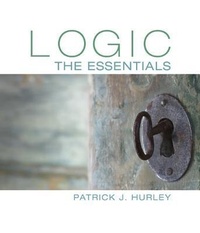
Logic
The Essentials
Published on 1. January 2015
Book
Paperback/Softback
456 pages
978-1-305-07092-9 (ISBN)
Description
LOGIC: THE ESSENTIALS concentrates on the fundaments of introductory logic. Practical in orientation and content, Essentials is loaded with class-tested, proven practice exercises. This new text is based on the classic and bestselling textbook, A Concise Introduction to Logic, and nearly all of the exercises in the correlative chapters, so central to the effectiveness of that text, have been retained to ensure more than enough practice for students to master the central concepts. The book focuses largely on deductive logic, but it contains sufficient treatment of induction to provide a solid footing for informal fallacies. The result is a contemporary approach--more focused, more practical, less theoretical--built on a tradition of precise, elegant, and clear presentation of the subject matter of logic, both formal and informal.
More details
Language
English
Place of publication
Belmont, CA
United States
Publishing group
Cengage Learning, Inc
Target group
College/higher education
Product notice
Paperback (trade)
Unsewn / adhesive bound
Dimensions
Height: 251 mm
Width: 216 mm
Thickness: 15 mm
Weight
794 gr
ISBN-13
978-1-305-07092-9 (9781305070929)
Copyright in bibliographic data and cover images is held by Nielsen Book Services Limited or by the publishers or by their respective licensors: all rights reserved.
Schweitzer Classification
Person
Patrick Hurley received his bachelor's degree in mathematics (with a second major in philosophy and a minor in physics) from Gonzaga University in 1964 and his Ph.D. in philosophy of science with an emphasis in history of philosophy from Saint Louis University in 1973. In 1972, he began teaching at the University of San Diego, where his courses included logic, philosophy of science, metaphysics, process philosophy and legal ethics. In 1987, he received his J.D. from the University of San Diego, and he is currently a member of the California Bar Association. Retiring from teaching in 2008, Dr. Hurley continues his research and writing, including work on A CONCISE INTRODUCTION TO LOGIC and RELIGION, POWER AND ILLUSION (Prometheus Books, 2022). His interests include music, art, opera, environmental issues, fishing and skiing. He is married to Dr. Linda Peterson, who retired from teaching philosophy at the University of San Diego in 2015.
Content
Preface.
1. BASIC CONCEPTS.
Arguments, Premises, and Conclusions. Recognizing Arguments. Deduction and Induction. Validity, Truth, Soundness, Strength, Cogency. Argument Forms: Proving Invalidity.
2. INFORMAL FALLACIES.
Fallacies in General. Fallacies of Relevance. Fallacies of Weak Induction. Fallacies of Presumption, Ambiguity, and Illicit Transference. Fallacies in Ordinary Language.
3. CATEGORICAL PROPOSITIONS.
The Components of Categorical Propositions. Quality, Quantity, and Distribution. Venn Diagrams and the Modern Square of Opposition. Conversion, Obversion, and Contraposition. The Traditional Square of Opposition. Translating ordinary Language Statements into Categorical Form.
4. CATEGORICAL SYLLOGISMS.
Standard Form, Mood, and Figure. Venn Diagrams. Rules and Fallacies. Reducing the Number of Terms. Ordinary Language Arguments. Enthymemes. Sorites.
5. PROPOSITIONAL LOGIC.
Symbols and Translation. Truth Functions. Truth Tables for Propositions. Truth Tables for Arguments. Indirect Truth Tables. Argument Forms and Fallacies.
6. NATURAL DEDUCTION IN PROPOSITIONAL LOGIC.
Rules of Implication I. Rules of Implication II. Rules of Replacement I. Rules of Replacement II. Conditional Proof. Indirect Proof. Proving Logical Truths.
7. PREDICATE LOGIC.
Symbols and Translation. Using the Rules of Inference. Quantifier Negation Rule. Conditional and Indirect Proof. Proving Invalidity.
Answers to Selected Exercises.
Glossary/Index.
1. BASIC CONCEPTS.
Arguments, Premises, and Conclusions. Recognizing Arguments. Deduction and Induction. Validity, Truth, Soundness, Strength, Cogency. Argument Forms: Proving Invalidity.
2. INFORMAL FALLACIES.
Fallacies in General. Fallacies of Relevance. Fallacies of Weak Induction. Fallacies of Presumption, Ambiguity, and Illicit Transference. Fallacies in Ordinary Language.
3. CATEGORICAL PROPOSITIONS.
The Components of Categorical Propositions. Quality, Quantity, and Distribution. Venn Diagrams and the Modern Square of Opposition. Conversion, Obversion, and Contraposition. The Traditional Square of Opposition. Translating ordinary Language Statements into Categorical Form.
4. CATEGORICAL SYLLOGISMS.
Standard Form, Mood, and Figure. Venn Diagrams. Rules and Fallacies. Reducing the Number of Terms. Ordinary Language Arguments. Enthymemes. Sorites.
5. PROPOSITIONAL LOGIC.
Symbols and Translation. Truth Functions. Truth Tables for Propositions. Truth Tables for Arguments. Indirect Truth Tables. Argument Forms and Fallacies.
6. NATURAL DEDUCTION IN PROPOSITIONAL LOGIC.
Rules of Implication I. Rules of Implication II. Rules of Replacement I. Rules of Replacement II. Conditional Proof. Indirect Proof. Proving Logical Truths.
7. PREDICATE LOGIC.
Symbols and Translation. Using the Rules of Inference. Quantifier Negation Rule. Conditional and Indirect Proof. Proving Invalidity.
Answers to Selected Exercises.
Glossary/Index.